
The rate of price rise of food items stood at 12.68 per cent in the corresponding week of the previous year.

Eggs, meat and fish also became 13.36 per cent more expensive on an annual basis, while cereal prices were up 4.13 per cent.
Food inflation, as measured by the Wholesale Price Index, was on a declining trajectory for the previous three weeks.
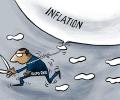
'As the Budget has taken some measures to spur growth, similar action from the MPC may be expected.'

Food inflation, as measured by Wholesale Price Index, stood at 9.13 per cent in the previous week.
Food inflation, as measured by the Wholesale Price Index, stood at 9.13 per cent during the previous week.

The weekly inflation figure is the highest during the past one year. Soaring onion and other vegetables' prices led to the sharp rise in inflation at 18.32 per cent for the week that ended on Christmas, up from 14.44 per cent recorded in the previous week.
As per data released by government on Thursday, price of pulses became cheaper by 5.63 per cent year-on-year.
According to data released by the government, prices of potatoes declined by 12.66 per cent year-on-year, while pulses fell by 5.02 per cent, onions by 3.64 per cent and wheat by 2.06 per cent.
Food inflation, measured by the Wholesale Price Index, was 7.33 per cent in the previous week.

Meanwhile, inflation of non-food articles was at 15.50 per cent for the week ended July 9, compared to 15.20 per cent in the previous week.
The latest numbers are the highest level of food inflation since the week ended March 26 when it had stood at 9.18 per cent.

The decline in food inflation is mainly because of falling prices of pulses, wheat and potato, according to the official data released on Thursday.

While most food items like wheat, pulses and potatoes turned cheaper, onions became costlier as their prices rose about 10 per cent within a week.

The drop in inflation, which is still not in comfort zone, is viewed as a breather for the government grappling with high price rise of essential commodities.

Annual food inflation fell for the second straight week, to 10.05 per cent for the week ended August 14, as prices of vegetables like potato and onion declined.

Food inflation fell marginally to 16.24 per cent for the week ended September 25, on slight easing of supply side pressures, even as prices of cereals, fruits, select vegetables and milk remained high.

The minister recalled the steps taken by the government to deal with general inflation, which was in the negative zone in June-August, 2009, and had since risen to 9.9 per cent in March, 2010.

This is the second consecutive week when food inflation has declined. On annual basis, potato prices eased by 49.69 per cent and onions became cheaper by 6.93 per cent.

After falling in the previous week, food prices again took a northward trajectory and went up by 13 percentage points.

Food inflation fell sharply by over 100 basis points to 16.61 per cent for the week ended April 17 on lower prices of fruits and vegetables.
This is the second consecutive week when food inflation has shown an upward trend, after a brief period of moderation in July and first half of August.

The wholesale price-based food inflation rose for the fourth consecutive week. In the previous week it stood at 17.94 per cent.

For the week ending January 2, food inflation (prices of non-processed food articles) stood at 17.28 per cent.

Prices for pulses fell by 0.47 per cent on a weekly basis.

Data released on Thursday showed prices of essential commodities like cereals went up by 12.7 per cent, rice by 11.75 per cent, wheat 12.6 per cent and pulses rose by 42 per cent.

In the corresponding week last year, food inflation was at 8.16 per cent. Prices of fruits and vegetables rose by 3 per cent, sea fish became costlier by 2 per cent and pulses such as arhar and moong became dearer by 1 per cent each over the week.

Food inflation fell to 16.30 per cent for the week ended March 6 on easing prices of pulses and vegetables, but fuel inflation shot up to 12.68 per cent.

'Inflation is not good for industry. Nor for the economy as a whole.'

Food inflation inched up to 17.40 per cent for the week ended January 16 on account of high prices of potato and pulses. The wholesale price-based food inflation was 16.81 per cent in the previous week. Potato prices rose as much as 57.56 per cent over the last year, followed by prices of pulses which jumped by 46.87 per cent.

Against this, food inflation stood at 13.68 per cent for the week ended October 31.
However, prices of most agricultural items, barring potatoes, onions and wheat, continued to rise.

India is among the three least-favoured Asian stock markets, according to BofA Securities whose survey found that 10 per cent of fund managers are underweight on Indian equities from a 12-month perspective.

Food inflation fell to 9.18 per cent for the week ended March 26, the lowest level in almost four months, on the back of a decline in the prices of pulses.

The FMCG industry in India achieved a 10.6% growth in value terms in the December quarter of 2024, driven largely by rural markets, which have surpassed the large urban markets in growth for the fourth consecutive quarter. Festive demand and consumption-driven growth played a key role, with overall volume up 7.1% despite inflationary pressures. However, the industry also saw a "preference shift of consumers towards smaller packs" due to high food inflation. Local manufacturers continue to outperform larger FMCG companies, fueled by consistent volume growth.

The paper says the rate of price rise in food items leads to lower income inequality in rural India.
Food inflation rose marginally to 11.49 per cent for the week ended February 12 from 11.05 per cent in the previous week, driven by rising prices of milk, egg, meat and vegetables.

Central bank said structural sources of food price pressures continue to persist.

Among the 30 Sensex firms, Asian Paints, Infosys, JSW Steel, UltraTech Cement, Power Grid, Larsen & Toubro, HCL Technologies and Tata Steel were the biggest laggards. Tata Motors, HDFC Bank, Bharti Airtel, ITC, IndusInd Bank and Axis Bank were the gainers.
The rate of price rise of food items was over 15 per cent during the same week last year.
 © 2026 Rediff.com - Advertise with us - Disclaimer - Privacy Policy - Sitemap - Feedback - About us - Terms of use - Grievances