For five consecutive policy reviews in 2023, the Reserve Bank of India (RBI) chose to hold rates, citing inflation threat. And when the prices did cool off a bit, it reminded all about the target to get the headline consumer price inflation at 4 per cent and the risks from food inflation. Heading into the new year, all eyes are on when RBI will cut the rates, especially after one of the Monetary Policy Committee (MPC) members stressed on the need for such an action in the face of the US Federal Reserve's guidance for easing rates.

'The long-term impact of elections is minimal.'

Retail inflation declined to a three-month low of 5.1 per cent in January, mainly due to subdued prices of vegetables, fruits and other food items, according to government data released on Monday. The fall indicates that retail inflation is inching towards the Reserve Bank's comfort level of 4 per cent. The Consumer Price Index (CPI) based inflation was on the rise for two straight months after touching a trough of 4.9 per cent in October 2023. In December, it stood at 5.69 per cent.

The size of Reserve Bank's balance sheet increased by 11.08 per cent to Rs 70.47 lakh crore as on March 2024, leading to the highest-ever dividend payout to the government, according to the central bank's annual report. In actual terms, the increase was Rs 7,02,946.97 crore over Rs 63.45 lakh crore as on March 2023.

The finance ministry expects a broad-based moderation in inflationary pressures on the back of an anticipated reduction in food prices as a result of the uptick in summer sowing. The retail inflation rate remained stubbornly clung to the 5 per cent mark in seven of the past eight months. "Core inflation is trending downwards, indicating a broad-based moderation in price pressures... Driven by strong domestic growth and benign global commodity prices, core inflation is declining continuously.

Equity benchmark Nifty scaled the psychological milestone of 21,000 in afternoon trade on Friday, and the Sensex touched its all-time intraday high of 69,888.33 after the central bank's decision to keep policy rates unchanged in line with market expectations. The 50-share benchmark index opened on a bullish note, after taking a breather on Thursday, and rose to 21,006.10. As many as 25 stocks were trading in the green, and 24 stocks defied the broader market and were trading in the negative territory.

Operating margins have been the primary driver of corporate earnings in India in recent quarters, despite revenue growth suffering from weak consumer demand. Companies across sectors have reported a sharp improvement in earnings before interest, tax, depreciation, and amortisation (Ebitda) margins over the past two years, benefiting from lower commodity and energy prices. Higher margins more than compensated for slower revenue growth, resulting in double-digit growth in net profit for five consecutive quarters.

Dabur India has been the worst performer in the fast-moving consumer goods (FMCG) space this year (CY23), posting a 1 per cent decline even as its peer index, the Nifty FMCG, has delivered returns of over 29 per cent in this period.

Wholesale price-based inflation rose to an eight-month high of 0.26 per cent in November, driven by a sharp jump in food prices, especially onion and vegetables. The WPI inflation was in the negative or deflationary zone for the past seven months since April and was at (-)0.52 per cent in October. The last positive WPI inflation was recorded in March at 1.41 per cent.

'Modigate is snowballing into a huge thing with the electorate. The BJP is in for huge punishment by the electorate.'

Retail inflation declined to a 25-month low of 4.25 per cent in May mainly on account of softening prices of food and fuel items, with experts saying that RBI is expected to hold interest rates steady in the current fiscal. This is the fourth straight month when retail inflation has declined and the third straight month of Consumer Price Index (CPI) based inflation remaining within the RBI's comfort zone of below 6 per cent. CPI-based inflation stood at 4.7 per cent in April and 7.04 per cent in May 2022.

Snapping its declining trend, retail inflation rose to a three-month high of 5.55 per cent in November on firming food prices, including vegetables and cereals, though it remains within the RBI's comfort zone of less than 6 per cent. Inflation based on the Consumer Price Index (CPI) was 4.87 per cent in October and 5.88 per cent in November 2022, the government data released on Tuesday showed. The previous high was 6.83 per cent in August and inflation had been on a decline since then.

The Planning Commission on Friday said that high inflation, primarily driven by rising food prices, is likely to ease in the next few months on the back of an expected good rabi crop.

Chief Economic Advisor V Anantha Nageswaran on Thursday said the economy is expected to grow at 6.5 per cent in the current fiscal notwithstanding deficient rains in August. India recorded economic growth of 7.8 per cent in the April-June quarter of 2023-24 against 13.1 per cent in the year-ago period. India's economy in Q1 grew at the fastest pace in a year, on the shoulders of a boost in capital expenditure both at central and state levels, along with stronger consumption demand, especially in rural areas, and improved performance in the services sector, he said.

Rice exporters have requested the Centre for a flat export duty of $80 per tonne for parboiled rice instead of the current 20 per cent duty to smoothen trade, a top official of the rice exporters' umbrella body said on Sunday. The Indian Rice Exporters Federation (IREF) has also requested the government to reconsider its export ban on white rice which was imposed in July and reduction in the minimum export price for basmati rice to $850 per tonne to prevent negative impacts on both export volumes and farmers. On Friday, the government had extended the 20 per cent duty on parboiled rice exports until March 24.

The Centre on Friday said it will sell 'Bharat Rice' in the retail market at Rs 29 per kg from next week to give relief to the common man and has also directed traders to disclose rice/paddy stock, as part of its efforts to control prices that have risen by around 15 per cent in the last one year. In a press conference, Union Food Secretary Sanjeev Chopra exuded confidence that these two measures along with the various restrictions of exports will help in cooling down the prices. Seeking to dispel market rumours, he categorically said the government has no plans to lift restrictions on rice exports any time soon.
Higher growth in vegetable demand relative to supply in the recent past has led to an upward trend in inflation, with spikes becoming more frequent. A study by rating agency Crisil found that vegetable inflation has been the most volatile in the food category, in fact. Inflation volatility is detrimental for both consumers and farmers and also sidetracks policymakers in the short term, necessitating frequent and repeated price-smoothing measures.

'Will Imran compromise with the army? We are all human beings. We all compromise.'

Reserve Bank of India (RBI) Governor Shaktikanta Das had stumped the market in the previous two policies - in August and in October - first with action and then with words. In August, it was the introduction of an incremental cash reserve ratio (I-CRR) to take out excess liquidity, which took the markets by surprise. In October, there was no action. Rather, what is known as "open mouth operation", Das' comment that the central bank might conduct open market operations (OMOs) by selling bonds tempered the euphoria in the bond markets after JP Morgan's inclusion of India in its Emerging Market Bond Index.

GDP growth of 7.7 per cent in the first half of this fiscal has "left sceptics gasping and woefully behind the curve", an RBI article said on Wednesday. It also stressed the buildup in the growth momentum is likely to be sustained. The article on the state of the economy published in the Reserve Bank's December Bulletin on Wednesday also said CPI-based retail inflation is expected to ease to 4.6 per cent in the first three quarters of 2024-25 from 5.6 per cent in November.

The Reserve Bank of India has also expressed concern over rising inflation and said the prevailing level is above its comfort zone.
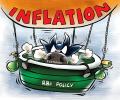
The Reserve Bank on Wednesday projected inflation to come down below the upper threshold level of 6 per cent by March quarter of the current fiscal. RBI Governor Shaktikanta Das said the central bank will keep 'Arjuna's eye' (focus) on the evolving inflation dynamics and will remain 'nimble and flexible' to deal with the price situation. Global commodity prices, including crude oil, have undergone some downward correction, but uncertainty continues to surround the near-term outlook in view of the prolonging geo-political hostilities. Moreover, the resurgence in domestic services sector activity could also lead to price increases, especially as firms pass on input costs.

Food inflation further eased to 16.04 per cent for the week ended April 24, as arrival of rabi (winter) crops cooled down prices of essential items.

Admitting that there has been an "unhappy pressure" on the prices of food grains and products, the government on Monday promised to tackle the problem even as it expressed confidence that it will aim at a growth rate of 8 per cent in the coming fiscal and 9 per cent in the next.

RBI says food supply constraints to taper off only over time.

Food inflation has jumped to 17.47 per cent for the week ended November 21 from 15.58 per cent in the previous week.
"We have to stand in readiness to go beyond keeping Arjuna's eye to deploying policy instruments, if necessary" to contain inflation, said Reserve Bank Governor Shaktikanta Das on Thursday. Headline consumer price index-based inflation projection for the second quarter of 2023-24 has been revised up substantially, primarily due to the price shock from vegetables, at 6.2 per cent by the RBI form 5.2 per cent estimated in June. Unveiling the bi-monthly monetary policy, Governor Das said the moderation in headline inflation to 4.6 per cent in the first quarter of 2023-24 was in line with the projections set out in the June MPC meeting.

India decisively withstood global headwinds in 2023 and is likely to remain as the world's fastest-growing major economy on the back of growing demand, moderate inflation, stable interest rate regime and robust foreign exchange reserves. Despite widespread pessimism witnessed among the developed nations and the worsening geopolitical situation, India recorded a gross domestic product (GDP) expansion of 6.1 per cent in the March quarter. The growth moved up to 7.8 per cent in the June quarter and was 7.6 per cent in the September quarter. For the first six months of this fiscal, the growth was 7.7 per cent.

Improved monsoon, solid fiscal performance, and capex push by the public and private sectors augurs well for India's macroeconomic stability and growth, the finance ministry's monthly economic review for June 2023 said. But the report said that while India's domestic fundamentals remain strong, negative cross-border spillovers and adverse global developments could act as a deterrent in achieving the high growth path this financial year. "An improved matching of aggregate supply and aggregate demand in the Indian economy underpins the progress made in the control of domestic inflation and the consequent strengthening of macroeconomic stability," the review said.

Fitch Ratings on Thursday retained India's growth forecast for the current fiscal at 6.3 per cent citing economic resilience despite tighter monetary policy and exports weakness, but upped year-end inflation projection on El Nino threat. The Indian economy grew 7.8 per cent in the April-June quarter of current fiscal on strong services sector activity and robust demand. "The Indian economy continues to show resilience despite tighter monetary policy and weakness in exports, with growth outpacing other countries in the region," Fitch said, while projecting 6.3 per cent growth for current fiscal (April-March), and 6.5 per cent for next fiscal.

'We are engaging in substantial open market sales of both wheat and rice to control food inflation; special measures of market intervention in vegetables, pulses and oil seeds were also taken to cushion the impact.'

The recent rally in small and midcap (SMID) stocks is not backed by fundamentals and is a case of irrational exuberance, analysts at Kotak Institutional Equities said in a recent report. The fundamentals of most of these companies have, in fact, worsened over the last few months, they noted. Yet, some analysts expect the bull run in these stocks to continue amid intermittent corrections.

Fuel and power inflation stood at 15.53 per cent during the week under review, compared to 15.49 per cent in the previous week.
The finance ministry has cautioned that global and regional uncertainties and domestic disruptions may keep inflationary pressures elevated in the coming months, warranting "greater vigilance" by the government and the Reserve Bank of India (RBI). "Russia's decision to terminate the Black Sea grain deal, along with dry conditions in major wheat-growing areas, caused a price spike in cereals. Domestic factors like white fly disease and an uneven distribution of monsoon exerted pressure on vegetable prices in India," the ministry said in its latest Monthly Economic Report for July, released on Tuesday. However, the report maintained, the recent price surge in certain food items "is expected to be transitory". "Tomato prices are likely to decline with the arrival of fresh stocks by the end of August or early September.

'She delivers on promises, especially on security issues which is a core concern for India.'
This article introduces you to a unique themed fund. This fund will not only provide you with global diversification but also let you profit from rising food prices.

Higher inflation has again become a matter of concern for fast-moving consumer goods (FMCG) companies. After prices of commodities like sugar and wheat moved higher and stabilised at those levels, the crude oil too surged, adding to FMCG firms' worries. Besides, a dry spell in August in the ongoing monsoon season impacted rural demand.

Containing high food prices is a dominant policy concern, the Reserve Bank said on Tuesday, amid expectations that it may raise short-term borrowing and lending rates next month.

A United Nations expert body on Thursday said surge in food prices in India is a matter of concern, but retail price inflation will cool down to 7.5 per cent this year from around 12 per cent last year.

Renewed inflationary pressures, led by a spike in prices of vegetables and cereals, have cast a spell on the equity markets in the past month. The BSE Sensex and Nifty50 have declined up to 2 per cent each during the period, clipping the 13 per cent rally from the March lows, shows data from ACE Equity. Investors typically consider shares of fast-moving consumer goods (FMCG) companies as defensive bets, putting their weight behind them in a falling market.
 © 2026 Rediff.com - Advertise with us - Disclaimer - Privacy Policy - Sitemap - Feedback - About us - Terms of use - Grievances