
Fitch Ratings on Friday said persistently higher oil prices could cause India's retail inflation to rise faster than the expected gradual pace, and lead to a slowdown in economic growth in the first half of financial year 2026-27 (FY27).

Retail inflation stood at 2.75 per cent in January under the new series of All India Consumer Price Index (CPI), with 2024 as the base year, released on Thursday.

Finance Minister Nirmala Sitharaman launched a strong attack on Rahul Gandhi and the Congress party, accusing them of compromising India's interests on the world stage and selling out farmers and the poor during their time in power.
Retail inflation rose to a three-month high of 1.33 per cent in December 2025 mainly due to higher prices of kitchen essentials, including vegetables and protein-rich items.

Retail inflation slipped to a multi-year low of 0.25 per cent in October, driven by the impact of the GST rate cut and subdued prices of vegetables and fruits, government data showed on Wednesday.

Retail inflation inched up to 0.71 per cent in November on rising prices of vegetables, protein-rich items, and fuel, government data showed on Friday. The consumer price index (CPI)-based retail inflation had fallen to a record low of 0.25 per cent in October, mainly due to lower prices helped by GST rate cuts and a favourable base.

The best way for India to prepare is by preserving and strengthening the RBI's hard-won credibility, point out Rajeswari Sengupta and Vaishali Garga.

Prospects of a bumper kharif harvest are expected to lower food inflation in the coming months, making the country's inflation outlook benign, the Union Ministry of Finance (FinMin) said in its monthly economic report for October released on Monday.
Retail inflation slipped to 1.54 per cent in September from 2.07 per cent in the preceding month mainly due to subdued prices of food items, including vegetables and pulses, according to government data released on Monday. The consumer price index (CPI) based inflation was 5.49 per cent in September 2024.
Retail inflation slipped to an eight-year low of 1.55 per cent in July mainly due to subdued prices of food items, including vegetables and cereals, according to government data released on Tuesday.

All six members of the Reserve Bank of India's (RBI's) monetary policy committee (MPC) expressed caution over food inflation during the December review, while two external members warned about high real interest rates as headline inflation approaches its target of 4 per cent. The central bank continued to maintain the status quo on both the repo rate and the stance in the December monetary policy. India's retail inflation in November rose to 5.5 per cent - its fastest pace in three months - due to higher food prices.

Retail inflation in August rose slightly to 2.07 per cent from 1.61 per cent in the preceding month, mainly due to increase in prices of vegetables, meat and fish, according to a government data released on Friday.

Wholesale price inflation (WPI) softened to 0.13 per cent in September on easing in prices of food articles and manufactured items, government data showed on Tuesday. WPI-based inflation was 0.52 per cent in August and 1.91 per cent in September last year.

The Reserve Bank on Wednesday revised upward its growth estimates for the current fiscal year to 6.8 per cent and lowered its inflation projection to 2.6 per cent based on an above-normal monsoon and the rationalisation of GST rates.

'The statistical confidence bands of the fan charts of the forecasts will provide a better sense of the potential variability of outcomes.'

Nearly a third of an average Indian citizen's consumption budget is spent on food.

Increased production of pulses, oilseeds, and cereals will help boost domestic supplies and contribute to keeping inflation low in the coming months.

While the economy will wait for a rate cut in December, the banking industry should be happy with the wave of liberalisation -- a big push for growth in bank credit, points out Tamal Bandyopadhyay.

'I do believe there will be a resolution in the next couple of months on the penal tariff and hopefully on the reciprocal tariff also.'

IMD data shows in the 24 hours between September 1 and 2, Haryana received 806 per cent more rainfall than normal, Punjab 759 per cent, Himachal Pradesh 510 per cent, Delhi 740 per cent, Chandigarh a staggering 1,638 per cent, and Rajasthan 193 per cent.

Daily essentials and food products will be cheaper from Monday, as leading FMCG companies have slashed prices, extending GST cut benefits to consumers.

Retail inflation dipped to an over six-year low of 2.82 per cent in May due to subdued food prices, remaining below the RBI's median target of 4 per cent for the fourth consecutive month, according to government data released on Thursday. Consumer Price Index (CPI)-based retail inflation was 3.16 per cent in April and 4.8 per cent in May 2024.
Retail inflation declined to over six-year low of 2.1 per cent in June, nearing the RBI's comfort zone, on account of subdued prices of food items, including vegetables, driven by widespread monsoon.
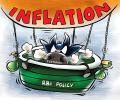
The Reserve Bank on Wednesday lowered the inflation projection for the current fiscal to 4 per cent from 4.2 per cent earlier, taking into account good agricultural output and falling crude prices.

Mixed views were expressed by top economists on the Reserve Bank of India's (RBI) Monetary Policy Committee's (MPC) decision to hold the repo rate at 5.5% and maintain a neutral stance. While some say the decision was as expected and one more rate reduction is expected this fiscal, there is also a view that rate cut by MPC was warranted given the evolving global situation.

Retail inflation eased to a nearly six-year low of 3.16 per cent in April mainly due to subdued prices of vegetables, fruits, pulses, and other protein-rich items, creating enough room for the Reserve Bank to go for another round of rate cut in the June monetary policy review. The Consumer Price Index (CPI) based inflation was 3.34 per cent in March and 4.83 per cent in April 2024. It was 3.15 per cent in July 2019.

Retail inflation dipped marginally to a nearly six-year low of 3.34 per cent in March due to a decline in prices of vegetables and protein-rich items. The Consumer Price Index (CPI) based inflation was 3.61 per cent in February and 4.85 per cent in March last year.
Retail inflation slipped to seven-month low of 3.61 per cent in February mainly due to easing prices of vegetables, eggs, and other protein-rich items, creating space for the RBI to go for another cut in interest rate next month.
India's consumer price index (CPI)-based retail inflation rate is likely to have cooled further in June, thus remaining below the 4 per cent target of the Reserve Bank of India (RBI) for a fifth consecutive month, giving the central bank wiggle room to focus on growth. Economists reckon that the decline is on account of easing prices in various categories of goods, especially food items, and a favourable base effect.
An article on 'State of the Economy' in the monthly Bulletin also said the improvement in the outlook for agriculture and the revival of rural spending have turned out to be the bright spots in the evolution of demand conditions. Consumer price inflation ticked up in June 2024 after three consecutive months of moderation as a broad flare-up in vegetable prices halted the overall disinflation that had been underway, it said.
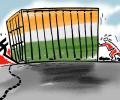
'We believe that in the new world order FTAs or bilateral trade agreements (BTAs) are the way forward.' 'They are enablers for our participation in global value chains. Today, around 70 per cent of global trade is tied to these chains.'

'An eerie similarity with 2019 inflation trajectory could now mean that the RBI and market inflation estimates could go awry.'

Wholesale price inflation marginally rose to 2.38 per cent in February due to expensive manufactured food items like vegetables oil and beverages, government data released on Monday showed. The Wholesale Price Index (WPI) based inflation was 2.31 per cent in January. It was 0.2 per cent in February 2024.
Wholesale price inflation (WPI) declined to a 14-month low of 0.39 per cent in May on easing prices of food articles and fuel, and experts said geopolitical tensions could push up prices.

Wholesale price inflation eased to 2.05 per cent in March, as against 2.38 per cent in February, government data showed on Tuesday. The wholesale price index (WPI) based inflation, however, rose year-on-year.

Continuing the downward trend, retail inflation fell to a five-month low of 4.31 per cent in January, mainly due to a decline in the prices of vegetables, eggs, and pulses. The Consumer Price Index-based retail inflation was 5.22 per cent in December and 5.1 per cent in January 2024. The previous low inflation was in August 2024 at 3.65 per cent.

S&P Global Ratings on Tuesday cut India's GDP growth projections to 6.5 per cent for the next fiscal as it expects that economies in the APAC region will feel the strain of rising US tariffs and pushback on globalisation. In its Economic Outlook for Asia-Pacific (APAC), S&P said despite these external strains, it expects domestic demand momentum to remain solid in most emerging-market economies.

Bharti Airtel, ICICI Bank, Eternal, Mahindra & Mahindra, HCL Technologies, HDFC Bank, Kotak Mahindra Bank, Tata Consultancy Services and Bajaj Finance were also among the laggards.

Wholesale price inflation dropped to 0.85 per cent in April as prices of food articles, manufactured products, and fuel eased, government data showed on Wednesday. WPI-based inflation was 2.05 per cent in March. It was 1.19 per cent in April last year.
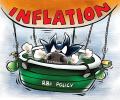
The Reserve Bank of India (RBI) has projected retail inflation at 4.2 percent for the next financial year beginning April while retaining the forecast for 2024-25 at 4.8 percent. The central bank attributed the expected easing of inflation to good kharif production, winter-easing in vegetable prices and favorable rabi crop prospects. However, the RBI also noted that continued uncertainty in global financial markets coupled with volatility in energy prices and adverse weather events presents upside risks to the inflation trajectory.
 © 2026 Rediff.com - Advertise with us - Disclaimer - Privacy Policy - Sitemap - Feedback - About us - Terms of use - Grievances