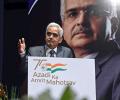
Reserve Bank Governor Shaktikanta Das on Thursday described cryptocurrencies as "clear danger" and said that anything that derives value based on make believe, without any underlying, is just speculation under a sophisticated name. The government is in the process of finalising a consultation paper on cryptocurrencies after gathering inputs from various stakeholders and institutions. Reserve Bank of India (RBI) has been flagging concerns about cryptocurrencies, which are seen as a highly speculative asset.
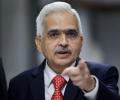
Reserve Bank Governor Shaktikanta Das on Wednesday said underlying economic activity in India continues to be strong, but external factors will cause some "dent" to the economy. Speaking at the BFSI Insight Summit 2022 organised by Business Standard, Das said the RBI tracks 70 fast moving indicators and most of them are in the "green box". It is the external sector, mired by a fear of recession or clear visibility about slowing growth in a large part of the world, where the challenges lie, he said, adding that the impact of external demand will "dent" the economy.

The much-talked-about sale of Ambuja Cement and ACC by Holcim Group will see the single-biggest outflow of foreign capital from the country if the two cement firms are acquired by Indian investors. The deal, valued at nearly $10.35 billion, will put in the shade Cairn Energy Plc's exit from India in 2010, when it sold Cairn India to Vedanta Group for $4.48 billion. According to various reports, big business groups such as AV Birla, JSW Group, and Adani Group are in the fray to acquire Holcim's assets in India.

'You may see some movement indicating a simpler tax regime with less exemptions but with fewer tax rates making life simpler for taxpayers.'

After selling dollars for the past few months, the Reserve Bank of India (RBI) may take a hands-off approach before its annual account closing by not trying to prop up the rupee as geopolitical tensions show signs of stabilising with global crude oil prices easing from its $140 peak. The central bank was a net buyer of dollars between April and September, and then turned a net seller in the following months, the data released by the RBI showed. The RBI continued to be a net buyer of $36.6 billion in this fiscal year - between April and January. In 2020-21, it purchased $68 billion on a net basis.
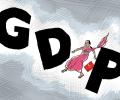
India's Gross Domestic Product (GDP) is expected to expand by 9.2 per cent in the current financial year, according to the Economic Survey 2021-22 tabled in the parliament on Monday. "Advance estimates suggest that the Indian economy is expected to witness real GDP expansion of 9.2 per cent in 2021-22 after contracting in 2020-21. "This implies that overall economic activity has recovered past the pre-pandemic levels," Economic Survey noted. Almost all indicators show that the economic impact of the "second wave" in Q1 was much smaller than that experienced during the full lockdown phase in 2020-21 even though the health impact was more severe, it said.

There has been a stellar rise for the Indian markets this far in calendar year 2021 (CY21) with the S&P BSE Sensex surging over 19 per cent. The gain in mid-and small-cap indices on the BSE has been sharper with both these indexes surging around 38 per cent and 54 per cent, respectively during this period. Rampant spread of Covid pandemic's Delta variant and the ensuing lockdown and mobility curbs across India, rising prices key commodities, including crude oil and its impact on inflation, possibility of tightening of policy stance by major global central banks, especially the US Federal Reserve (US Fed) have been some of the key headwinds that the markets successfully negotiated during this period.
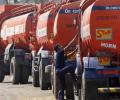
Every time the Indian economy has faced headwinds due to international developments, the oil sector has played a crucial role, explains A K Bhattacharya.

As the country moves towards creating a spot gold exchange, markets regulator Sebi's whole time member G Mahalingam on Wednesday suggested routing all the imports of the precious metal through the exchange ecosystem in the future. Such a "funnelling" would ensure that gold monetisation takes place right at the source as the metal enters the country, he said while addressing a conference organised by industry lobby Ficci. However, he also noted that the issue has not been dealt with in the papers floated by Sebi.

The country's exports are expected to contract by 5.8 per cent and imports by 11.3 per cent during the second half of the current financial year, though implementation of several measures by the government would help support exports going forward, according to the Economic Survey 2021. With gradual recovery of economic activities, the survey said that imports and exports have picked up. During the first half of 2020-21 (April-September), exports dipped by 21.31 per cent to $125.25 billion while imports declined by 40 per cent to $148.69 billion.
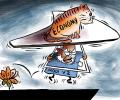
The reform priorities are clear: enhance savings, improve productivity. Just 25 basis points of moving interest rate up or down would not boost investment: Former RBI Governor Y V Reddy.

Large trade deficit and rupee decline against the US dollar are putting pressure on the CAD, and these steps are likely to have a positive impact on the external sector.

The Reserve Bank of India has kept the key short term lending rate (repo rate) unchanged at 7.25%.

Such minutes will be available within two weeks from the date of its confirmation in the next meeting of the central board and on being signed by the chairman in the same meeting, the RBI said in a statement on its website.

Weighed down by a weak rupee, the Reserve Bank on Tuesday chose to keep all key interest rates unchanged and asked the government to take urgent steps to reign in the high current account deficit.

The RBI left key policy rates unchanged and cut the GDP growth estimate for this fiscal to 5.5 per cent from 5.7 per cent.

The lower CAD was primarily on account of a decline in the trade deficit.
Delay in the tapering of the $85 billion-a-month bond buyback programme by the US Fed (tapering will start from January 1) gave the country time to replenish the forex reserves and rein in the high current account gap.
The broader markets ended lower with mid-caps and small-caps falling over 1 per cent on the BSE.
It's too early to assess their effect on real investment and output.

Industrial production (IIP) grew to a three-year high of 6.4 per cent in August, up from 4.1 per cent in July.

... if high oil prices persist or stock prices correct sharply.

The Reserve Bank in its first mid-quarter policy review on Monday kept the key interest rates unchanged because of elevated food inflation, rupee depreciation and uncertainty over foreign fund inflows.

Falling private sector investment and farm distress are problems that call for immediate attention, says T N C Rajagopalan.
The rapid decline in fiscal health and deterioration in the external sector outlook has prompted the Reserve Bank of India (RBI) to ask the government to hasten domestic reforms to curb its subsidy bill and encourage renewed equity flows.

'Rather than cutting and pasting from advanced economies, we should use basic economic principles to think about what is right for India at the stage of development at which we are,' says Chief Economic Advisor Krishnamurthy Subramanian.
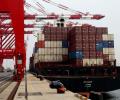
The WTO's quarterly outlook indicator, comprising seven trade parameters, stood at 96.3, the lowest since March 2010 and down from 98.6 in November. Exports from India would be hit if there is a slowdown in world trade.

Flagging widening current account deficit as a major risk, the Reserve Bank of India (RBI) on Monday said the government should speed up decision-making and improve business climate to arrest the continuing decline in net foreign direct investment (FDI).

A continued focus on low inflation will be important to keeping gold imports, IMF said.
'It is my belief and expectation that Indian entrepreneurs will continue to contribute effectively in our journey ahead to achieve the shared vision'

'Mere fundamentals will not do the trick,' cautions former commerce secretary Rahul Khullar.
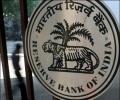
The Reserve Bank on Thursday said the macroeconomic risks to the Indian economy have increased over the last six months due to the fall in growth, external sector developments and subdued performance of the corporate sector.
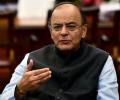
After the April-July fiscal deficit data was released on August 31, several analysts hinted that the government may need to go for cuts in capital expenditure to meet the fiscal deficit target.

India's exports remained in the negative territory for the 11th month in a row.
GDP growth for the current year is expected to be about 8.5 per cent while inflation likely to be below five per cent, Reserve Bank of India Governor Y V Reddy said in Chennai on Friday. "For the current year, though subject to review, current expectations is GDP growth will be 8.5 per cent.Inflation would be below five percent," he said at a management seminar conducted by the Great Lakes Institute of Management.

Outlook for external sector is the most favourable.

The IS curve is a measure of the sensitivity between GDP and prevailing interest rates.

It is high time to manoeuvre the rupee more effectively and predictably, even as it has to be recognised that such tweaking of the rupee needs to be accompanied by reforms to the real sector and factor markets.

The government would also take steps to promote exports and restrict non-essential imports, said Jaitley
 © 2026 Rediff.com - Investor Information - Advertise with us - Disclaimer - Privacy Policy - Sitemap - Feedback - About us - Terms of use - Grievances