
A record amount of pension money may be finding its way into the stock market, if buying figures in the National Stock Exchange (NSE) data are any indication. Category inflows touched Rs 37,409 crore for the three months ending September 2025, shows an analysis of NSE data.

Indian equity markets experienced a volatile trading day, with the Sensex and Nifty closing almost flat. Market sentiment was influenced by global cues, US-Iran talks, and profit-booking activities.

Indian benchmark equity indices Sensex and Nifty experienced a significant crash in early trade, triggered by a sharp increase in crude oil prices and escalating tensions in the Middle East.

With domestic markets turning choppy, investors are increasingly scouting for opportunities overseas to diversify portfolios and hedge against a weakening rupee.

The Indian rupee weakened against the US dollar due to rising crude oil prices, geopolitical tensions in the Middle East, and foreign fund outflows.

Rupee slumped 69 paise to an all-time low of 92.18 against the US dollar in early trade on Wednesday, as a sharp spike in crude oil prices amid geopolitical tensions following the escalation of the US-Iran conflict weighed on investor sentiment.

'The next two to three weeks will not be decided in Washington.' 'They will be decided in Tehran, in whatever calculation Iran makes about the costs of continued resistance against the costs of appearing to have yielded.'

Direct-to-consumer meat and seafood platform Licious is betting big on "micro markets" within cities as the next lever of growth.

The United States, which entered this war in expectation of a short, sharp win along the Venezuela model, is now preparing for deeper involvement in a conflict it does not fully control, without the allies it typically relies on, against an adversary that is not behaving as expected, in a global environment that is already absorbing economic shock. Prem Panicker continues his must read daily blog on the Gulf War.

In the present hyper-connected world, there are many domestic and global factors that affect financial markets. Of them, the most powerful and often least predictable are geopolitical events, which often boil down to one diplomatic headline.

Indian stock market indices Sensex and Nifty experienced a significant decline, driven by rising crude oil prices, sustained foreign fund outflows, and selling pressure in major bank stocks.

Indian equities on Dalal Street saw volatility. Track Sensex, Nifty50 movement and key market drivers for Feb 25, 2026.

From a modest salary to Rs 1 crore, here's Ramalingam Kalirajan's smart compounding blueprint for young earners

Accel and Google's AI Futures Fund have announced the five startups selected for the 2026 Atoms AI Cohort, focusing on enterprise, voice, and industrial AI solutions, with each startup receiving significant investment and resources.

Foreign brokerages have started to cut their year-end targets for the Nifty 50 index amid the ongoing West Asia conflict.

Chelsea have been fined a record total of 10.75 million pounds ($14.3 million) for historical breaches of the Premier League's regulations, the league said on Monday.

Human rights and sports advocacy groups are urging the International Olympic Committee (IOC) to reconsider reported plans for universal genetic sex testing for female athletes and a blanket ban on transgender and intersex competitors, warning of potential harm to gender equity in sports.

The Indian government has relaxed foreign direct investment (FDI) norms for countries sharing land borders with India, including China, a move that amends press note 3 of 2020.

India has lost its $5 trillion market capitalisation (mcap) tag following Monday's sharp selloff in equities and a simultaneous slide in the rupee.

The business value of the league, popularly called the IPL, surged to a record $18.5 billion last year, U.S.-based investment bank Houlihan Lokey says.

Indian equities on Dalal Street saw volatility as global market trends and fresh tariff concerns linked to Donald Trump impacted investor sentiment. Track Sensex, Nifty50 movement and key market drivers for Feb 24, 2026.

For decades, multinational pharmaceutical companies and Indian drugmakers worked in ways that supported each other: MNCs brought innovation and brands, while Indian companies built scale through generics and cost efficiency. There was an important overlap - generic drugs - but this is shrinking fast. And the consequences are reshaping India's gigantic pharmaceutical market.
Benchmark indices Sensex and Nifty experienced a significant decline, falling over 1 per cent due to foreign fund outflows and global uncertainties.

After a brief pause in October, foreign investors resumed selling, pulling out a net Rs 3,765 crore from Indian equities in November, driven by global risk-off sentiment, volatility in global tech stocks and selective preference for primary markets over secondary markets.

'Money is not just about greed or accumulation. It gives you freedom, dignity and choice. And you have every right to all three.'

Balanced advantage funds (BAFs), which adjust between stocks and bonds depending on market conditions, have increased their equity holdings over the past year, with most schemes now predominantly invested in equities.
Benchmark indices tumbled about 2 per cent on Friday, capping one of the most turbulent weeks for domestic equities as investors fretted that the West Asian conflict could drag on for weeks or even months.
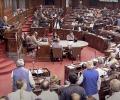
Opposition MPs in the Rajya Sabha criticised the Modi government's economic policies, citing the LPG crisis, lack of energy security, and concerns over the Economic Stabilisation Fund.

Share of IPOs opening above issue price drops to 64.6%, median gains shrink sharply amid market volatility.

Equity benchmark indices Sensex and Nifty rebounded sharply by nearly 1 per cent on Monday, driven by strong buying in power, banking, and financial stocks.
The Iran conflict led to a sharp correction in Reliance Industries Ltd's (RIL's) share price, which has been partially reversed by a rebound.

'It's a changing world and the opening up doesn't mean that concerns with regards to security have gone away.'

'Oil is still well below its all-time highs, and the world is gradually running out of known reserves.'
Indian equity markets closed higher, driven by gains in PSU bank, auto, and financial stocks, following the US Supreme Court's decision on tariffs. Sensex climbed 479.95 points to 83,294.66, and Nifty advanced 141.75 points to 25,713.
Equity benchmark indices Sensex and Nifty advanced for the third straight session on Tuesday driven by firm global cues and optimism over India-US trade agreement, even as investors turned to profit-booking at higher levels.

'The outlook for the next Samvat is more constructive, as many of the earlier drags are gradually becoming supports.'

The BSE Sensex plummeted 1,236 points, wiping out nearly Rs 7 lakh crore in investor wealth, driven by escalating tensions between the US and Iran and subsequent market selloff.
Equity benchmark indices Sensex and Nifty experienced a significant decline, primarily driven by a selloff in IT stocks due to concerns about AI disruption and renewed worries over global trade.

'Except for extremely conservative investors, others can consider allocating 10 to 20 per cent of their portfolio to small caps.'
Benchmark Sensex tumbled 1,236 points or 1.5 per cent while Nifty closed near 25,450 on Thursday following an across-the-board sell-off amid escalating geopolitical tensions between the US and Iran.
 © 2026 Rediff.com - Advertise with us - Disclaimer - Privacy Policy - Sitemap - Feedback - About us - Terms of use - Grievances