
Revenue collection next financial year may be affected, and, along with this, subsidies on food and fertilisers can go up if the war in West Asia drags for long, according to experts.

The reduction in the goods and services tax (GST) rates has increased the momentum in India's economic activity both on the supply and demand sides, while robust agricultural activity - reflected in the strong onset of rabi sowing and adequate reservoir levels - has reinforced the outlook for food supply and rural incomes, the finance ministry said on Thursday.

The prospect of protracted uncertainties in the global economic landscape not only pose a risk for India's growth outlook in 2025-26, but are also likely to dent the private sector's capital raising and investment plans, the finance ministry averred on Tuesday, cautioning the country's corporates that the era of 'easy pickings' was over.
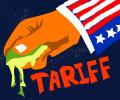
'If the near-term economic pain is absorbed more by those who have the ability and the financial strength to do so, then small and medium enterprises in downstream industries will emerge stronger from the trade imbroglio.'
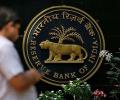
With inflation comfortably below the Reserve Bank of India's (RBI's) 4 per cent median target and likely to undershoot its 3.7 per cent projection for 2025-26 (FY26), there is room for the monetary policy easing cycle to be sustained, the Finance Ministry said on Monday. The comments, featured in the ministry's Monthly Economic Review for June 2025, assume significance ahead of the Monetary Policy Committee (MPC) meeting of the Reserve Bank of India (RBI) scheduled to begin from August 5.

India's macroeconomic health is in a "relative goldilocks situation", and although the risk of higher landed oil prices, due to insurance cost surges and closure of choke points due to the brief Israel-Iran war, has receded, it is "too soon to sound the 'all clear' for the rest of the year", the Finance Ministry said on Friday.
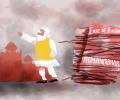
Improved monsoon, solid fiscal performance, and capex push by the public and private sectors augurs well for India's macroeconomic stability and growth, the finance ministry's monthly economic review for June 2023 said. But the report said that while India's domestic fundamentals remain strong, negative cross-border spillovers and adverse global developments could act as a deterrent in achieving the high growth path this financial year. "An improved matching of aggregate supply and aggregate demand in the Indian economy underpins the progress made in the control of domestic inflation and the consequent strengthening of macroeconomic stability," the review said.

Geopolitical tensions, trade policy uncertainties, volatility in international commodity prices and financial market uncertainties pose considerable risks to India's economic growth in the coming year, the finance ministry cautioned on Wednesday. "Global trade continues to be affected by uncertainty in the policy environment... tariff-related developments in multiple countries have heightened trade-related risks, affecting investment and trade flows globally.

Facing criticism from the government over the central bank prioritising inflation over growth, the new RBI Governor Sanjay Malhotra on Monday said that prospects of the Indian economy are expected to improve on the back of high consumer and business confidence in 2025. "As we strive to preserve financial stability to support a higher growth path for the Indian economy, our focus remains steadfast on maintaining stability of financial institutions and, more broadly, systemic stability," Malhotra said in foreword to the Financial Stability Report.

'If weak indicators persist, there is a risk that India could slip into a prolonged slowdown similar to the one experienced between 2014 and 2019,' warns Debashis Basu.
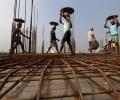
The review will not only present data, trends but also list out the achievements of the Narendra Modi government

Days before Diwali, the monthly economic review by the finance ministry has highlighted moderation in urban demand, softening consumer sentiments and limited footfall as areas that need to be watched. In its review, released on Monday, the ministry also noted the early signs of artificial intelligence displacing workers, as described in anecdotal reports. The commentary from several large consumer goods companies, including Nestl India, Hindustan Unilever, and ITC, in their recent quarterly earnings, has been around a sluggish urban demand. Rural consumption, however, has mostly seen a revival, the companies pointed out.

Structural reforms, pro-people programmes and employment opportunities helped the economy get new vigour, the finance minister said. After contracting by 5.8 per cent in 2020-21, the economy recorded a growth of 9.1 per cent in 2021-22.

'The global situation is not very good.'

India's headline retail inflation is expected to moderate further in the months to come, as low wholesale inflation will transmit to consumer prices, the Ministry of Finance said in its latest monthly economic review (MER) on Monday. "Inflationary pressures eased in February, with slight moderation in Consumer Price Index (CPI) inflation and Wholesale Price Index (WPI) inflation softening to a 25-month low. "With WPI inflation easing, its transmission to CPI inflation is soon expected," the MER for February said.

The finance ministry on Thursday raised concerns over the possible impact of El Nio conditions on India this year, saying if recent forecasts came true, the country could see lower agricultural output and higher inflation. "Some meteorological agencies predict the return of El Nio conditions in India this year. "If these predictions are accurate, then monsoon rains could be deficient, leading to lower agricultural output and higher prices," the ministry said in its monthly economic review.

India appears poised to sustain its growth in a more durable way than before with the economy carrying the momentum from FY23 into the current fiscal year, the Annual Economic Review for 2022-23 released by the finance ministry on Thursday said. However, the report cautioned that escalation of geopolitical stress, enhanced volatility in global financial systems, sharp price correction in global stock markets, a high magnitude of El-Nino impact, and modest trade activity and FDI inflows, are factors that could constrain the pace of growth. "Should these developments deepen and dampen growth in the subsequent quarters, the external sector may challenge India's growth outlook for FY24," the finance ministry said.

At this poignant historic moment one can only wish that institutions are not built by bricks and mortars, but also by the rich Parliamentary traditions which have stood the test of time which needs to be strengthened by all stakeholders, notes Rup Narayan Das, a former joint secretary of the Lok Sabha Secretariat.

Vijay Kelkar, advisor to the finance minister, has been entrusted with the new task of preparing quarterly review of the economy as mandated under the Fiscal Responsibility and Budget Management Act.
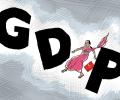
India's economy continues to be robust, but downside risks such as rising crude oil prices, adverse weather conditions, and the global banking crisis outweigh the upside potential in gross domestic product (GDP) growth in the current financial year (FY24), the finance ministry said on Tuesday in its Monthly Economic Review for March. "We reiterate that downside risks to our official forecast of 6.5 per cent for real GDP growth in FY24 dominate upside risks," the review said. "Opec's surprise production cut has seen oil prices rise in April, off their lows of low-seventies per barrel in March.

In Kerala, the use of black ranges from such convenience to strictures by community and religion to fashion and personal choice. One would have to be really insecure or too fond of the well settled life to see black solely as a badge of protest, points out Shyam G Menon.

India's consumer price index (CPI)-based inflation could ease in the coming months thanks to the arrival of kharif crops, lower international commodity prices, and a pass through of lower input costs to consumers, the finance ministry said in its Monthly Economic Review (MER) for October, which was released on Thursday. The MER, however, warned that the global macroeconomic situation remained precarious and a recession in many advanced economies would impact India's exports. "Easing international commodity prices and new Kharif arrival are set to dampen inflationary pressures in the coming months.

A 6-7 million tonnes shortfall in rice production due to a fall in paddy sowing area is likely to keep rice prices at elevated levels, adding to the inflationary pressure that the slowing economy is already grappling with. Elevated food prices, including that of cereals, had led to retail inflation reversing a three-month declining trend, to touch 7 per cent in August. Similarly, the wholesale price inflation, which declined to 11-month low, also showed price pressures from cereals resulting from wheat output being impacted by severe heat waves in some parts of the country.

India's current account deficit is expected to deteriorate in the current fiscal on account of costlier imports and tepid merchandise exports, according to the Finance Ministry's monthly economic review. The review released on Thursday by the ministry also said that global headwinds would continue to pose a downside risk to growth as crude oil and edibles, which have driven inflation in India, remain major imported components in the consumption basket. For the present, it said, "their global prices have softened, as fears of recession have dampened prices somewhat. This would weaken inflationary pressures in India and rein in inflation."

Finance Minister Nirmala Sitharaman will kick start the customary pre-Budget consultation exercise with stakeholders from Wednesday by holding the first such meeting with experts of agriculture and agro-processing industry. She will be seeking inputs from various stakeholders, including industry bodies, farmer organisations and economists for reviving consumption and boosting growth hit by the COVID-19 pandemic. The growth this year is expected to be in the double-digit during the current fiscal.

Armed with necessary macro and micro growth drivers, India is on its way to becoming the fastest growing major economy in the world, a finance ministry report said. Rapid vaccination and teeming festivities will push India's ongoing recovery resulting in narrowing of demand-supply mismatches and greater employment opportunities, as per the monthly Economic Review prepared by the ministry.

The department of economic affairs, in its Monthly Economic Review for September, said critical reforms undertaken by the government will put India to a strong and sustainable growth path in the long run.

Maintaining a rapid pace of the vaccination drive and quickly bridging healthcare infrastructure gaps across both urban and rural areas would emerge as the most sustainable stimulus for durable recovery of the Indian economy, says a report by the department of economic affairs.
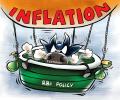
'While intensification of fuel prices and broad-based domestic cost pass-through pressures is a downside risk, core inflation is expected to strengthen further as demand recovers to pre-Covid levels,' the ministry said on Friday.

Spending continues to be less as people who are getting direct benefits from the government are choosing to save in the current situation.
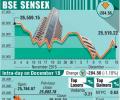
The S&P BSE Sensex lost 285 points to end at 25,519.

865 million Indian adults require vaccination.

FY22 will be the year to rebuild with the IMF projecting output growth at 11.5 per cent, economic survey at 11.0 per cent and the RBI's Monetary Policy Committee at 10.5 per cent.

An official announcement to this effect would be made next week. The vice-chairman would be of Cabinet rank.

Rumours in the bureaucracy on his successor include the names of Sajjid Chinoy of JP Morgan, Rathin Roy of the National Institute of Public Finance and Policy, Neelkanth Mishra of Credit Suisse and the principal economic advisor, Sanjeev Sanyal.

We knew from the moment the pandemic took hold that this would be a long haul -- at least 12 to 18 months. Nothing should have changed that assessment, says Mihir S Sharma.
In this exclusive interview with Rediff.com's Suman Guha Mozumder,Time International's new Editor Bobby Ghosh discusses Iraq, India and the New Journalism.
A fascinating conversation with one of the world's finest reporters.

The Centre's outgo on major subsidies was up 49 per cent to about Rs 1.42 lakh crore (Rs 1.42 trillion) in the first half of the fiscal against Rs 95,190 crore (Rs 951.9 billion) in the same period last year.

Economic growth rate had slipped to decade's low of 5 per cent in 2012-13 mainly on account of the impact of the global financial woes.

He was most recently credited as one of the brains behind labour law reforms in Rajasthan
 © 2026 Rediff.com - Advertise with us - Disclaimer - Privacy Policy - Sitemap - Feedback - About us - Terms of use - Grievances