
This year's Budget has come at a time when the economy had just begun to recover from the impact of an unprecedented global economic crisis.
Among the aam aadmi measures, leaders sought an increase in the minimum support price mainly for sugarcane, income tax relief to the salaried class and more benefits to senior citizens. Suggestions were also made to increase subsidy for diesel for farmers and fishermen. Soft loans for minorities and SC/STs were also demanded. But issues like disinvestment, SEZ amendments, insurance bill or financial sector reforms were not discussed.
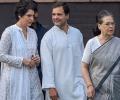
Sonia Gandhi's prime ministerial ambition for her son has been a major factor in the Congress's internal politics since 2004, points out Amulya Ganguli.
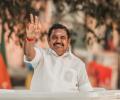
A time has thus come when state encouragement for rural students led to empowerment of the socio-economically marginalised sections of the population. It included women. Today, with greater exposure and consequent enlightenment, it has gone beyond 'empowerment' to become 'entitlement', says N Sathiya Moorthy.
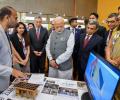
He said that India will work with Singapore to bring the Regional Comprehensive Economic Partnership to early conclusion. He also said the India-Singapore Comprehensive Economic Cooperation Agreement has been reviewed and the two sides will work to further upgrade it.
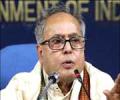
'It is my belief and expectation that Indian entrepreneurs will continue to contribute effectively in our journey ahead to achieve the shared vision'

T N Ninan on how the 'reformer' groups are milking the economy to serve their ends.
Economists expect a push to reforms by newly-appointed Finance Minister Pranab Mukherjee, who they said is the right person to head the important ministry.
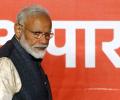
The article is in stark contrast to the TIME cover story done on Modi earlier this month titled 'India's Divider in Chief', written by Aatish Taseer, son of Indian journalist Tavleen Singh and late Pakistani politician and businessman Salmaan Taseer.
If FIIs come in looking for higher returns, this will help turn India Incs fortunes but a reform-oriented government is critical, says Nilesh Shah.

The prime minister was responding to a question that many of his admirers are disappointed about the slow pace of economic reforms in India.
Many analysts were surprised at the speed with which India bought the IMF gold. However, they believe that it is a very smart move as by buying IMF gold, New Delhi is shoring up its bullion reserves and slowly trying to hedge its bets on the US dollar which has been losing value against other currencies.

'Firms such as Infosys, were started by people without instantly recognisable surnames. Our success motivated numerous new entrepreneurs,' writes Nandan Nilekani in his book Imagining India.

'If the government cannot provide the best resources to IIT faculty, it has no right to expect the best research either,' says Santosh Ansumali.
With the biggest mandate for any Indian government in nearly two decades, Mr Singh can now enact bold legislation - including financial, labour and land reforms.
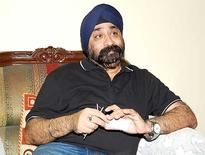
Gobind Kaur, Dr Manmohan Singh's sister, and her children travel down memory lane.
Marshall Bouton, council president, in an online interview said that over the last couple of years, the Indian government had been 'hamstrung' by its alliance with Left in pushing economic reforms further.

However, foreign capital inflows into equity market restricted the rupee's fall to some extent.
The Prime Minister should focus his energies now on reforming higher education.
The key to whether the current aversion will extend into the long run is whether the government has a plan to deal with both terror and kickstarting key economic reforms.

From a hard core Leftist in the late 1960s to being the liberal face, Palaniappan Chidambaram combines in him the qualities of a bold reformer, experienced administrator and a taskmaster in whatever assignment is given to him.

The architect of India's economic reforms, Manmohan Singh, has another big mission on his hands now.
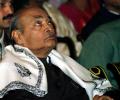
Former Prime Minister P V Narasimha Rao has finally got a memorial in his name in the national capital, ten years after his demise.
The monthly income of an average Indian for the first time in the country's history has crossed Rs 3,000, thanks to economic reforms and a high growth rate of above 9 per cent achieved for three years since 2005-06.The per capita income, a measure of average income of a citizen, went up 12.2 per cent to Rs 37,490 per annum during 2008-09, said the advance estimate for national income released by the Central Statistical Organisation (CSO) on Friday.

Union Finance Minister Arun Jaitley said despite a global slowdown and its impact on countries, India remains insulated from the economic fallout.

The Indian government will present the annual budget for 2016-17 on February 29.
Finance Minister P Chidambaram on Thursday said he would reach out to all political parties to support bills on economic reforms in Parliament.
"High rate of economic growth has bypassed 77 per cent of population, which is living on a meagre income of Rs 20 per day... barely sufficient to survive," he said, while addressing the eighth Editors' Conference on social sector issues in New Delhi on Thursday.

Several of Modi's actions reflect political courage.

The Aditya Birla group's decision to merge two companies, each with an existing clutch of diverse businesses, flies in the face of the accumulated wisdom regarding conglomerates, says T N Ninan.
Deputy chairman of the Planning Commission Montek Singh Ahluwalia has been awarded the honorary degree of Doctor of Civil law at the University of Oxford.
The list of departures from the path of economic reforms can be longer.
A majority of the CEOs polled said the emerging political situation at the Centre could derail the pending economic reforms agenda (nuclear power, foreign direct investment in retail, etc).

'What stood out at these meetings between industry representatives and government leaders was how the equation between the ministers and industry had undergone a subtle and qualitative change,' points out A K Bhattacharya.
India has a better chance of growing independent of the West than any other country in Asia.
The reservation of jobs in the private sector will tantamount to putting the clock back on economic reforms and not even political parties are ready for a legislation making employment of SCs and STs binding on India Inc, industry body Ficci said.
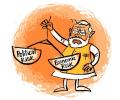
'Should the most important part of economic reform not comprise the way we look at the fiscal deficit?', asks T C A Srinivasa Raghavan.
ICICI Bank's Managing Director and Chief Executive K V Kamath is of the opinion that inspite of the marginal dip in growth India's long-term economic growth potential remains sustainable. However, he said the growth may slip from the previous 10 per cent level to around 8 per cent this fiscal. The services sector, contributing 60% to GDP, will help sustain the growth path. He said present inflation is a supply-side phenomenon and is not due to any over-heating in the economy.
Senior Politburo member Sitaram Yechury said the party has started discussions on the third alternative and any party that wants to be part of it must: 1. Uncompromisingly oppose communal forces. 2. Oppose the anti-people economic reforms. 3. Oppose all efforts to try to make India a subordinate ally to United States' imperialism.
The Bharatiya Janata Party said it is pro-economic reform but wants the government to stoop before it can conquer on securing its support for key legislative changes, chiefly in banking, insurance and pensions, which form part of the reform agenda.
 © 2026 Rediff.com - Advertise with us - Disclaimer - Privacy Policy - Sitemap - Feedback - About us - Terms of use - Grievances