
The government on Monday abolished the Commodity Transaction Tax (CTT) that was announced in the Budget last year, but was yet to be implemented and the commodity exchanges rejoiced the decision.
With the developed world seeing a fragile recovery from the recession, projected to be a modest 1-2 per cent in the second half of 2009-10, a further financial crisis was not completely ruled out, said C Rangarajan, chairman of the Economic Advisory Council. He said the slow recovery of the developed countries had a negative impact on external demand for both manufactured goods and services from India.
Although the WPI-based inflation has been in the negative for two consecutive weeks, the Consumer Price Index, which measures movement in the prices that consumers pay, reported double-digit increase in May.
It forecast a growth of 9 per cent for 2011-12.

The Prime Minister's Economic Advisory Council on Friday said the economy will grow by 8.5 per cent, up from a projected 8.2 per cent, and inflation will come down from double digits to 6.5 per cent by the end of 2010-11.

The Prime Minister's Economic Advisory Council on Wednesday favoured further increase in petroleum prices in line with the global trend.

The finance minister said figures for second quarter economic growth are yet to come, but industry has started picking up. The Indian economy grew by 6.1 per cent in the first quarter. On inflation, Mukherjee said the government has taken steps to ensure that the adverse impact of inflationary pressures is reduced by strengthening supply management.

The former Governor of RBI said India would see 'definite signs of recovery' in the second half of 2009-10. On growth forecast, he said this fiscal will see a rate of 6 and 6.5 per cent, but it will be higher next fiscal.
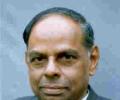
Although the economy did well during the second quarter (July-September) recording a growth of 7.9 per cent, the output of agriculture and allied sector slipped to below 1 per cent.

Ahmadis are designated non-Muslims in Pakistan's Constitution and their beliefs are considered blasphemous in most mainstream Islamic schools of thought.
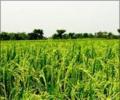
Foodgrain production in current is fiscal is likely to fall by at least 10%, if not more. It may be better to be realistic in our estimates than give unrealistic positive spin to these figures, says Himanshu Thakkar.

The Prime Minister's Economic Advisory Council member G Govinda Rao on Thursday said the Reserve Bank can raise the key rates ahead of its April 20 annual monetary policy to tame the high headline inflation.

The gross domestic product grew by 6.1 per cent in the first quarter of 2009-10 and the year may end with 6.5 per cent.
In an interview with Business Standard's Sapna Dogra Singh and John Samuel Raja D, C Rangarajan says there are some encouraging signs in the economy, but the real recovery will come only in 2010-11.
Growth in the six core industries -- crude oil, petroleum refinery products, coal, electricity, cement and finished steel -- in April-March 2008-09 was 2.7 per cent against 5.9 per cent in the previous fiscal. Crude oil production continued to remain in the negative zone as it dipped by 3.1 per cent in April while it had registered a growth rate of 1 per cent a year ago.
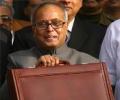
Last year, the Survey suggested a long list of reforms, but most of these found no place in the Budget.

According to the Central Statistics Office data, the jump in the retail inflation based on Consumer Price Index was mainly due to rise in prices of kitchen items like vegetables, meat and fish.

The Prime Minister's Economic Advisory Council (PMEAC) expects the economy to grow by over 7.2 per cent during the current fiscal and exceed 8 per cent in 2010-11, thanks to increased economic activity.
"India's economic fundamentals are quite robust and its economy remains the second-fastest growing one in the world," the prime minister's Economic Advisory Council's chairman Suresh Tendulkar told reporters in Mumbai. According to him, the financial meltdown in advanced economies 'has been very serious'.

Food inflation is expected to cool off in the next two months from the current high of about 18 per cent on expectation of better Rabi (winter) crop, Prime Minister's economic panel member said.

The private demand is still not picking up and the funds under market stabilisation scheme are also maturing.
According to Jagdish Shettigar, chairman of BJP's economic cell and former member of the Prime Minister's Economic Advisory Council, infrastructure, especially road building, will be a priority. It is now also certain that work on the controversial 111-km Nandi Infrastructure Corridor Enterprise connecting Bnagalore and Mysore will be accelerated. "We have always supported NICE," said a BJP leader.
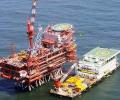
Last month, the government approved the proposal of doubling gas price from RIL's KG basin from $4.2 mmbtu to $8.4 mmbtu from April 1, 2014.
The Prime Minister Economy Advisory Council has projected a mere two per cent growth in the sector for the current year. Earlier in August, PMEAC had projected the agriculture production to grow at a lower pace of two per cent in the current year as against 4.5 per cent in 2007-08.

The Prime Minister's economic panel on Tuesday said it could revise upward the economic growth forecast to 7 per cent from 6.5 per cent for the current fiscal on the back of robust economic growth in the second quarter.
Last week, the India Meteorological Department downgraded its monsoon forecast to 'below normal'. This has led to fears whether it would affect agricultural output and bring down India's growth in the current fiscal. The agriculture sector contributes around 17 per cent to the gross domestic product and employs around 60 per cent of the nation's total workforce.

Under the new Monetary Policy Framework, the central bank aims to contain inflation at 4 per cent with a band of (+/-) 2 per cent.

The Reserve Bank may raise key policy rates by up to 50 basis points in its July 27 monetary policy review to check double-digit inflation, said a member of the Prime Minister's Economic Advisory Council.
Projecting 34 per cent decline in foreign capital inflows due to uncertain external environment, the PM's Economic Advisory Council (PMEAC) on Wednesday made a strong case for easing the External Commercial Borrowing guidelines to help corporates borrow funds from overseas debt market.

On an average, PMEAC said economic growth could be around 6.5 per cent.
The Prime Minister's EAC is expected to give its outlook on economy for the current fiscal in a week's time.
The luncheon at his residence was attended by Planning Commission Deputy Chairman Montek Ahluwalia, Chairman of PM's Economic Advisory Council C Rangarajan, former RBI Governor Bimal Jalan, Foreign Secretary Shiv Shanker Menon and officials of the Prime Minister's Office.

Having recorded about 9 per cent growth rate in three consecutive years since 2005-06, India's growth rate fell to 6.7 per cent during 2008-09 on account of the impact of the global financial crisis. India recorded a growth rate of 6.1 per cent during the first quarter of this fiscal.
The Prime Minister's economic panel on Wednesday said the government needs to draw a programme to rein in the fiscal deficit of over six per cent which is not sustainable.

The Reserve Bank of India has forecast the economy to grow by 6 per cent with an upward bias.

NITI Aayog has a dual role of a monitor and advisor.
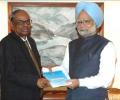
Chairman of the Economic Advisory Council to the Prime Minister (PMEAC) Chakravarthi Rangarajan has resigned following the defeat of the Congress-led UPA in the general elections.

The committee had eminent people on it and making any allegations like this is 'outlandish', Sitharaman said.
Bringing back money stashed in Swiss banks by Indians is not going to make any 'significant difference' to the overall economy, Prime Minister's economic advisory panel head Suresh Tendulkar said on Monday.
India grew at 6.7 per cent in 2008-09. For the current fiscal 2009-10, the Economic Survey projected a 7 per cent growth rate plus/minus 0.75 per cent.
 © 2026 Rediff.com - Investor Information - Advertise with us - Disclaimer - Privacy Policy - Sitemap - Feedback - About us - Terms of use - Grievances