
Amid the crisis in Libya, increase in fuel prices would become 'inevitable' if crude oil remains at $100 per barrel, Prime Minister's Economic Advisory Council chairman C Rangarajan said on Monday.

With high prices remaining a concern, Prime Minister's Economic Advisory Council chairman C Rangarajan on Wednesday said all policy measures, like rate hikes and intervention in grain markets, will be undertaken to bring down inflation to comfort zone of 4-5 per cent.
Prime Minister Manmohan Singh mourned his death in his message to Tendulkar's wife Sunetra.
Bold reform measures to sustain high growth trajectory figure high.
Inflation, as measured by the Wholesale Price Index, stood at 8.66 per cent in April.
Rangarajan's reaction came after the release of the latest data, which showed headline inflation going up to 9.06 per cent in May from 8.66 per cent in April on the back of rising prices of manufactured products and petrol.

Rangarajan also called for improvement in the country's corporate-bond market saying that this will help even small companies to raise adequate funds.

Rejecting IMF and World Bank's "unduly" pessimistic projections, Prime Minister's key economic advisory council chairman C Rangarajan on Thursday exuded confidence that the growth would be around 5.5 per cent in the current fiscal.

Food inflation is an area of concern for the common man and government with rate of price rise touching as high as 18.32 per cent in the last week of December mainly fueled by mass consumption items like vegetables, milk and protein-based items.

The central bank is slated to review its credit policy on January 25.
The Prime Minister's Economic Advisory Council said on Monday that India's GDP growth will slow down to 8.2 per cent in the current fiscal. Its earlier growth projection was at 9 per cent.
The main worry is that the inflation rate is expected to remain high at 9 per cent till October, the Prime Minister's Economic Advisory Council said.
With the Budget barely a week away, the Prime Minister's Economic Advisory Council on Monday made a case for withdrawing some of the tax incentives to the industry to put the economy back on track for fiscal consolidation.

The Prime Minister's economic panel said high food inflation reflects lacklustre performance of the farm sector, which together with infrastructure, remains the main bottlenecks to higher growth.

Prime Minister Manmohan Singh last month had said inflation would moderate to 5-6 per cent by the end of the calender year.
C Rangarajan, chairman of the Prime Minister's Economic Advisory Council, on Thursday said he expects the Indian economy to grow by 8.5 per cent in FY'12 on the back of services sector and industry expansion, though he hinted that agriculture might not be a big contributor.

The committee will suggest an action plan for abolishing the present system of classifying expenditure into plan and non-plan, an official statement said.

Keeping in abeyance suggestions of the Prime Minister's Economic Advisory Council, government on Friday said it has no intention to allow private sector to set up nuclear power plants independently.

With major sectors of the economy showing signs of slowdown, the list of those pegging India's economic growth at below eight per cent in the current financial year is expanding.

The business model of the microfinance sector must change, emphasised C Rangarajan, chairman of the Economic Advisory Council to the Prime Minister, saying that the microfinance movement must have as its ultimate goal the desire to help the poor and enable them to come out of poverty.

Prime Minister's Economic Advisory Council Chairman C Rangarajan dashes bullion firms' duty cut hopes.
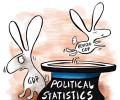
There has been criticism of the official statistics ever since MoSPI came out with new methodology to estimate the GDP on the base year of 2011-12 compared to earlier 2004-05.
The Prime Minister's Economic Advisory Council on Monday projected the economic growth in the country at 8.6 per cent for the current fiscal on the back of rebound in farm output and inflation to come down to 7 per cent by March-end due to declining food prices.

Driven by high growth of 8.9 per cent of the manufacturing sector, the economic growth in the current fiscal is likely to be 7.2 per cent, the CSO said in its advance estimates for the national income released on Monday.

The Reserve Bank of India may consider withdrawing excess liquidity in the system to tame high inflation in its monetary policy review later this month, Suresh Tendulkar, economist and former head of the Prime Minister's Economic Advisory Panel, said on Tuesday.
A meeting of a ministerial panel headed by Finance Minister Pranab Mukherjee, to consider raising diesel price by at least Rs 2 a litre, was deferred twice last month and no new date has been notified yet.

Food inflation rose to 17.47 per cent in the third week of November against 15.58 per cent in the previous week.
India's projected growth rate may be marginally affected if there\nis a bad monsoon, as it will affect agricultural output, said Suresh Tendulkar,\nchairman of the prime minister's Economic Advisory Council.

The prime minister's Economic Advisory Council had said inflation would be at 7-8 per cent by the year-end, compared with 10.55 per cent in June.

The Food Security Act as proposed by the UPA government assures rice/wheat at Rs 3 a kg to BPL families as a matter of legal right.

To rein in prices, the RBI could tweak in policy rates to either suck out money supply or make borrowings costlier.

The government will have a tough time correcting its financial course from the current high level of fiscal deficit, unless it decides to raise taxes or cut spending, said Prime Minister's Economic Advisory Council (PMEAC) member Govinda Rao.
The men who advice the man who runs the country are experts and their experience says it all.

Asked whether the Budget should start the process of exist, Rangarajan told reporters in New Delhi, "What is required, is a roadmap towards normalisation".

Interest rates may harden a bit by the end of the current financial year, according to C Rangarajan, chairman of the Prime Minister's Economic Advisory Council.
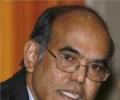
Stating that counter-cyclical measures to combat the impact of the global financial meltdown were important, Subbarao said the government borrowings had gone up 'rapidly and abruptly' hindering transmission of monetary measures to bring about lowering of interest rates.

The RBI governor, D Subbarao had met finance minister Pranab Mukherjee on December 18, fuelling speculation that the monetary policy would be tightened.

Inflation jumped to 4.78 per cent in November, driven by rising prices of essential food items like pulses, fruits and vegetables.
 © 2026 Rediff.com - Investor Information - Advertise with us - Disclaimer - Privacy Policy - Sitemap - Feedback - About us - Terms of use - Grievances
