
Prime Minister Narendra Modi on Thursday asserted that the world community must reject any linkage between religion and terrorism while formulating a "genuinely international" partnership in the fight against all forms of terror acts.

India is likely to play a bigger role when the 10-member ASEAN and six other Asian nations meet in the backdrop of differences between China and Japan.

In the midst of a hectic campaign schedule, Modi needs to find time to meet visiting leaders and attend the East Asia Summit in the Philippines.

By changing the nation's name from India to Bharat, would this landmass overnight lose the emotional and cultural linkage that had been built over generations, centuries and millennia, asks N Sathiya Moorthy.

Last month, President Trump offered to be the "mediator" between India and Pakistan on the Kashmir issue when he met Prime Minister Imran Khan for the first time at the White House.

While addressing the 14th ASEAN-India summit, the PM noted that growing radicalism and spread of extreme violence are the other security threats.
Calling for cooperation among Asia Pacific countries to tackle the global economic uncertainty, Prime Minister Manmohan Singh on Thursday said the vast growth potential of India and these nations can be realised only by inculcating a "collective temper".

"We often thought of terrorism as a peripheral problem for this region. The barbaric terrorist strikes in Paris, Ankara, Beirut, Mali and on the Russian aircraft is a stark reminder that its shadow stretches across our societies and our world, both in recruitment and choice of targets," Modi said in his remarks at the East Asia Summit.

Speaking against the backdrop of sharp differences among East Asian countries over use of resources of mineral-rich South China Sea over which China lays sole claim, the prime minister said, 'concerted effort and collective action on the part of the countries gathered in the region can strengthen mutual understanding and help us address shared challenges'
Prime Minister Manmohan Singh on Tuesday night returned home from Cambodia after attending the ASEAN and East Asia Summits which provided India with an opportunity to enhance its economic cooperation with the region amid lingering financial crisis in the West.

Both India and China are in Phnom Penh to participate in the two-day East Asia Summit, an offshoot of the Asean meet. China and India, along with the US, Russia, Australia, New Zealand, Japan and South Korea are participating countries in EAS, besides the 10 Asean members.

The statements made by Obama and Suu Kyi during his Myanmar visit highlighted the differing perceptions of the two over the sustainability and durability of the actions taken by the Thein Sein government, notes B Raman.
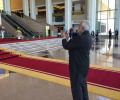
Prime Minister Narendra Modi on Wednesday made his Instagram debut, sharing a picture from the venue of the ASEAN summit.
Prime Minister Manmohan Singh left Phnom Penh for home on Tuesday after attending the ASEAN and East Asia Summits besides holding talks with his Japanese and Chinese counterparts and interacting with United States President Barack Obama.
US President Barack Obama's proposed visit will be coming less than a month after a new spell of violence between the native Buddhists of the Rakhine State and the Rohingya Muslims, points out B Raman
"India is a big part of my plans," United States President Barack Obama said on Tuesday as Prime Minister Manmohan Singh congratulated him in person on his re-election.
Prime Minister Manmohan Singh attended the 10th ASEAN-India summit in Phnom Penh on Monday with the aim of strengthening India's relations with countries in the South East Asian region.
Prime Minister Manmohan Singh has put off his visit to Japan from Thursday for the annual summit in view of the sudden political developments in that country.
A day after attending the India-Asean summit and the East Asia Summit in furtherance on India's Look East policy, Prime Minister Manmohan Singh on Sunday credited Singapore for leading to the strategic shift in the nation's foreign and economic policies.
Prime Minister Manmohan Singh on Thursday embarked on a four-day visit to Indonesia and Singapore with an aim of bolstering partnership with East Asia at a time when the United States and Europe are going through economic crisis.
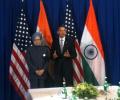
Dr Singh and Obama, who met on the sidelines of ASEAN and East Asia Summits, talked about strengthening the bonds of strategic ties put in place during the historic visit of the US President to India in November last year.
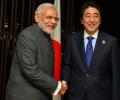
The national flag was in the background of Modi and Abe's customary handshake at the Summit and was hoisted on a stand next to that of Japan.
Prime Minister Manmohan Singh left for Bali and Singapore on Thursday.
India and South Korea have reached an agreement on civil nuclear cooperation.
Prime Minister Manmohan Singh arrived in Tokyo on the first leg of his three-nation visit, during which he would hold talks with his Japanese counterpart Naoto Kan on a range of issues, including civil nuclear energy cooperation.
Prime Minister Manmohan Singh said on Sunday in an interview to the Japanese media in Tokyo that India is confident of signing a 'win-win' civilian nuclear deal with Japan and is looking forward to a comprehensive economic partnership agreement to boost bilateral trade.

Having invested close to $15 billion in Indonesia, Indian firms have lined up further $15-16 billion investments.

It was clear in Brunei at the 8th East Asia Summit that China doesn't want the South China Sea issue to even dominate the discussion, reports Sheela Bhatt, who is part of the prime minister's media contingent to the summit

India will make a strong pitch for new initiatives with ASEAN countries to collectively respond to challenges thrown up by the global economic meltdown and climate change during the two day India-ASEAN and East Asia Summits beginning in Thailand tomorrow.
Apart from emphasising the importance of India's economic development, and its re-integration into the global economy, Dr Singh has repeatedly emphasised the importance of the ideas that define the Indian civilization and the Indian Republic for global peace, security and challenges, ranging from terrorism to pandemics.
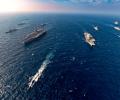
Remarks from Indian External Affairs are significant as it comes after China slammed Quad and said the formation of "exclusive cliques" targeting other countries runs counter to the trend of the times and is "doomed to fail".

Describing the boundary question with China as a "complex issue", Prime Minister Manmohan Singh on Sunday said it cannot be "wished away" and both sides have an obligation to maintain peace and tranquility pending a solution.

Prime Minister Narendra Modi on Thursday night left for Australia on the second leg of his three-nation tour during which he will attend the annual summit of the Group of 20 of the world's developed and emerging economies.
Manmohan Singh faced stiff competition in Singapore. No, not at the East Asia Summit or in meetings with the Asean. But the rival attractions of two imaginative exhibitions on India's past and an exhaustive three-day conference titled "Early Indian Influences in Southeast Asia" eclipsed his presence while China's Wen Jiabao basked in media glory that reflected the reality of economic and military power.

The two leaders are understood to have discussed ways to expand bilateral ties. The 30-minute meeting took place on the sidelines of the ASEAN-India summit. Trade between the two countries has been growing at a rapid pace and the two nations have set an ambitious target of $10 billion to be achieved by 2010.
India will not be signing the ambitious Free Trade Agreement with the 10-nation economic bloc, Association of Southeast Asian Nations, at the 4th East Asia summit to be held in Thailand on April 11 and 12. Commerce Minister Kamal Nath will be attending the summit, where the seventh India-Asean meeting is also scheduled at the same venue.
On the sidelines of the India-ASEAN summit, Prime Minister Singh might also have bilateral meetings with some of the leaders.
India said on Tuesday it views the 16-member forum of the East Asia Summit as an opportunity to create a regional architecture for cooperation and deeper integration in the Asia Pacific region.
Ways to expand cooperation with East Asian countries will top the agenda of two-day visit of Prime Minister Manmohan Singh who left for Singapore on Tuesday to attend the ASEAN and East Asia Summit. Noting that the trade between India and the ASEAN had been growing rapidly, Singh said it had "surpassed" the expectations as it stands at $30 billion.
 © 2026 Rediff.com - Advertise with us - Disclaimer - Privacy Policy - Sitemap - Feedback - About us - Terms of use - Grievances