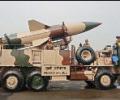
India on Friday said it would come out with a new Defence Production Policy in the next two months under which domestic industries would certainly get orders for products developed by them after indigenous research.
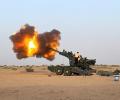
Neither the BJP, nor the Congress before it, made any manifesto commitments on defence spending, even though allocations have plummeted from 4 per cent of gross domestic product (GDP) in the late 1980s to less than 2 per cent today, points out Ajai Shukla.

'The procurement cycle still consumes too much time; little has changed.'

"We hope to introduce the new Defence Production Policy as well as the Defence Procurement Policy from January 20100. We are going to take some drastic steps to achieve our goal of speedy indigenisation," Defence Minister A K Antony announced in New Delhi on Wednesday.
Commerce ministry had recently brought out a discussion paper that called for allowing 100 per cent FDI in the defence sector.
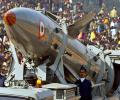
The ministry of defence has set a goal of $26 billion, including export of $7 billion for the industry by 2025-26 through its Defence Production Policy 2018.

The govt hiked defence budget by 7.81 per cent over last year's Rs 2.74 lakh crore.

It is baffling how the PM chose the LCH as an indigenous product to celebrate on Rashtriya Raksha Samarpan Parv, even while his Cabinet holds up manufacturing clearance for 15 LCHs on the grounds that they are not Indian enough.
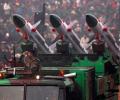
Defence experts want defence expenditure to be at 3% of GDP, which they consider minimum to counter the two-front threat from China and Pakistan, internal insurgencies, and dominating a 7,500 km coastline and the Indian Ocean beyond. What Arun Jaitley has given India this Budget is 2.16% of GDP, observes Ajai Shukla.

The defence ministry is shooting to achieve an annual export target of $5 billion by 2025.

The corridor is expected to attract around Rs 1,250 billion investment and create 4,00,000 jobs. It will start from Mysore, pass through Bengaluru in Karnataka, to connect with Chennai, Coimbatore, Salem and Tiruchy in Tamil Nadu.

'Defence does not new 'planning commissions'; it needs an implementation commission.'
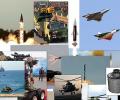
With 40 per cent of defence procurement still coming from abroad, the government on Friday said it is working to boost indigenous manufacturing capacity to reduce dependence on foreign supplies.

The secretary defence production wants to make India (currently the largest importer of weaponry) one of the world's top five defence manufacturers and a global leader in artificial intelligence and cyberspace.
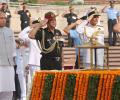
Ajai Shukla presents an action plan for Defence Minister Rajnath Singh to fix the systemic weaknesses in defence.

Its 'failure not just affects the military's effectiveness but could also be politically vulnerable for the BJP,' observes Ajai Shukla.

'At 1.58% of GDP, the defence budget is one of the lowest since the Chinese aggression of 1962.' 'The government of the day has lost sight of the fact that defence of the country is as important as its growth,' says Brigadier S K Chatterji (retd).

Irked by India's status as the world's biggest arms importer, Modi wants to build an advanced defence industry

What the new defence minister does with the Rafale fighter jet deal will decide if India wants to build genuine, long-term defence capability through an indigenous product that slashes life-cycle costs, or opt for glitzy signing ceremony with foreign vendors that would please the public, says Ajai Shukla.

'It is the government's most important duty to ensure that when war breaks out, the armed forces are absolutely ready to face the adversary -- well equipped, well trained and in high spirits,' says Brigadier Gurmeet Kanwal (retd).
 © 2026 Rediff.com - Investor Information - Advertise with us - Disclaimer - Privacy Policy - Sitemap - Feedback - About us - Terms of use - Grievances