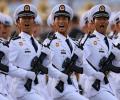
China's latest defence budget surges to $275 billion, fueling its ambitious military modernisation program and intensifying geopolitical dynamics in the region.

The Indian economy recorded a six-quarter high growth of 8.2 per cent in July-September, as factories churned out more products in anticipation of a consumption boost from the GST rate cut, according to government data.
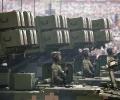
China's second-ranked general, He Weidong, is under investigation for corruption, along with nine other senior military officers punished for discipline violations and work-related crimes. This crackdown comes ahead of a key Communist Party conclave.
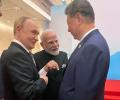
'One Chinese interlocutor said India should realise that "China can do without India, but India could not do without China", pointing to its inability to do without Chinese intermediates and components,' former foreign secretary Shyam Saran discovers on a visit to China.
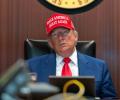
'What the Americans want is to destabilise Iran. For destabilising Iran, you need access. 'One access is through Iraq. The other access is through Pakistan.'

Foreign investors continue to exhibit confidence in the country's equity market, injecting Rs 19,860 crore in May driven by favourable global economic indicators and strong domestic fundamentals. This positive momentum follows a net investment of Rs 4,223 crore in April, data with the depositories showed.

Foreign investors continue to show confidence in the country's equity market, infusing Rs 14,167 crore so far this month, largely driven by favourable global cues and robust domestic fundamentals. Notably, this inflow has come despite the ongoing military tensions between India and Pakistan.
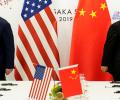
The call lasted approximately one and a half hours, and resulted in a very positive conclusion for both countries.
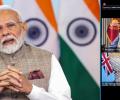
There is a "high possibility" of a meeting between Bangladesh Chief Adviser Muhammad Yunus and Prime Minister Narendra Modi on the sidelines of the BIMSTEC Summit in Bangkok, a senior official said. The meeting comes amid strained ties between the two countries, marked by India's concerns over violence against Hindus and a rise of hardline Islamist forces in Bangladesh. Yunus's recent comments about India's northeastern states being landlocked and Bangladesh being the "only guardian of the ocean" in the region have drawn sharp reactions from Indian politicians. However, a Bangladesh official insists that Yunus's statement was misinterpreted.
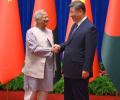
Bangladesh's Chief Adviser Muhammad Yunus has called upon China to expand its economic influence in Bangladesh, controversially mentioning that India's northeastern states being landlocked could present an opportunity. Yunus, who recently visited China and met with President Xi Jinping, highlighted Bangladesh's role as the "only guardian of the ocean " in the region, suggesting it could be a pathway for Chinese economic expansion. This statement has sparked debate, with Sanjeev Sanyal, a member of Prime Minister Narendra Modi's economic advisory council, questioning the relevance of India's landlocked states in Yunus' appeal to China. Yunus, however, emphasized the importance of a strong friendship with China, viewing it as a counterbalance to India. During his visit, Yunus signed nine agreements with Beijing and secured USD 2.1 billion in investments, loans, and grants from the Chinese government and companies.

The report comes on the heels of surprisingly poor export data that showed exports slumping by six per cent in February.
From the 30-share Sensex blue-chip pack, Titan, Adani Ports, UltraTech Cement, Tata Consultancy Services, NTPC, Bharti Airtel, Tech Mahindra, Infosys, Hindustan Unilever and JSW Steel were the biggest laggards.

Amid China's economic slowdown, the country's economic challenges may increase manifold and its economy may be hit harder in the wake of the Ukraine-Russia crisis.
The encouraging growth figure from China comes at a time when majority of the advanced economies are expected to contract in the wake of the global financial turmoil. China, the world's fastest growing economy, expanded at a rate of 6.1 per cent in the first quarter of 2009.
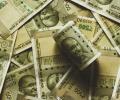
Foreign investors pulled out a massive Rs 94,000 crore (around $11.2 billion) from the Indian stock market in October, making it the worst-ever month in terms of outflows, triggered by the elevated valuation of domestic equities and attractive valuations of Chinese stocks. Before this, foreign portfolio investors (FPIs) withdrew Rs 61,973 crore from equities in March 2020. The latest outflow came after a nine-month high investment of Rs 57,724 crore in September 2024.

From the 30 Sensex firms, Mahindra & Mahindra, Bajaj Finance, Asian Paints, Nestle, Bharti Airtel, UltraTech Cement, Hindustan Unilever, ITC, and HDFC Bank were the major laggards. In contrast, Infosys, Tech Mahindra, Tata Motors, Axis Bank, Tata Consultancy Services and State Bank of India were among the gainers.

Quarterly earnings from corporates, global trends, and trading activity of foreign investors will guide market sentiment this week, analysts said, adding that benchmark indices may face volatile trends. "The upcoming release of Q2 results will be closely watched, providing insights into corporate performance. "Meanwhile, the escalating tensions between Israel and Iran introduce a significant geopolitical risk, potentially leading to increased oil prices and market volatility.
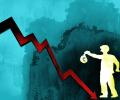
Foreign investors turned net sellers in October, withdrawing shares worth Rs 58,711 crore in the month so far owing to escalating conflict between Israel and Iran, a sharp rise in crude oil prices, and the strong performance of the Chinese market. The outflow came following a nine-month high investment of Rs 57,724 crore in September. Since June, Foreign Portfolio Investors (FPIs) have consistently bought equities, after withdrawing Rs 34,252 crore in April-May.

'While investors need to be prepared for making some losses, they should not lose big money chasing euphoria amid fear of missing out.'

It will be the second Budget of the Modi 3.0 government and eighth straight Budget for Nirmala Sitharaman, rare in Indian polity.

Chinese President Xi Jinping on Thursday congratulated President-elect Donald Trump on his election victory and called for China and the United States to find the right way to manage the differences by strengthening dialogue and communication.
The Chinese economy grew at its slowest pace in 13 years posting 7.8 per cent year-on-year growth in 2012 amid external jitters and domestic woes.

Investors need to carefully assess country-specific risks. 'This is especially true of a market that is less transparent than the US.'
The Chinese economy is headed for troubled waters, with its manufacturing sector shrinking in November for the first time in nearly three years, in a fresh sign of a further economic slowdown that may prompt it to loosen its monetary policy.

Li is currently attending the WEF annual meeting in Davos in back drop of release of the annual GDP figures by China highlighting the continuation of the slowdown of the world's second largest economy.


Overall, China's economy expanded at a rate of 11.1 percent on year-on-year basis during the first half of 2010.

China's economy, which suffered 6.8 per cent slump in the first quarter due to the coronavirus pandemic -- the worst in 44 years -- bounced back posting 4.9 per cent growth between July and September buoyed by the government's sweeping efforts to stimulate demand and consumption.

The Chinese economy recorded a stellar growth of 11.9 per cent in the first three months of 2010, marginally higher than projected.
The government should use interest rates for more than administrative measures to handle economic growth in the long term.

An improvement in political relations, anchored in a restoration of peace and tranquillity at the border, could open up opportunities for expanded economic and commercial relations between them, suggests former foreign secretary Ambassador Shyam Saran.

'At this moment you cannot give her asylum because if you do, then you are directing public anger against India.'

On Wednesday, the Chinese authorities extended a ban on sales of shares by large shareholders.
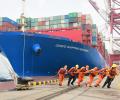
Analysts, however, predict it would be an uphill climb for export-reliant China's economy going forward as it faced intensified conflict with the US and the negative fallout on its external trade due to Beijing's increasingly aggressive policies towards countries like India resulting in bans of its products and services.
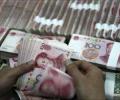
There has been an increase of $17 trillion in total debt in China.

Jaishankar said India should be confident enough to "leverage" the international system to create the "best possible outcome".

China's population growth has been slowing since 2016 as the high cost of raising children, a greater pursuit of individualism and a diversified lifestyle dampen enthusiasm to start a family.

The re-opening of the Chinese economy, as it moves away from its zero-Covid policy, could help stabilise commodity prices, according to some of the country's top metal companies. They view this as a positive for demand, at a time when markets such as the US and Europe have been largely weighed down by slowdown concern now. "Most of us in the metals business are hoping the Chinese economy picks up because half of any metal demand, including demand for aluminium, comes from China.

From the Sensex pack, Tata Motors, HCL Technologies, Power Grid, Tech Mahindra, NTPC, Axis Bank, Kotak Mahindra Bank, Larsen & Toubro, Wipro, Nestle, Tata Consultancy Services and Infosys were among the major gainers. Bajaj Finance, Bajaj Finserv, Mahindra & Mahindra, UltraTech Cement, IndusInd Bank and State Bank of India were the major laggards.
The head of the European monetary authority stepped off the plane at Beijing airport, and was transported by a high-speed train faster than France's TGV, to the centre of Beijing.
 © 2026 Rediff.com - Investor Information - Advertise with us - Disclaimer - Privacy Policy - Sitemap - Feedback - About us - Terms of use - Grievances