
'There are unscrupulous traders who create fake invoices by showing bogus e-way bills, movement of goods.' 'Since the entities registered across different states, and kept on changing their numbers, tracing them was difficult.'

The finance ministry on Monday said the recent raid on perfume trader Peeyush Jain's house in Kanpur, from where more than Rs 177 cr unaccounted cash was unearthed, was the "biggest ever seizure of cash" by an enforcement agency. The December 26 raid, which resulted in Jain's arrest, included searches at Jain's residential/factory premises in Kannauj, where about Rs 17 crore in cash have been recovered, the ministry said in a release. Further searches are underway at Jain's residential/factory premises in Kannauj.

The searches since December 22, which resulted in Jain's arrest, also included searches at the trader's residential/factory premises in Kannauj, wherein about Rs 17 crore in cash, 23 kg of gold and 600 kg sandalwood oil having a market value of about Rs 6 crore have been recovered, the ministry said in a release.
The shortfall in the Centre's GST collections has raised concerns over it meeting the fiscal deficit target of 3.3 per cent of GDP, reports Ishan Bakshi.
Mop up grows 10% y-o-y at Rs 1.05 trillion, almost equal to levels in February before a nationwide lockdown to contain the coronavirus pandemic

This is the third consecutive month when GST mop-up remained below the Rs 1 lakh crore mark, despite the festival season.

The investigation against HUL was initiated on the basis of an anonymous complaint. It alleged 'profiteering' of around Rs 535 crore between November 15, 2017, and February 28, 2018.
The mop-up could have been much higher, but tax on imports fell 2 per cent y-o-y.

Experts said this will mean that companies, which have offices in multiple states, will have to raise Goods and Services Tax invoice for functions performed by employees in head office that has helped branches in other states.

Only 69 per cent of the assessees filed returns

K M Mani was appointed the chairman of the panel in March this year.
Is the curated and limited data put out by the central government sufficient enough to pass a judgement on the trend in GST collections, particularly that of the Centre?
The change in the peak rate will not alter the 4-slab rate structure of 5, 12, 18 and 28 per cent agreed upon last year, but is only a provision being built into the model law to take care of contingencies in future, two officials in the know told PTI.

The states which achieved "extraordinary growth" in total taxes collected include Kerala (44 per cent), Jharkhand (20 per cent), Rajasthan (14 per cent), Uttarakhand (13 per cent) and Maharashtra (11 per cent), an official statement said.

The forthcoming Budget, the last full one before the 2019 Lok Sabha elections, is expected to contain a number of sops and feel-good announcements, especially regarding social sector schemes.

Since the legal changes in the draft laws would take some time, it was decided to postpone the November 25 meeting
Tax experts said historically in July and August indirect tax collections remain subdued and pick up with the onset of the festive season post Ganesh Chaturthi.

States should have enough time. We still do not know the rules. There are a lot of operational difficulties, says Jammu and Kashmir Finance Minister Haseeb Drabu.

Know what terms like anti-profiteering, CGST, SGST, IGST means in the new regime
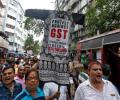
After 17 tumultuous years, a nationwide Goods and Services Tax (GST) will rollout from midnight of June 30, overhauling India's convoluted indirect taxation system and unifying the $2 trillion economy with 1.3 billion people into a single market.

The government should bring natural gas under the Goods and Services Tax (GST) regime to realise Prime Minister Narendra Modi's vision for a gas-based economy and raising the share of the environment-friendly fuel in India's energy basket, an industry body that represents the likes of Reliance Industries as well as state-owned firms, has said. Natural gas is currently outside the ambit of GST, and existing legacy taxes -- central excise duty, state VAT, central sales tax -- continue to be applicable on the fuel. In its pre-Budget memorandum to the finance ministry, Federation of Indian Petroleum Industry (FIPI), which boasts of members from across the oil and gas spectrum, also demanded rationalisation of GST on transportation of natural gas through pipeline as well as on re-gasification of imported LNG to help bring down cost of the environment friendly fuel.
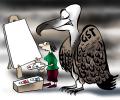
Experts said if the slowdown, and subsequent weakness in GST mobilisation, continued, it would curtail the Centre's resources to a considerable extent in the current financial year.
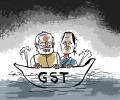
The collections stood at Rs 98,202 crore in the month, against Rs 1.02 trillion in July. The figures indicate continuation of economic slow down which was reflected in the gross domestic product (GDP) growth which plummeted to a 25-quarter low of 5 per cent in the first quarter of 2019-20, experts said.

So far, 38.38 lakh taxpayers accounting for 64.42 per cent of the total businesses, who had registered in July, filed returns.
The Centre is likely to introduce the Central GST and integrated GST bills in late November or early December in the ongoing session in the form of money Bills.

With recent rate cuts, November collections could be even less
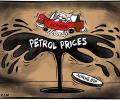
Many states are open to the idea of petrol and diesel being brought under the goods and services tax (GST) regime - contrary to the perception that they are averse to it - but they want a concrete proposal, including a compensation mechanism, from the Centre. West Bengal Finance Minister Amit Mitra says while the issue can be discussed, the Centre may not be keen to bring the change because it earns "much more" from taxes on petrol and diesel. "(The peak rate of) GST is 28 per cent. Under the regime, the Centre would only get 14 per cent. "So, definitely, the Union government does not want GST on fuel. It is all lies. Currently, they are in a very cozy place," Mitra said.

The direct tax collections are likely to fall short of the revised Budget target by Rs 650 billion and, in fact, were Rs 150 billion lower than the original estimate for the fiscal

Although the June collections were higher than that in July, however, it is important to note that during the previous month, a large number of taxpayers also paid taxes pertaining to February, March and April 2020 on account of the relief provided due to COVID-19.

GST is levied on every transaction in the supply of goods and services, barring certain exempted items
The high court's order, which says refunds paid on service inputs can be restricted, runs contrary to Gujarat HC verdict and could complicate matters.
As much as Rs 6,696 crore has been released to the states as GST compensation for the month of March 2018, as on May 29.

The budgeted indirect tax collection target is Rs 9.26 trillion, and the Centre has collected around Rs 5 trillion in the first 8 months. So it needs another Rs 4.2 trn in the last four months

The instruction is that audit of large units be completed within seven working days, of medium units in five working days and of small ones in three.

Appearing on Rediff Chat, G Srikanth, partner in GSV Associates, Chartered Accountants, Chennai, and member of the Institute of Cost and Management Accountants, answered readers' queries on the Goods and Services Act.

The Supreme Court Monday said the Centre was testing its "patience" and "emasculating" tribunals by not appointing officials to the quasi-judicial bodies which are facing severe crunch of presiding officers as well as judicial and technical members and sought action on the matter by September 13.

After the government sought Parliament's nod for a second batch of supplementary demand for grants that will cause a hit of Rs 2.99 trillion to the exchequer, doubts suddenly arose about the government's ability to meet the Budget projections of reining in its fiscal deficit at 6.8 per cent of gross domestic product (GDP), or Rs 15.06 trillion, for the current financial year. Till now, many were of the opinion that the government would succeed in checking the deficit at a much lower figure than what was given in the Budget Estimates (BE). The government had sought Parliament's approval to spend Rs 3.74 trillion extra, but Rs 74,517.01 crore will be matched by equal savings on other heads.

'The professional or the freelancer needs to pay taxes from his pocket first and then wait for payments from his clients.'
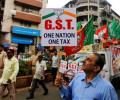
The buoyancy in the tax revenue of GST reflects the upswing in the economy and better compliance

Businesses with more than Rs 10 lakh turnover may end up paying the central goods and services tax, with the Centre not agreeing to states' suggestion of keeping the threshold at Rs 1.5 crore.
