
In line with central legislation, Maharashtra government will soon levy a cess on all public and private construction in the state costing over Rs 10 lakh (Rs 1 million) expecting to generate Rs 2,000 crore (Rs 20 million) anually for rolling out schemes for construction labour. The welfare measures include insurance, healthcare and education with the aim of providing security and well-being of labourers.
Faced with huge cost overruns due to a delay in building the rural roads under Bharat Nirman, the Planning Commission is now looking at alternative ways to fund the ambitious rural development project of the United Progressive Alliance (UPA) government.The rural road project, christened the Pradhan Mantri Gram Sadak Yojana (PMGSY), has seen tardy performance on the target of constructing 146,185 km of rural roads by 2009.

The Cabinet is believed to have asked the Department of Telecom to examine imposing a Swachch Bharat cess on spectrum charges paid annually by service providers.
This was discussed at a meeting chaired by the Prime Minister's Principal Secretary, TKA Nair, on January 12 with the Indian Bank Association, industry bodies and human resource development ministry officials.
The Confederation of Indian Industry on Monday proposed a 5 per cent cess to develop railway infrastructure and exuded confidence that 7-8 per cent GDP growth was achievable in the next decade.
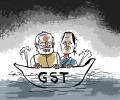
The government on Tuesday informed Rajya Sabha that GST compensation of Rs 17,176 crore is pending to states as on June 2022. Replying to supplementaries during the Question Hour, Minister of State for Finance Pankaj Chaudhary said the Centre is giving GST compensation to states for five years. He said even during Covid times when no GST was collected, the Government of India had given compensation to states after taking loans of Rs 1.1 lakh crore and 1.59 lakh crore during 2020-21 and 2021-22.
The National Council of Applied Economic Research also says that the fiscal deficit will overshoot budget target to touch 4.7 per cent of GDP in 2004-05.
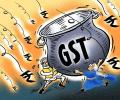
Continuing the upward trend, GST collections rose 10 per cent to about Rs 1.64 lakh crore in December compared to Rs 1.49 lakh crore in the same month a year ago. During the April-December 2023 period, gross Goods and Services Tax (GST) collection witnessed a robust 12 per cent growth, reaching Rs 14.97 lakh crore against Rs 13.40 lakh crore mopped up in the same period of the previous year, the finance ministry said in a statement on Monday. The average monthly gross GST collection of Rs 1.66 lakh crore in the first nine-month period this year represents a 12 per cent increase compared to the Rs 1.49 lakh crore average recorded in the corresponding period of FY23, it added.

Taxpayers with old, outstanding taxes will benefit from the CBDT's new scheme.

'We need a candidate who will do our work and fight with the authorities; someone we can hold accountable.' 'Piyush Goyal is not that candidate.'
GST collections rose 12 per cent to over Rs 1.49 lakh crore in February, the finance ministry said on Wednesday. February 2023 witnessed the highest cess collection of Rs 11,931 crore since implementation of GST. The collections are, however, lower than the second highest Goods and Services Tax (GST) mop-up recorded in January at over Rs 1.57 lakh crore.

The panel, headed by the Union finance minister and comprising of representatives of all states and UTs, decided on tax rate based on recommendation of a group of ministers that looked at taxing casinos, horse racing and online gaming.

Major carmakers like Maruti Suzuki and Honda did not have diesel technology and it is in the last 3-4 years that they invested in diesel vehicles owing to shift in demand towards such models
No longer a discretion of the tax administrator, the audit of returns filed by taxpayers is now based on a selection by algorithms, notes Tarun Bajaj.
GST collections jumped 15 per cent to nearly Rs 1.68 lakh crore in November, the finance ministry said on Friday. Goods and Services Tax (GST) mop-up was over Rs 1.45 lakh crore in November 2022.

The intial round of efforts did not achieve the objectives fully.

The Union government is projected to share about 32 per cent of central taxes with states during the financial year 2024-25 against the 15th Finance Commission's recommendation of 41 per cent. The Revised Estimates (RE) for FY24, too, show a similar share of states in the central taxes at 32 per cent. In absolute terms, however, there has been an increase in the amount devolved to states compared to the Budget Estimates (BE) for FY24 at Rs 11 trillion.

Following are comments from economists at leading financial institutions, banks and rating agencies on the interim Budget:

'If such a practice were feasible, every state would seek additional funds, posing a significant risk to the overall health of the economy.'
GST collection in May rose 12 per cent to Rs 1.57 lakh crore, the finance ministry said on Thursday. The gross Good & Services Tax (GST) revenue collected in the month of May, 2023 is Rs 1,57,090 crore of which Central GST is Rs 28,411 crore, State GST is Rs 35,828 crore, Integrated GST is Rs 81,363 crore (including Rs 41,772 crore collected on import of goods) and cess is Rs 11,489 crore (including Rs 1,057 crore collected on import of goods).
The Centre has cleared the entire GST compensation payable till date by releasing Rs 86,912 crore to states, the finance ministry said on Tuesday. Of this, Rs 25,000 crore is released from the GST compensation fund and the balance Rs 61,912 crore is being released by the Centre from its own resources pending collection of cess. Of the total compensation released, Rs 17,973 crore is towards April and May dues, Rs 21,322 crore towards February-March dues and Rs 47,617 crore is the balance of compensation payable up to January 2022.
Government is planning to levy a 10-20 paise per litre cess on petrol and diesel to fund build up 45 days' strategic crude oil reserves to meet contingency requirement like disruption in supplies in the event of war.
GST collections rose 12 per cent to over Rs 1.61 lakh crore in June, the finance ministry said on Saturday. The gross GST collection has crossed Rs 1.60 lakh crore mark for the fourth time since the roll-out of the indirect tax regime six years ago on July 1, 2017. The average monthly gross GST collection for the first (April-June) quarter of the 2021-22, 2022-23 and 2023-24 are Rs 1.10 lakh crore, Rs 1.51 lakh crore and Rs 1.69 lakh crore, respectively, the finance ministry said in a statement.
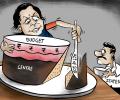
Kerala Finance Minister KN Balagopal on Friday urged the Centre to provide more fiscal powers to the states as well as increase the shareable proportion of the GST collections. Besides, he asked the central government to expedite approval for the semi-high-speed railway line or the Silverline project from Thiruvananthapuram to Kasargod. The project is mired in controversies.

Widening of the tax base, doing away with cess and surcharge, improvement in compliance and moderation in tax for emerging sectors are some of the suggestions submitted to the Finance Ministry ahead of the Budget by Think Change Forum (TCF). Experts are of the opinion that there is a need to grow tax revenues for the government to drive economic growth and make investments in developmental activities, TCF, the think tank said in a statement. Towards this end, poor compliance was identified as a weak link in achieving targeted collections leading to complex issues like overtaxing, complicated tax structures, rising litigation, among others.

The government must expedite its plan for asset sale and privatisation, both of which hardly got any mention in the Budget speech, points out A K Bhattacharya.

Amit Gupta examines the taxation of dividend-paying stocks, share buybacks, and bonus shares.

The government on Friday slapped an export tax on petrol, diesel and jet fuel (ATF) while also joining nations like the UK in imposing a windfall tax on crude oil produced locally. A Rs 6 per litre tax on export of petrol and ATF and Rs 13 per litre tax on export of diesel is effective from July 1, finance ministry notifications showed. Additionally, a Rs 23,250 per tonne tax was levied on crude oil produced domestically.

Anamika Pareek explains the advantages of investing in tax-saving options like the equity-linked savings schemes.
GST collection rose 11 per cent to over Rs 1.65 lakh crore in July as a result of anti-evasion measures and higher consumer spending. This is the fifth time since the rollout of the Goods and Services Tax (GST) regime that monthly collections have crossed the Rs 1.60 lakh crore mark -- making it the new normal. "Gross GST revenue collected in July is Rs 1,65,105 crore of which CGST is Rs 29,773 crore, SGST is Rs 37,623 crore, IGST is Rs 85,930 crore (including Rs 41,239 crore collected on import of goods) and cess is Rs 11,779 crore (including Rs 840 crore collected on import of goods)," the finance ministry said in a statement.

Rajasthan Chief Minister Ashok Gehlot on Wednesday said the accused in the Kanhaiya Lal killing case in Udaipur were 'linked' to the Bharatiya Janata Party and should have been 'hanged by now' but the investigation by the National Investigation Agency was not progressing as it should.

Dwaipayan Bose examines the seven important factors that investors about exchange traded funds must know before they start investing/trading in them.

India will grow at around 7.4 per cent in 2022-23 and continue at the same pace in the next year as well, Union Finance Minister Nirmala Sitharaman said on Friday. Sitharaman said there are risks on the external front and this is not the right time to throw caution to the wind, and also assured exporters of all the necessary support from the government as they face the headwinds. Speaking at the FE Best Bank Awards event here, Sitharaman said global agencies like IMF and the World Bank have taken cognisance of the strengths of the Indian economy by saying that it will be among the fastest growing ones in the next two years.

At a time when consumers increasingly embrace green mobility solutions, it is not electric cars but hybrids that are taking the lead, as automotive sales data indicate. Since January, 64,097 electric cars have been sold compared to 266,465 hybrids, according to data from the ministry of road transport and highways' Vahan dashboard. Hybrid car sales have surged from 4.42 per cent of the 4.1 million cars sold in calendar year 2022 to 7.2 per cent this year.
GST collections in September rose 26 per cent to over Rs 1.47 lakh crore, the finance ministry said on Saturday. Goods and Services Tax (GST) mop-up has been over Rs 1.40 lakh crore for seven months in a row.
At a time when consumers increasingly embrace green mobility solutions, it is not electric cars but hybrids that are taking the lead, as automotive sales data indicate. Since January, 64,097 electric cars have been sold compared to 266,465 hybrids, according to data from the Ministry of Road Transport and Highways' Vahan dashboard. Hybrid car sales have surged from 4.42 per cent of the 4.1 million cars sold in calendar year 2022 to 7.2 per cent this year.
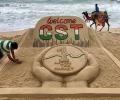
Six years after the rollout of the biggest indirect tax reform in India, Goods and Services Tax (GST) revenue of Rs 1.5 lakh crore every month has become a new normal and tax officers are focusing on dealing with fraudsters who are adopting newer modus operandi to game the system, causing loss to the exchequer. To apprehend black sheep, who operate as syndicates and create fake entities on the basis of forged documents to claim input tax credit (ITC), tax officers have started using data analytics, artifical intelligence and machine learning aiming to curb evasion, which was over Rs 3 lakh crore since inception of GST. It was over Rs 1 lakh crore in 2022-23. Thinktank Global Trade Research Initiative (GTRI) said the most critical pending GST reform is upgradation of GST Network to prevent fake supplies and fraudulent claims of Input Tax Credit (ITC).
 © 2026 Rediff.com - Investor Information - Advertise with us - Disclaimer - Privacy Policy - Sitemap - Feedback - About us - Terms of use - Grievances