
Updated new base years for national accounts and other macro-indicators are expected to come into effect from January-February 2026, coinciding with the first and second advance estimates of national income for FY26, senior official sources aware of the development told Business Standard. "The statistics ministry set up the Advisory Committee on National Accounts Statistics (ACNAS) earlier this week. "It will advise on the base year for GDP (gross domestic product) and its alignment with other macro-indicators.

A careful reading of the national income accounts suggests that after a strong recovery from the pandemic, there has been a significant ebbing of dynamism over the last three quarters to more modest levels recently, note Arvind Subramanian and Josh Felman.

The rate of price rise has been on a decline for the past four months.

Even the Central Statistical Office has started using GDP as the main measure of economic activities since January 15 this year

The country's demographic dividend is dissipating, with seriously adverse consequences for young India, asserts Shankar Acharya, former Chief Economic Adviser to the Government of India.
The GDP growth is estimated to come at the "deceptively high" level of 20 per cent for the April-June 2021 quarter but is far below the same in the pre-COVID times, rating agency Icra said on Wednesday. Icra said the low base of the last year, when the GDP had contracted by close to 24 per cent, "conceals" the impact of the second wave of COVID-19 infections. Economic activity is boosted by robust government capital expenditure, merchandise exports and demand from the farm sector, it said, estimating the GDP to grow by 20 per cent and the gross value added (GVA) will register a growth of 17 per cent for the June quarter.

The IMF on Tuesday cut India's economic growth forecast by 0.5 percentage points to 9 per cent for the current fiscal year, with its chief economist Gita Gopinath saying that the slight downgrade is mainly due to the impact of the spread of the Omicron variant. "If you look at the 2021-22 fiscal year, we have a slight downgrade of -0.5 percentage points and for the next fiscal year 2022-23 we have a slight upgrade of 0.5 percentage points. So, growth for the previous fiscal year is now nine per cent and for this year now is at nine per cent. We moved it up slightly," Gopinath told reporters during a news conference in Washington. In its latest update of World Economic Outlook on Tuesday, the International Monetary Fund has cut India's economic growth forecast to 9 per cent for the current fiscal year ending March 31, joining a host of agencies which have downgraded their projections on concerns over the impact of the spread of Omicron on business activity and mobility.

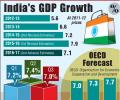
GDP growth during 2018-19 is estimated at 7 per cent as compared to 7.2 per cent in 2017-18.

The earlier high was in January this year at 5.07 per cent.

According to the Central Statistics Office data, the jump in the retail inflation based on Consumer Price Index was mainly due to rise in prices of kitchen items like vegetables, meat and fish.

The manufacturing sector, which constitute more than 77 per cent of the index, recorded a growth of 5.2 per cent in April, up from 2.9 per cent in the year ago month.

Economists, however, caution against interpreting the data as a broad-based revival

The rate of price rise in the food basket contracted by 0.86 per cent in October compared to 0.51 per cent rise in September
The rate of price rise in the protein rich items like eggs, milk and other products too moderated in March as against the previous month.

The Reserve Bank is likely to cut the repo rate by 25 basis points (bps) after the Budget.
Earlier, the CSO in its advance estimate had pegged the GDP growth rate for 2018-19 at 7.2 per cent.

Quoting from the report of Central Statistics Office, the former deputy chief minister Sushil Kumar Modi said that Bihar's growth rate has reduced to half at 8.82 per cent in 2013-14 against 15.05 per cent in 2012-13.
Capital expenditure by private companies halved in FY13 from that in FY08; households put more money into gold, houses.
The economy is expected to grow 4.9 percent in 2013/14, marginally lower than the finance ministry's estimate of a 5 percent growth, dragged down by a contraction in the manufacturing sector, a government statement said on Friday.
'I expect fourth quarter GDP growth to be sharply down.' 'I would imagine it would shave off at least one percentage point, if not more, as compared to the third quarter.'

Ireland, a predominantly Catholic country, has recorded the death of Indian dentist Savita Halappanavar as the only maternal casualty in 2012, which a new report has found was not true.

The rate of price rise for consumer foods eased to 4.7 per cent in January, from 4.96 per cent in December.

The first economic readings to be published in 2015 will be out on Monday, when the government releases industrial output data for November and the consumer price index for December.

Corporate results confirm worst fears about growth trajectory.
India's problem cannot be blamed on external considerations alone.
When FM was that the third-quarter GDP data was not in line with his ministry's optimism, he had said he relied on the advice of his advisors.

In a paper, EAC-PM accused Subramanian of "cherry-picking high-frequency indicators" to express his skepticism about the growth rates after 2011-12.

On overall basis, the inflation in the food segment increased to 4.42 per cent in November as compared to 1.9 per cent in the preceding month.

The final Budget for the fiscal is likely to be tabled in July after formation of the new government.

Manufacturing output, which constitutes about 76 per cent of the industrial production, fell by an annual 6 per cent, the Statistical Office said.
Reflecting general rise in living standard, India's per capita income is estimated to grow above Rs 60,000 per annum or over Rs 5,000 per month, said the government data.
Reflecting growing prosperity, India's per capita income grew by 15.6 per cent to Rs 53,331 per annum in 2010-11, crossing the half-a-lakh rupees mark for the first time, according to government data.
Reflecting growing prosperity, India's per capita income grew by 15.6 per cent to Rs 53,331 per annum in 2010-11, crossing the half-a-lakh rupees mark for the first time, according to government data.

108 economists, social scientists said it was imperative that agencies like CSO and NSSO are not subject to political interference.

"The process of rectification began immediately. . . it has already begun. . . the immediate correction was already there. So far what else I can do to improve the quality of the expenditure side figures, I have already started," Chief Statistician TCA Anant said.

Slowdown in industrial production notwithstanding, a marginal increase in inflation raised the clamour for another round of rate cut by the Reserve Bank on April 4 to boost economic activity.

Factory output as measured in terms of IIP had grown by 7.3 per cent in December 2017.

In terms of industries, 10 out of 23 industry groups in the manufacturing sector showed positive growth during November 2018.

The manufacturing sector, which constitutes 77.63 per cent of the IIP, contracted by 0.4 per cent in March as compared to 5.7 per cent expansion in the year-ago month.

Items such as cereals and products, meat and fish, oils and fats became cheaper
 © 2026 Rediff.com - Advertise with us - Disclaimer - Privacy Policy - Sitemap - Feedback - About us - Terms of use - Grievances