
With 7 per cent economic growth, India is not creating enough jobs as reflected by the number of applicants for vacant posts in some states, Reserve Bank's former governor Raghuram Rajan said and suggested the government needs to focus on promoting labour-intensive industries to generate employment. Rajan further said some Indians, especially those at upper level, are comfortable and have high incomes, but consumption growth from the lower half of the country has still not recovered to pre-pandemic level.

'Whether I am optimistic or pessimistic is not the issue; I am just going by the evidence available.' 'The Indian economy and financial sector are now well-placed and very resilient in dealing with any kind of spillover coming from the external world.'
The Securities and Exchange Board of India (Sebi) might relax the disclosure norms around rumour verification to help smooth implementation and ease compliance amid pushback from India Inc, said people in the know. The rule has been notified following amendments to the Listing Obligations and Disclosure Requirements (LODR) by Sebi. However, its implementation has been deferred until February.

As the results season kicks in, the quarterly earnings numbers of several blue-chip firms -- such as Infosys and Reliance Industries -- along with global trends and trading activity of foreign investors, will determine equity market movement in the holiday-shortened week ahead, according to analysts. The domestic WPI inflation data for June -- scheduled to be announced on Monday -- will also influence trading sentiments, traders said. Markets will remain closed on Wednesday for Muharram.

S&P Global Ratings on Wednesday upgraded India's sovereign rating outlook to positive from stable while retaining the rating at 'BBB-' on robust growth and improved quality of government expenditure. S&P said it could upgrade India's sovereign rating in the next 2 years if the country adopts a cautious fiscal and monetary policy that diminishes the government's elevated debt and interest burden while bolstering economic resilience.

Gold seems to be losing its glitter in India due to a rise in prices. Demand in Q2CY24 was 149.7 tonnes - a 5 per cent drop compared to 158.1 tonnes in the same period last year, according to a report by the World Gold Council (WGC). Demand by value in April-June 2024 stood at Rs 93,850 crore, up by 14 per cent compared to Rs 82,530 crore in the same period last year.

The Reserve Bank of India (RBI) will launch the Unified Lending Interface (ULI) nationwide in due course, aiming to transform India's lending sector, similar to how the Unified Payments Interface (UPI) revolutionised the payments ecosystem, Governor Shaktikanta Das said on Monday.

The Reserve Bank of India's (RBI's) job to bring down inflation is not over, and any premature move on the policy front could undermine the success achieved so far on the price situation, according to RBI Governor Shaktikanta Das. RBI's rate setting panel, Monetary Policy Committee (MPC), had met for three days from February 6-8. The panel decided to leave the key policy rate unchanged at 6.5 per cent for the sixth time in row.
The Reserve Bank of India has brought 100 metric tonnes of gold reserve from the UK to India as there is enough domestic storage capacity, and nothing more should be read into it, Governor Shaktikanta Das said on Friday. The RBI moved 100 metric tonnes of its gold stored in the UK to domestic vaults in FY24.

The bank has targeted to disburse an additional Rs 500 crore (Rs 5 billion) of home loans by April end with the introduction of the new scheme, a statement said in Mumbai on Thursday. Lending rates for loans between Rs 500,000 and Rs 20 lakhs would now be offered at eight per cent as against 9.25 per cent earlier, the bank said.
The Reserve Bank of India (RBI) has recognised the Fintech Association for Consumer Empowerment (FACE) as a self-regulatory organisation (SRO) in the fintech sector, the central bank announced on Wednesday. The banking regulator received three applications for fintech SRO. Of the remaining two applications, one has been returned by the RBI with a provision for resubmission after meeting specific requirements, while the third application is still under examination, said Governor Shaktikanta Das at the Global Fintech Fest in Mumbai.

India has moved 100 metric tonnes of its gold stored in the UK to domestic vaults in FY24, sources said on Friday. This is one of the biggest movements of gold undertaken by the country since 1991, when pledging a substantial part of the gold holding to tide over a foreign exchange crisis resulted in its movement out of vaults. The country's overall gold holding increased 27.46 metric tonnes in FY24 and it stands at 822 metric tonnes, as per official data.

From the Sensex pack, Tata Steel, Titan, Tech Mahindra, Wipro, Bajaj Finserv, Bajaj Finance, Nestle India, Tata Motors and JSW Steel were the biggest laggards. ICICI Bank, Axis Bank, HDFC Bank, State Bank of India and Kotak Mahindra Bank were the gainers.

Urjit Patel's reappointment will raise market hopes that Rajan, will also be offered an extension when his tenure ends in September.

The National Payments Corporation of India on Thursday granted approval to Paytm-owner One97 Communications Ltd to participate in UPI as a Third-Party Application Provider (TPAP) under the multi-bank model. Axis Bank, HDFC Bank, State Bank of India, and YES Bank will act as Payment System Provider (PSP) banks to Paytm.

Reserve Bank of India (RBI) is unlikely to cut the benchmark interest rate at its upcoming monetary policy review meeting, taking place soon after the announcement of the Lok Sabha election results, amid inflation challenges, said experts. The Monetary Policy Committee (MPC) may also refrain from rate cut as economic growth is picking up, notwithstanding the elevated interest rate of 6.5 per cent (repo) prevailing since February 2023. The meeting of the Reserve Bank Governor Shaktikanta Das headed MPC is scheduled for June 5 to 7.
The Reserve Bank (RBI) resisted a 'raid' planned by some in the government to extract Rs 2-3 lakh crore from its balance sheet in 2018 to meet populist spending in run-up to general elections, Viral Acharya, who was deputy governor at RBI at that time, has written.

An article on 'State of the Economy' in the monthly Bulletin also said the improvement in the outlook for agriculture and the revival of rural spending have turned out to be the bright spots in the evolution of demand conditions. Consumer price inflation ticked up in June 2024 after three consecutive months of moderation as a broad flare-up in vegetable prices halted the overall disinflation that had been underway, it said.

India's foreign exchange reserves increased $2.95 billion to $645.58 billion for the week ended March 29, the Reserve Bank of India (RBI) said on Friday. This is the sixth consecutive week of a jump in overall reserves. The kitty had increased $140 million to $642.63 billion in the previous reporting week.
India's forex reserves jumped by $2.98 billion to a fresh peak of $648.56 billion for the week ended April 5, the RBI said on Friday. In the previous reporting week, the forex kitty had increased by $2.951 billion to $645.583 billion, which was an all-time high. In September 2021, the country's forex kitty reached an all-time high of $642.453 billion, a level that was breached in March this year.

India's forex reserves decreased $2.282 billion to $640.33 billion for the seven days ended April 19 in the second consecutive week of drop in the kitty, the Reserve Bank of India (RBI) said on Friday. The reserves had dropped $5.40 billion to $643.16 billion in the previous reporting week, ending a multi-week trend of an increase, which also saw the overall reserves touching a new all-time high of $$648.56 billion for the week ended April 5.
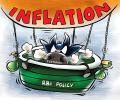
Amid a debate on the basis of a monetary policy stance, one may be curious enough to know how non-food retail inflation has behaved over the years in India. Let the eager souls catch a glimpse of facts. In the past 10 years, non-food inflation came down below 4 per cent on two occasions - pre-Covid period of 2019-20 and now in the first four months of the current financial year (FY25).

India's forex reserves increased by $6.4 billion to $642.49 billion for the week ended March 15, the Reserve Bank said on Friday. In the previous reporting week, the overall reserves had risen by $10.47 billion to $636.09 billion. In October 2021, the country's forex kitty had reached an all-time high of $645 billion.

'While Indian markets are indeed not inexpensive, the valuations of largecap stocks are still a considerable distance from being overstretched.'
Quarterly earnings from corporates, the US Fed interest rate decision and other global trends will be the major driving factors for determining movement in the domestic equity market in a holiday-shortened week ahead, analysts said. Besides, factors like trading activity of foreign investors, global oil benchmark Brent crude and rupee-dollar trend would also influence trading.
The Reserve Bank of India (RBI) on Monday did a four-day variable rate reverse repo (VRRR) auction to reduce liquidity in the banking system as the overnight money market rates fell below the repo rate, said market participants. The repo rate is 6.50 per cent. Banks parked Rs 18,750 crore at the auction against a notified amount of Rs 50,000 crore at a weighted average rate of 6.49 per cent.

Dr T V Somanathan is the first finance secretary to be appointed Cabinet secretary since 1985. His appointment at this juncture seems to carry much meaning for the forthcoming trajectory of reforms and restructuring of India's steel frame.
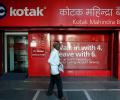
Cracking down on repeated non-compliance of IT norms, the RBI on Wednesday barred Kotak Mahindra Bank from onboarding new customers through its online and mobile banking channels and issuing fresh credit cards with immediate effect after the regulator found "serious deficiencies" in the lender's IT risk management. These actions, the RBI said, are necessitated based on significant concerns arising out of Reserve Bank's IT examination of the bank for the years 2022 and 2023 and the continued failure on part of the bank to address these concerns in a comprehensive and timely manner.
Reserve Bank of India on Friday said NPCI has been asked to examine the possibility of it becoming a third party application provider for continued UPI operations of the Paytm app. The central bank has barred Paytm Payments Bank from accepting further credits into its customer accounts and wallets after March 15, 2024.

The bias for the BSE benchmark index, technical charts suggest, is likely to remain bullish as long as the index holds above 75,600 levels for the rest of the year.

Bond market participants expect an open market operation (OMO) auction in the first week of November as the banking system liquidity is expected to ease on the back of government spending and maturity of bonds. According to market participants, the Reserve Bank of India (RBI) will issue a notification on OMO sales by October 31. They speculate that the central bank might conduct the auctions in multiple tranches of Rs 10,000 crore.

The Reserve Bank on Wednesday approved a Rs 2.11 lakh crore dividend payout to the central government for 2023-24, more than double the amount it paid for the previous 2022-23 financial year. The decision was taken at the 608th meeting of the Central Board of Directors of the Reserve Bank of India held under the chairmanship of Governor Shaktikanta Das.

India recorded a current account surplus of $5.7 billion or 0.6 per cent of GDP in the March quarter, the Reserve Bank of India said on Monday. This is the first time in ten quarters that the crucial metric of the country's external strength has turned into surplus mode. In the year-ago period, the current account deficit stood at $1.3 billion or 0.2 per cent of GDP, and the same was $8.7 billion or 1 per cent of GDP in the preceding quarter ending December 2023.

Frequent weather shocks caused by climate change pose challenges for the monetary policy as well as downside risks to economic growth, a Reserve Bank report said. Global average temperatures are on a rise, with accompanying increase in extreme weather events (EWE), and the economic and social impact of global warming is becoming increasingly evident, said RBI's Monetary Policy Report - April 2024. The report said that climate change has increased the frequency and ferocity of weather shocks, posing challenges for monetary policy.

The Directorate of Enforcement (ED) has launched a preliminary investigation or a pre-open inquiry into alleged violations related to the Foreign Exchange Management Act (Fema) in the Paytm Payments Bank case, according to sources in the know. The probe follows serious concerns raised by the Reserve Bank of India on multiple violations by the Paytm bank, which is a joint venture between One97 Communications, which is the parent company of Paytm, and the group's founder Vijay Shekhar Sharma.

'It makes sense to have gold in one's portfolio keeping the political and economic risks of 2024 in mind.'

Vijay Shekhar Sharma has stepped down as part-time non-executive Chairman of Paytm Payments Bank Limited (PPBL), and the board of the bank has been reconstituted. The Reserve Bank has barred the PPBL from accepting deposits and credits from any customer post-March 15 for persistent non-compliances and continued material supervisory concerns in the bank. PPBL has reconstituted its Board of Directors with the appointment of Ex-Central Bank of India chairman Srinivasan Sridhar, retired IAS officer Debendranath Sarangi, former executive director of Bank of Baroda Ashok Kumar Garg, and former IAS officer Rajni Sekhri Sibal, Paytm said in a regulatory filing on Monday.

Oil and LNG prices are likely to shoot up if Iran is to block Strait of Hormuz, through which countries like India import crude oil from Saudi Arabia, Iraq and UAE, leading to a spike in inflation, analysts said on the Iran-Israel conflict. The Iran and Israel conflict has escalated over the last few days. Iran first launched drone and rocket attacks on Israel, which retaliated by firing a missile. Crude oil prices have hovered around USD 90 per barrel since the conflict.

Benchmark stock indices Sensex and Nifty rallied more than 1.6 per cent to close at lifetime high levels on Thursday following buying in banking, oil and auto shares and a record dividend payout by the RBI to the government. Regaining the 75,000 level after its best single-day gain since January 29, the 30-share BSE Sensex closed at all-time peak of 75,418.04, up by 1,196.98 points or 1.61 per cent over the last close.

'The FSIB will conduct interviews for the SBI chairman position on May 21-22 as the tenure of the current chairman Dinesh Kumar Khara is scheduled to end by August.'
