
'Within India, people want high-quality, personalised banking services, and the demand for such services has exploded.'

Even as the high inflation figure for October has ruled out any possibility of a rate cut by the Reserve Bank of India's (RBI's) monetary policy committee (MPC) in December, a rate cut in February also looks uncertain due to global uncertainties. Economists told Business Standard that unless domestic growth slows markedly, the outlook on rate cut remains unclear. India's headline inflation touched a 14-month high of 6.2 per cent in October, breaching the MPC's upper tolerance band of 6 per cent.

All investors should ideally have a 10 to 15 per cent allocation to gold. Whether they invest in gold ETFs or SGBs should depend on their investment horizon.

The Reserve Bank on Monday barred IIFL Finance Ltd from disbursing gold loans, with immediate effect following multiple supervisory concerns, including serious deviations in assaying and certifying the purity of the yellow metal. A leading financial services provider, IIFL Finance offers a range of loans and mortgages. The latest directions from the Reserve Bank of India (RBI) pertain to only the gold loan business.

Invest with a 5 to 7 year horizon so that you are able to ride out price volatility and benefit from the long-term trends of demand and macroeconomic shifts.

In addition to interest rates, review the fine print for penalties and repayment terms, and select a reputable lender to avoid harsh recovery practices.

India's forex kitty jumped by $10.47 billion to $636.09 billion for the week ended March 8, the Reserve Bank said on Friday. In the previous reporting week, the overall reserves had risen by $6.55 billion to $625.63 billion. In October 2021, the country's forex kitty had reached an all-time high of $645 billion.

'India's fundamentals are a lot better (than those of other emerging market economies).' 'India will suffer (witness a fall in its stock market) what I call the second order effect.' 'And the second order will happen when these funds (belonging to macro and hedge fund investors and which have leveraged Japanese yen-carry trades), because they lose money elsewhere as lot of their positions were financed by borrowing Japanese yen, will have to book profits in investment destinations where they are making money, including in markets like India.' 'They (these investors) will have to effectively sell in countries like India and which is the consequence (the crash in equity markets) that Indian markets might see.'

The Reserve Bank of India (RBI) conducted two overnight variable rate reverse repo (VRRR) auctions on Tuesday, marking the first instance of such action in a single day. The move aimed to reduce liquidity from the banking system, which has been largely in deficit mode for the past four months. Market participants noted that the central bank held the second VRRR auction due to its awareness of funds being released to banks during the day.

'When interest rates rise, the NAVs of these funds will fall.' However, they won't fall as much as longer-duration funds.

In FY24, loans given out by such firms had topped a whopping Rs 146,517 crore, up by 49 per cent year-on-year and spread over 10.19 million accounts (up 35 per cent).

The finance ministry is in favour of extending the August deadline for public sector banks (PSBs) as well as insurance companies to increase their minimum public shareholding (MPS) to the mandated 25 per cent, said a senior government official. "The election results will determine the course of action. "Most likely, those who did not receive an extension to meet the minimum shareholding norm will be granted one," the senior government official said.

India's foreign exchange reserves declined in the week that ended on April 12, after having risen for the seventh straight week to hit an all-time high of $648.56 billion. As per the latest data released by the Reserve Bank of India (RBI), the country's foreign exchange kitty declined by $5.40 billion to $643.16 billion in the April 12 week. India's foreign currency assets (FCA), the biggest component of the forex reserves, declined by $6.51 billion to $564.65 billion, the central bank's weekly statistical data showed.

'Young investors should focus more on equity, while retired senior citizens should prioritise fixed income.' 'Mid-career investors should aim for a balanced allocation.'

Retail inflation eased to a one-year low of 4.75 per cent in May as prices of some kitchen items declined marginally, according to government data released on Wednesday. The Consumer Price Index (CPI) based retail inflation was 4.83 per cent in April 2024 and 4.31 per cent in May 2023 (previous low).

From the Sensex pack, Adani Ports & Special Economic Zones, Mahindra & Mahindra, Reliance Industries, HDFC Bank, Larsen & Toubro, NTPC, State Bank of India, UltraTech Cement and Kotak Mahindra Bank were the major gainers. In contrast, Tata Steel, Titan, Bajaj Finserv, JSW Steel, Bajaj Finance, Hindustan Unilever, ITC, Tata Motors and Tata Consultancy Services were among the laggards.

The Financial Intelligence Unit-India (FIU-India), the national agency responsible for analysing suspicious financial transactions, has received requests from four more offshore crypto exchanges to operate in India again, said a senior government official familiar with the matter. In the beginning of 2024, India had banned nine crypto exchanges - Binance, Kucoin, Huobi, Kraken, Gate.io, Bitstamp, MEXC Global, Bittrex, and Bitfenix - for non-compliance with anti-laundering law in the country.

What stood out in his 15-year journey as a member of the political executive at the Centre was his glowing record as India's most successful and effective finance minister. Both as prime minister and finance minister, he understood the importance of gradualism, except when the economy or the polity was in a crisis.

'Invest only in stocks of those companies that deliver on earnings and there is earnings visibility too for the next few quarters.'
For five consecutive policy reviews in 2023, the Reserve Bank of India (RBI) chose to hold rates, citing inflation threat. And when the prices did cool off a bit, it reminded all about the target to get the headline consumer price inflation at 4 per cent and the risks from food inflation. Heading into the new year, all eyes are on when RBI will cut the rates, especially after one of the Monetary Policy Committee (MPC) members stressed on the need for such an action in the face of the US Federal Reserve's guidance for easing rates.

Release of key macroeconomic numbers, monthly derivatives expiry, and global cues are likely to drive stock market movement this week, according to analysts. Markets will also be reacting to remarks made by the US Federal Reserve Chair Jerome Powell, they said. "This week, we expect the market to witness a gradual up-move with stock-specific action.

The Reserve Bank of India on Friday revised upwards the GDP growth projection for the current fiscal to 7.2 per cent from 7 per cent on rising private consumption and revival of demand in rural areas. Unveiling the bi-monthly monetary policy, RBI Governor Shaktikanta Das said estimates released by the National Statistical Office (NSO) placed India's real gross domestic product (GDP) growth at 8.2 per cent in 2023-24. "During 2024-25 so far, domestic economic activity has maintained resilience," he said, adding that manufacturing activity continues to gain ground on the back of strengthening domestic demand.

India's forex reserves jumped by $5.74 billion to $622.47 billion for the week ended February 2, the Reserve Bank said on Friday. In the previous week, the overall reserves had increased by $591 million to $616.73 billion. In October 2021, the country's forex kitty had reached an all-time high of $645 billion.

Among the 30 Sensex firms, Asian Paints, Infosys, JSW Steel, UltraTech Cement, Power Grid, Larsen & Toubro, HCL Technologies and Tata Steel were the biggest laggards. Tata Motors, HDFC Bank, Bharti Airtel, ITC, IndusInd Bank and Axis Bank were the gainers.

Stock markets would take cues from the biggest event of the week -- the US Fed interest rate decision, besides tracking the trends in global markets and trading activity of foreign investors, analysts said. Last week, a heavy decline in smallcap, midcap firms, foreign fund outflows and elevated crude oil prices in the international market dented investors' sentiments. Experts said equity markets may remain volatile in the near-term amid a host of global central bank's monetary policy decisions lined up during the week.

The RBI on Friday gave 15 days more till March 15, 2024 to Paytm Payments Bank Ltd (PPBL) to stop deposits, credit transactions or top-ups in any customer accounts, wallets, and FASTags, keeping in view the interest of customers, including merchants. As per a January 31 order of the central bank, PPBL was asked to stop further deposits, credit transactions, or top-ups in any customer accounts, prepaid instruments, wallets, FASTags, and National Common Mobility Cards, after February 29.

'The structural story of India is a multi-decadal story.' 'One should stay invested in that story and avoid reacting to what is happening globally.'
The Reserve Bank of India (RBI), on Thursday issued orders restraining commercial transactions routed through intermediaries by a card network. The central bank, without naming the card network, said the intermediary with an arrangement with the network, did not have the authorisation to function under the Payment and Settlement Systems (PSS) Act. This led the regulator to suspend the arrangement till further notice.

The Reserve Bank of India (RBI) abstained from selling any US dollars throughout February, for the first time in nine months. The decision comes amid increasing pressure on the rupee, as expectations of rate cuts by the US Federal Reserve keep pushing back. The last time the RBI did not sell dollar over a month was in May 2023.

Rs 135.3 crore. How much of it was salary, and how much commission?

The Reserve Bank of India (RBI) on Monday said 97.87 per cent of the Rs 2000 denomination banknotes have returned to the banking system, and only Rs 7,581 crore worth of the withdrawn notes are still with the public. On May 19, 2023, the RBI announced the withdrawal of Rs 2000 denomination banknotes from circulation. The total value of Rs 2000 banknotes in circulation, which was Rs 3.56 lakh crore at the close of business on May 19, 2023, has declined to Rs 7,581 crore at the close of business on June 28, 2024.

Moody's Investors Service on Wednesday said the outlook for global banks for 2024 is negative as central banks' tighter monetary policies have resulted in lower GDP growth. It said Indian banks' profitability will increase further on lower provisioning expenses and robust growth in higher-yielding retail segments. "Our outlook for global banks for 2024 is negative as central banks' tighter monetary policies have resulted in lower GDP growth.

The three day MPC meeting began on Monday and the decision will be announced on Wednesday by RBI Governor Shaktikanta Das.

'A 10 to 15 per cent allocation to gold in portfolios reduces risk without compromising on potential returns.'
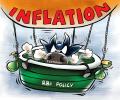
Reserve Bank Governor Shaktikanta Das on Friday said there is no plan to loosen interest rates as inflation continues to be the top priority for the central bank. Speaking to reporters at the central bank headquarters here, Das clarified that the inclusion of "over tightening" in his statement while announcing the fifth consecutive status quo in rates, should not be construed as anything else. A "loosening" in rates is not on the table, Das added.

'We expect market consolidation and recommend buying during market dips.'

Companies in the banking, finance sector and insurance (BFSI) sector have underperformed on the bourses despite leading the earnings growth charts in the post-pandemic period. This has created a dichotomy between their earnings and share prices. BFSI companies have never been less expensive than the rest of the equity market.

Beleaguered Paytm Payments Bank's managing director and CEO Surinder Chawla has resigned from the company, a regulatory filing said on Tuesday. Chawla's resignation comes amidst Paytm Payments Bank facing prohibitory action from banking regulator RBI. "Surinder Chawla, managing director and CEO of PPBL, has tendered his resignation on April 8, 2024, on account of personal reasons and to explore better career prospects.

When evaluating bonds, returns shouldn't be the sole factor. Pay close attention to the bond's credit rating. It should ideally be AA or higher.

The average cost of data breaches in India reached $2.18 million in 2023, marking a 28 per cent increase since 2020, according to the Reserve Bank of India's (RBI) Currency and Finance report for 2023-24. The report said that India's average data breach cost was still below the global average. The most common attacks in India are phishing which was at 22 per cent and stolen or compromised credentials was 16 per cent. The automotive industry is highly vulnerable to cyber attacks, whereas the banking and financial services sector, benefiting from stringent regulations, enjoys comparatively stronger protection.
