
The Reserve Bank has kept the key policy rates unchanged, while the Cash reserve Ratio (CRR) has been cut by 25 bps to 4.25%.

RBI has held its short-term lending (repo) rates unchanged at eight per cent since April 2012.

'RBI is already late in addressing inflation pressures.'

When costs go down, interest rates will go down, says managing director and CEO Aditya Puri.
RBI expects more from the government than last week's very limited package of reforms and fiscal measures.
Banks to lower rates shortly; RBI cuts CRR by 25 bps and signals easier policy in October
Banks to lower rates shortly; RBI cuts CRR by 25 bps and signals easier policy in October

At the Interbank Foreign Exchange (Forex) market, the rupee resumed sharply higher at 53.80 a dollar compared to last Friday's close of 54.30.

Last year SBI's credit growth was 15.6 per cent.

State Bank of India Chairman Pratip Chaudhuri again made a strong pitch for a reduction in banks' Cash Reserve Ratio (CRR) at the Reserve Bank's mid-quarter review of monetary policy scheduled September 7.

Reserve Bank of India Governor D Subbarao surely knows how to crack a joke even on as mundane a topic as the cash reserve ratio (CRR).

"The economy is going through a very difficult patch and business confidence has plummeted. New investments have slowed down," Assocham President Rajkumar Dhoot said during his interaction with RBI Governor D Subbarao ahead of the central bank's monetary policy review scheduled on April 17.
ICICI Bank Chairman K V Kamath on Thursday disagreed with the suggestion of SBI chief Pratip Chaudhuri that RBI should scrap CRR, saying it is part of the monetary policy and no issue can be made of it.

A day after RBI deputy governor's comment, Chaudhuri says his idea on cash reserve ratio was meant to ignite public debate

In view of high inflation and deficient monsoon rainfall, the Reserve Bank may find it difficult to cut the key lending rate to boost the economy as is being demanded by the industry.

HDFC and HDFC Bank's merger - touted as India's biggest-ever corporate merger - pumped up shares of the two entities on the bourses. Shares of Housing Finance Development Corporation (HDFC) skyrocketed 9 per cent while those of HDFC Bank zoomed 10 per cent. In comparison, the benchmark S&P BSESensex and the Nifty50 indices settled 2.2 per cent higher on Monday.

At a time when headline inflation has been moderating, most were expecting the central bank to take a firmer stance on growth.

Real estate developers said on Tuesday that RBI's decision to cut cash reserve ratio will help improve the liquidity position of various sectors, including realty, but felt that interest rates should be brought down to boost housing demand.

At present, CRR, the portion of deposits which commercial banks keep with the central bank, stands at 6 per cent.

The central bank kept cash reserve ratio unchanged at 4 per cent.
RBI will be cautious easing rates further given oil price uncertainties
Consequently, the reverse repo rate under the LAF will remain unchanged at 7.5 per cent and the marginal standing facility (MSF) rate at 9.5 per cent.

That's the only way to convince those who have money to return to the bank fold, ditching other asset classes, says Tamal Bandyopadhyay.
The transmission of the last cash reserve ratio cut has also not happened fully because that came in March.

Last month, RBI slashed cash reserve ratio -- the percentage of deposits that banks have to keep with the RBI -- from 5.5 per cent to 4.75 per cent. With this, the central bank had infused Rs 48,000 crore (Rs 480 billion) into the economy.
The Reserve bank of India has kept the repo rate and reverse repo rates unchanged in its mid-quarter review of monetary policy announced on Thursday.
The possibility of key policy rate cut is not bright as industrial output grew by 6.8 per cent in January against just 2.5 per cent in the previous month.
State Bank of India Chairman Pratip Chaudhuri says though Friday's cash reserve ratio cut will help ease short-term rates, liquidity may continue to be tight and, hence, a further 25-bp (basis point) cut in CRR can be expected.
This cut was welcome not just for its well-planned timing, but also for its relative size; the RBI has, too often, moved with baby steps when strides are called for.

To ease liquidity situation, the Reserve Bank today slashed CRR -- the portion of deposits banks are required to keep with the central bank -- by 0.75 percentage points, a step that will infuse Rs 48,000 crore (Rs 480 billion) into the economy.
'Nations like India with high inflation and public debt should be cautious'

Similarly, 51 per cent of 105 market participants polled by RBS said they do not expect a CRR cut in the quarterly policy announcement next Tuesday.

In the mid-year monetary policy review on Tuesday, RBI, left the key interest rate unchanged but reduced cash reserve ratio by 0.25 per cent to infuse additional liquidity of up to Rs 17,500 crore (Rs 175 billion) into the system.

Reserve Bank Governor D Subbarao will, however, not touch the policy rate or the repo, rate at which RBI lends to banks, on October 30 when he unveils the half-yearly monetary policy because headline inflation continues to be elevated at 7-7.5 per cent, the agency said.

Experts say the central bank will refrain from using the CRR as a liquidity tool, as a reduction in the rate will go against its current anti-inflationary stance.
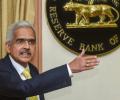
Financial markets are under stress and require steps by the central bank for market stability and revival of economic growth, he said while announcing the decisions taken by the Monetary Policy Committee in Mumbai.

If RBI slashes its borrowing rate, banks lend at a lower rate. Also, deposit rates go down.

Financial services firm AnandRathi analysed the key points of the policy soon after it was announced.

RBI is also considering a proposal to re-introduce inflation-indexed bonds.
 © 2026 Rediff.com - Investor Information - Advertise with us - Disclaimer - Privacy Policy - Sitemap - Feedback - About us - Terms of use - Grievances