
Market participants attribute the stability to the Reserve Bank of India's timely intervention in the foreign exchange market, both in terms of selling and buying dollars.
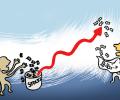
In a dazzling resurgence, foreign investors have graced the Indian equity markets with an influx of nearly Rs 1.5 lakh crore in 2023, fuelled by optimism over the country's resilient economic fundamentals amid shadows of a gloomy global scenario. Experts believe that the positive trend may continue in 2024. This follows Indian equities witnessing the worst-ever net outflow of Rs 1.21 lakh crore by FPIs in 2022 on aggressive rate hikes by the central banks globally after net inflows for three consecutive years.

Fundraising through the issuance of shares to qualified institutional investors has seen hectic activity in the first half of the current fiscal year (FY24), with 20 companies mobilising over Rs 18,400 crore, more than four-fold from the year-ago period, on positive investors' sentiments. Moreover, the robust trend of Qualified Institutional Placements (QIPs) in the first half of the fiscal year 2023-24 is expected to persist throughout the second half of the year too, Sanjay Moorjani, Research Analyst at SAMCO Securities, told PTI. Prashant Rao, director and head of equity capital markets, Anand Rathi Investment Banking, said that market and investor sentiments play an important role for these issuances.

'MNCs now recognise India's capacity for innovation and its pivotal role in substantive contributions to global product development.'

Economic growth, which we are taking for granted, slows for a completely different set of local or global factors and the Modi premium vanishes, observes Debashis Basu.

Since the start of this financial year (FY24), the stock of Aurobindo Pharma has been one of the top pharma gainers, enhancing investor wealth by over 68 per cent, with a third of those gains coming in the last three months. The stock is riding on multiple triggers given its investments in the production-linked incentive or PLI scheme, biosimilars, injectables and vaccines, which should drive revenues and profits over the medium term. Better than expected performance after the June quarter results led to a revision of earnings estimates for FY24 and FY25.

'A key reason for the strong interest in IPOs has been an increased focus on profitability and reasonable pricing of deals.'

The fees charged by investment banks to manage initial public offerings (IPOs) have increased to an average 3.23 per cent of the issue size this calendar year, the highest since 2020. The average fee is up 8 per cent compared to last year, when it stood at 2.99 per cent. The investment banking fees have increased as the average IPO size has shrunk this year.

Fundraising via initial public offers (IPOs) dropped 52.2 per cent to $147.2 billion in the first eight months of calendar year 2023 (CY23), suggests a recent report by GlobalData, a London-based analytics and consulting company. At the country level, the report suggests, India topped the charts with 152 transactions worth $3.8 billion during this period, primarily due to a higher number of SME IPOs, followed by the US with 99 deals totaling $16 billion, while China ranked third with 88 transactions worth $32.3 billion. "An analysis of GlobalData's Deals Database reveals that there were 750 IPO listings registered with an aggregate deal value of $147.2 billion in the first eight months of 2023 on the stock exchanges worldwide.

Deteriorating ties between India and Canada could have a bearing on flows into the domestic capital markets. At present, Canada is the seventh largest country for foreign portfolio investor (FPI) flows into India. According to the National Securities Depository Ltd (NSDL), the assets under custody (AUC) of FPIs domiciled in Canada stood at nearly Rs 1.8 trillion ($21 billion) at the end of August. Almost 85 per cent of these investments are in listed equity, while the remaining in debt and hybrid instruments.

Domestic mutual funds (MFs) have underpinned demand for most public floats this year, dominated by small- and mid-sized initial public offerings (IPOs). Of the 24 IPOs that have hit the market so far this financial year (2023-24, or FY24), MFs have played the role of 'anchor investors' in 20. They have subscribed to over 40 per cent, or Rs 2,850 crore, worth of shares of the Rs 6,900 crore on offer in the anchor category, according to data provided by PRIME Database, a firm that tracks primary market data.

The RBI interest rate decision, industrial production data for June and the ongoing quarterly earnings from corporates would largely drive the stock markets this week, analysts said. Other major factors such as global market trends, the movement of oil prices and the trading activity of foreign investors would also influence trading, they added. "The market will have an eye on the RBI Monetary Policy Committee (MPC) meeting, which will be announced on August 10, 2023. We are heading towards the last batch of Q2 earnings of key companies such as Adani Ports, Coal India, Hero MotoCorp, Hindalco and ONGC, among others, which will lead to stock-specific movement," said Pravesh Gour, senior technical analyst, Swastika Investmart Ltd.

Within three trading sessions in May, foreign portfolio investors (FPIs) have pumped in Rs 9,461 crore into Indian equities. This follows net inflows worth Rs 7,936 crore in March, and Rs 11,631 crore in April. The trend, analysts said, could continue going ahead as the US Federal Reserve may soon halt its interest rate hike cycle, which will strengthen foreign fund inflows into emerging markets, including India.

The 2023-24 (FY24) July-September quarter (second quarter, or Q2) proved to be a mixed period for asset management companies (AMCs). While the two largest listed AMCs, HDFC and Nippon, reported robust growth in both revenue and profits, the other two, Aditya Birla Sun Life and UTI, experienced profit declines. HDFC AMC reported an 18 per cent year-on-year increase in Q2 revenue to Rs 765 crore, while Nippon's revenue rose 15 per cent to Rs 475 crore.

A plea has been filed in the Supreme Court for initiation of contempt proceedings against the Securities and Exchange Board of India (SEBI), alleging it has violated the timeline for completing the investigation and submitting its report on the allegations of stock price manipulation by the Adani group. An application has been filed by PIL petitioner Vishal Tiwari saying that despite the deadline given to the SEBI it has failed to comply with the direction of the court and has not submitted the final conclusion/report as was directed by the court. It said by the order dated May 17, 2023, the apex court directed SEBI to submit its report till August 14, 2023.

The stock exchange on which they are traded boasts higher profits than most of the companies whose shares are hitting new highs. Only 37 of approximately 2,000 listed companies with comparable data for 2022-23 (FY23) reported higher profits, while the rest had lower profits. Despite rising corporate profitability, the universe of companies that outperform the National Stock Exchange (NSE) in terms of profitability has been shrinking of late, according to an analysis of companies with comparable data over the past seven years.

The rupee depreciated by 9 paise and settled at its all-time low level of 83.13 against the US dollar on Wednesday, weighed down by a surge in crude oil prices and strong American currency. Forex traders said the Indian rupee depreciated as the US dollar rose to the highest levels in six months. Moreover, elevated crude oil prices also weighed on rupee.

Consensus remained elusive on a common BRICS currency as business leaders from the five-bloc nations debated the pivotal issue at a business forum on the periphery of a summit of the five-member bloc being hosted here by South Africa. In their two addresses at the Summit so far, the leaders of Brazil, Russia, India, China and South Africa have made no or scant references to the issue either. "The BRICS Business Forum discussed the international payments system in detail. "Participants also debated the question of whether a BRICS currency is possible or desirable, with strong views expressed both for and against and little consensus reached," Sim Tshabalala, chief executive of Standard Bank Group, told several hundred captains of industry from the partner countries and over 40 other nations across the globe at the Summit.

Indian IT services sector's revenue growth will slow down to 3 per cent in the current fiscal from 9.2 per cent in the previous financial year, a domestic ratings company said on Tuesday. Icra Ratings said the profitability will also take a beating in this financial year and the operating profit margin will narrow by up to 1 percentage point to 20-21 per cent. The topline growth will come down to 3-5 per cent in FY24 from the 9.2 per cent posted in FY23, the agency said, attributing the slowdown to softening demand.
Investor confidence in unlisted shares was shaken after recent developments that saw online drugstore PharmEasy issuing new shares in a rights issue at a 90 per cent discount to its previous valuations and Reliance Retail's move to buy back and cancel shares held by public investors. Both stocks were, at one time, very popular in the unlisted market, with canny investors cornering them with the objective of benefiting from their listing. "Since investors have suffered losses on both counts, they will be careful when it comes to dealing in shares of unlisted companies," observes a broker dealing in unlisted shares, adding that there will be some rationality to the pricing.

"We will raise Rs 300 crore via bonds of two-, three- and five-year tenures. This will be our maiden bond issuance and is part of our effort to widen funding sources," says Vimal Bhandari, executive vice-chairman and chief executive officer (CEO), Arka Fincap. The firm, a subsidiary of Kirloskar Oil, is only five years old and small (assets of around Rs 5,000 crore with an "AA" rating), but the response to this float will be closely watched: It would be the first by a non-banking finance company (NBFC) after Mint Road upped the risk weights on bank exposures to them by 25 percentage points. The move by the Reserve Bank of India (RBI) has caught NBFCs off guard even though the issue had been flagged by Governor Shaktikanta Das with their corner-room occupants (and that of banks) in July and August 2023 - on consumer credit and the dependency on bank borrowings.

Finance ministry lines up major plans to be implemented within three months.
Sebi on Tuesday restrained two Brightcom Group officials, M Suresh Kumar Reddy and Narayan Raju, from holding any managerial position in the company or its subsidiaries until further orders. Reddy is the promoter-cum-chairman and MD of Brightcom Group Ltd (BGL) while Raju is the chief financial officer. Besides, the regulator also banned Reddy from the securities market until further orders.

M&M was the biggest loser in the Sensex chart, falling 6.39 per cent, followed by Tech Mahindra, Nestle India, Bajaj Finance, Axis Bank, ITC, JSW Steel, HDFC Bank and RIL. On the other hand, Sun Pharma, Tata Motors, Bharti Airtel, L&T and Infosys were among the winners, rising up to 2.10 per cent.

In the June quarter of FY24, 51 per cent of consumers who took small-ticket personal loans already had more than four credit products at the time of accessing yet another new loan, compared with just 17 per cent in the June quarter of FY20, points out Tamal Bandyopadhyay.

India's inclusion in JP Morgan's bond index can channel billions of dollars into India. How will the government securities market handle it?

Lord Jo Johnson, younger brother of former British prime minister Boris Johnson, has resigned his non-executive directorship of a UK-based investment firm linked with the now-withdrawn Adani Enterprises Follow-on Public Offer (FPO). 'The Financial Times' newspaper referenced UK Companies House records to reveal that 51-year-old Lord Johnson had been appointed as a director of London-based Elara Capital Plc in June last year and resigned on Wednesday, the day when the Adani Group announced withdrawal of the FPO. Elara, which described itself as a capital markets business raising funds for Indian corporates, was among the bookrunners on the FPO.
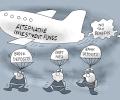
Portfolio management services (PMS), catering to higher networth individuals (HNIs), are facing tough competition from emerging alternative investment funds (AIFs), evident from their dwindling client base. In May, the number of clients for the industry stood at 125,390, down 20,528 in two months, shows data from the Securities and Exchange Board of India (Sebi). "PMS managers also have a high active ratio, which means their portfolios are quite differently positioned and more actively managed, compared to the benchmark, which is also a highlight for long-term investors.
This is the concluding part of a three-part series, where Aditi Roy Ghatak and Paranjoy Guha Thakurta discus how share prices in India are manipulated and the future of the country's stock exchanges.
The decline in LIC's share price makes it the biggest wealth destroyer among IPOs which hit the market after COVID-19 took hold globally in 2020.

Companies, which missed out on listing earlier, are giving it another shot but with significantly-reduced issue sizes. In the recent past, companies such as TVS Supply Chain Solutions, Suraj Estate Developers, and ESAF Small Finance Bank have re-filed their draft red herring prospectuses (DRHPs) with the Securities and Exchange Board of India (Sebi). This came after they slashed their issue sizes by 20-60 per cent.

'As our per capita income increases and various demographic segments emerge, the need for various kinds of protection and risk covers will become even more explicit.'

The BSE is planning to reintroduce its Sensex-30 derivatives and is in the process of collecting feedback from members, the MD and CEO of the premier bourse, Sundararaman Ramamurthy, said on Friday. The Sensex-30 derivatives products (options and futures), which were launched in 2000, had failed to generate much interest among investors compared to the rival exchange's Nifty-50 derivatives. "We are trying to reintroduce Sensex-30 derivatives, and have started the consultation process by taking the feedback of market participants," Ramamurthy said at an Assocham-organised event in Kolkata.

M&M was the top loser in the Sensex pack, skidding 3.31 per cent, followed by Reliance Industries, Bajaj Finserv, ICICI Bank, Maruti, Tata Motors and Tech Mahindra. On the other hand, Tata Steel, L&T, Axis Bank, Bharti Airtel and HDFC Bank were among the gainers.

ITC topped the Sensex gainers' chart with a jump of 3.31 per cent, followed by Reliance Industries, Bajaj Finance, ICICI Bank, Infosys, Axis Bank and Wipro. On the other hand, NTPC, UltraTech Cement, L&T, Sun Pharma, Asian Paints and Maruti were among the major laggards.

Capital markets regulator Sebi on Wednesday asked all investors to link their PAN with Aadhaar number by March-end for continual and smooth transactions in the securities market. The non-compliance with this would be considered non-KYC compliant, and there could be restrictions on securities and other transactions until the Permanent Account Number (PAN) and Aadhaar are linked, Sebi said in a statement.

Brokers have requested for a three-month extension from the Securities and Exchange Board of India (Sebi) for the validation of Know Your Client (KYC) records. In a letter to Sebi, industry body -- Association of National Exchanges Members of India (Anmi) -- has cited various issues and concerns raised by its members that have hampered the smooth completion of the validation process within the stipulated timeline. The Sebi circular had given KYC Registration Agencies (KRAs) a timeline of 180 days, ending on April 30, 2023, to validate client KYCs.

From the Sensex pack, Hindustan Unilever, Asian Paints, Bajaj Finance, Nestle, Bajaj Finserv, Reliance Industries, Larsen & Toubro, Maruti, Infosys and Bharti Airtel were the major laggards.

SBI was the biggest loser in the Sensex pack, tumbling 2.83 per cent, followed by Infosys, TCS, Bajaj Finance, Tech Mahindra, Wipro and Axis Bank. In contrast, Titan, L&T, NTPC, Power Grid, Sun Pharma, ITC and HDFC twins were among the prominent winners, rising as much as 1.97 per cent.

A number of companies are hitting the stock market with public offers despite the volatile investor sentiment, with three companies slated to launch their IPOs in the next two days, taking the total number to 12 this month.
 © 2026 Rediff.com - Investor Information - Advertise with us - Disclaimer - Privacy Policy - Sitemap - Feedback - About us - Terms of use - Grievances