
The 30-share Sensex ended up 165 points at 29,044 and the 50-share Nifty gained 54 points to close at 8,834.

The Index of Industrial Production grew 5.6 per cent in August, compared with a revised 15.2 per cent in July.

Belying fears of a slowdown, industrial growth accelerated to 13.8 per cent in July from 7.2 per cent in the corresponding month last year, on the back of a 63 per cent jump in capital goods production.

The broader NSE Nifty gained 22 points to 10,480.60

During the month, inflation in vegetables shot up to 35.99 per cent, as against 26.10 per cent in October. Likewise, the prices of cereals and eggs grew at a faster pace of 3.71 per cent.

'Growth would have to be 7% in the October-March period, if the year as a whole is to clock 6%.' 'Who would bet on that when, in the world of real numbers, both exports and imports have continued to fall, car sales have continued to slump, and the industrial production index shows yet again a drop in output?', asks T N Ninan.

The November IIP has been revised upwards to 3.9% from 3.8%.

Recovery possible only if investment cycle picks up.

Analysts said even though the Indian economy is expected to slow down to 7.2 per cent in fiscal 2020, it is still the best bet for investment for foreign investors.

11 top defensive stocks in the information technology (IT), pharmaceutical and fast moving consumer goods (FMCG) sectors made a new all-time high, while cyclical stocks saw a sell-off.
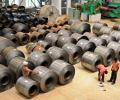
The IIP growth was 0.6 per cent as against 1.7 per cent in April last year.

Top companies added employees at 3% CAGR from 2003-04 to 2013-14, while revenues grew at 18%.

Gripped by the pre-election frenzy, Indian markets seem to be factoring in the victory by the Narendra Modi-led BJP.

The index rising for the fourth straight session surged 564 points.

The elections held in April-May 2019 will be an important determinant of future growth and investment.

Sentiments remained upbeat for yet another session following healthy gains across Asian and a higher opening at European markets

Appreciating rupee against the dollar and fresh buying by domestic institutional investors added to the momentum
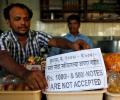
India Inc said policymakers should take doable steps to revive fixed investments and production of capital goods

From the 30-share pack, 18 stocks ended with gains led by SBI, which surged 27.58 per cent, and ICICI Bank 14.69 per cent.

The internals of the food inflation are worrying, given a broad-based uptick across categories that tend to be sticky, such as proteins, and a narrower-than-expected reduction in inflation for vegetables.
The 30-share BSE Sensex closed 42 points lower at 22,509 levels and NSE Nifty slipped over 16 points at 6,736 levels.
A recovery from lower levels in the last hour of trade led by buying in banking, metals and realty stocks, capped losses.
Infosys, TCS and HCL Technologies ended 1-2% higher due to weakness in rupee.
With a change in investor preference to cyclical stocks like those of capital goods, infrastructure and automobile firms, the defensives, especially the IT pack, have taken a back seat.

The expansion in total new orders was supported by greater sales to international markets
Analysts expect momentum to continue but say a progressive govt will be key

Historically, the IIP performance has shown little or no correlation to corporate performances.

It appears that the focus of commerce minister Anand Sharma, when he unveils the new foreign trade policy, will be to eliminate unnecessary paperwork and thereby help reduce transaction costs for exporters, while retaining the basic framework of the present FTP.

While the surcharge on super-rich would help garner additional income of around Rs 12,000 crore this fiscal on the direct tax side.
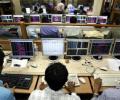
The Sensex resumed lower at 28,566.50 and dropped further to 28,183.32 before finishing at 28,227.39, showing a loss of 490.52 points or 1.71 per cent.

Investors lost around Rs 1.57 lakh crore in market valuation on Friday.

According to Japanese financial services major Nomura, despite slowing external demand, the domestic growth cycle is improving.

For the entire 2015-16 fiscal, the factory output grew at 2.4 per cent, down from 2.8 per cent in the previous fiscal.
The recent rally has seen investors' preference shift to high-beta and policy reform-driven sectors like capital goods, banking, power, infrastructure and oil and gas.
The 30-share Sensex ended at 21,101.03, up 21 points higher from its previous close and the borader 50-unit Nifty gained 10 points at 6,284.50.
BSE Small-Cap and Mid-Cap indices were up more than 1% each, with both these indices outperforming the Sensex today.

Sustained foreign funds outflows and the rupee depreciating 68 paise to hit a three-month low of 64.88 (intra-day) against the dollar affected investor sentiment

For the 50-share NSE Nifty, the close came in at 10,739.35, higher by 47.05 points, or 0.44 per cent
Reliance Industries, HDFC Bank, Tata Steel, Sun Pharma and ITC were the top Sensex dragging the benchmark 93 points lower.
Markets ended at fresh all-time closing highs, led by aggresive buying in capital goods and bank shares.
 © 2026 Rediff.com - Investor Information - Advertise with us - Disclaimer - Privacy Policy - Sitemap - Feedback - About us - Terms of use - Grievances