
'Short term volatility is likely due to various factors, global and domestic; investors may use this as an opportunity to increase the allocation to equities.'

India's industrial production rose 3.1 per cent in September, according to official data released on Friday. As per the Index of Industrial Production (IIP) data by the National Statistical Office (NSO), the manufacturing sector's output surged 2.7 per cent in September 2021.

M&M was the top gainer in the Sensex pack, rallying nearly 6 per cent, followed by Bajaj Auto, Titan, Bajaj Finance, HDFC Bank and PowerGrid.

Tata Steel was the top gainer in the Sensex pack, rallying nearly 4 per cent, followed by Bajaj Finance, M&M, Bajaj Finserv and Reliance Industries. NSE Nifty advanced 33.95 points to a fresh high of 16,563.05.

India's industrial production growth remained subdued for the second straight month and expanded by 3.2 per cent in October, mainly due to the waning low base effect while mining, power and manufacturing sectors performed well. The manufacturing sector, which constitutes 77.63 per cent of the Index of Industrial Production (IIP), grew two per cent in October, according to data released by the National Statistical Office (NSO) on Friday. The mining sector output rose 11.4 per cent in October, while power generation increased 3.1 per cent.

'We never go overboard on any stock, no matter how good it may seem.'

India remains an attractive destination for foreign direct investments (FDI) on account of healthy prospects of economic growth and its skilled workforce, according to a survey by Deloitte. A large proportion of international business leaders remain confident in India's short- and long-term prospects and are readying plans to make additional and first-time investments in the country, it said on Tuesday. "The survey, which questioned 1,200 business leaders of multinational corporations in the US, UK, Japan and Singapore, found that India remains an attractive destination for investments, scoring highly for its skilled workforce and prospects for economic growth," the survey - India's FDI Opportunity - said.
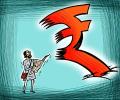
Equity investors became poorer by over Rs 8 lakh crore in five days of market plunge. The BSE benchmark has lost 2,062.99 points or 4 per cent in five trading sessions. On Thursday, the 30-share BSE benchmark tanked 585.10 points or 1.17 per cent to close at 49,216.52. Following the bearish trend, the market capitalisation of BSE-listed companies declined by Rs 804,216.71 crore to Rs 2,01,22,436.75 crore in five days.

Investor wealth slumped by Rs 3.7 lakh crore on Monday, as the equity market recorded its biggest single-day fall in two months.

Despite headwinds, it remains "structurally bullish" on India and expects the Sensex to scale up to the 70,000-mark by December 2022; 80,000 level in a bull-case scenario and hover around the 50,000-mark as a bear-case, the brokerage house said in a report.

Commerce and Industry Minister Piyush Goyal on Monday said the existing foreign trade policy (FTP) will be extended for six months till March 31 next year. The government had earlier extended the FTP 2015-20 until September 30 this year due to the Covid-19 crisis. The FTP provides guidelines for enhancing exports to push economic growth and create jobs.

Despite unprecedented levels of uncertainty in Samvat 2077, investors have little to complain about on the returns front. The BSE Sensex delivered returns of 38 per cent in this period, while the Nifty registered a return of over 40 per cent. As is the case in bull markets, companies in the small- and mid-capitalisation basket outperformed the benchmarks, with returns almost twice those of frontliners.

'Investors should keep them on their radar and invest over a longer time frame, and expect some of these companies to bite the dust.'

Russia's war on Ukraine has sent steel prices soaring to its highest levels in the domestic market since November 2021. But there is little cheer in the industry. That's because input costs are spiralling out of control, leaving the big boys nearly as high and dry as the small, medium and secondary steel producers. Russia and Ukraine are major providers of steel and raw materials to the world.

After the hit of the pandemic, India Inc is now worried about the adverse impact of inflation and higher commodity prices on their revenues and margins. The inflation scare is the strongest among manufacturers of consumer goods such as automobiles, consumer durables, and fast-moving capital goods (FMCG). Companies across sectors fear they will not be able to pass on the hike in input costs to their consumers due to weak demand, which, in turn, would lead to a hit on margins and profitability in the forthcoming quarters.

From the pandemic shocks to state polls to global trends, a raft of sentiment drivers are expected to steer the Indian stock market in 2022 after a historic year of massive investor returns and milestones. The Union Budget, which will be closely watched for further reform moves, and quarterly earnings of corporates will be among the developments on investors' radar amid global central banks moving towards tighter interest regime in the wake of inflationary pressures. The year 2021 was rewarding in a big way for equity investors.

'Market feels this Budget will promote all-round growth and that is what is giving it confidence.'

Finance Minister Nirmala Sitharaman presents her fourth Budget in Lok Sabha on Tuesday.

'The markets seem apprehensive and that explains why the markets have been feeling slightly uncomfortable ahead of the Budget.' 'After the event, when all the concerns are resolved and clarity emerges, markets will decide what to do next.'

UltraTech Cement was the top loser in the Sensex pack, shedding around 3 per cent, followed by M&M, HDFC Bank, IndusInd Bank, Axis Bank and Reliance Industries. NSE Nifty fell 50.80 points or 0.38 per cent to 13,478.30.
While she primed up spending on infrastructure to create jobs and boost economic activity, Sitharaman did not tinker with income tax slabs or tax rates. Her Budget for the fiscal year beginning April 2022 proposed a massive 35 per cent jump in capital expenditure to Rs 7.5 lakh crore, coupled with rationalisation of customs duty, an extension of time for setting up new manufacturing companies and plans for starting a digital currency and tax crypto assets.

The Business Confidence Index (BCI) prepared by the Delhi-based think tank NCAER declined by 27.5 per cent in the first quarter of the current financial year over the previous quarter mainly on account of the second wave of the COVID-19 pandemic. The BCI on a quarter-on-quarter basis decreased by 35.3 per cent for the services sector, 32.9 per cent for the consumer durables sector, 32.3 per cent for the capital goods sector, 17 per cent for the intermediate goods sector and 14.3 per cent for the consumer non-durables sector, NCAER said in a release.

The government has held back the release of complete data of the Index of Industrial Production (IIP) for April, as was done for the same month last year due to the COVID-19 lockdown. Last year in June, the National Statistical Office (NSO) had held back the release of complete IIP data due to the effect of the nationwide lockdown on factory output. This year too industrial production was hit due to lockdown restrictions imposed by states to curb the second wave of the pandemic.
Industrial production surged by 13.6 per cent in June mainly due to a low-base effect and good performance by manufacturing, mining and power sectors but the output remained below the pre-pandemic level. The manufacturing sector, which constitutes 77.63 per cent of the Index of Industrial Production (IIP), grew by 13 per cent in June this year, according to the data released by the National Statistical Office (NSO) on Thursday. The mining sector output rose by 23.1 per cent in June while power generation increased by 8.3 per cent.

'Increased allocations for MNREGA could have provided the much needed push to rural demand and consumption at a time when recovery continues to remain uneven.'

ICICI Bank was the top gainer in the Sensex pack, rising over 3 per cent, followed by ITC, SBI, HCL Tech, Axis Bank, Bajaj Finserv and Tech Mahindra. NSE Nifty advanced 32 points to 15,856.05.

Tech Mahindra was the top gainer in the Sensex pack, jumping over 5 per cent, followed by Bajaj Finance, Bharti Airtel, Bajaj Finserv, L&T, Tata Steel and Infosys. NSE Nifty surged 191.95 points to 15,824.05.

Budget for 2022-2023 has returned to its agenda for protectionism in the name of creating a self-reliant India, points out A K Bhattacharya.
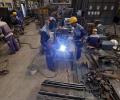
Industrial production growth entered positive territory after a gap of two months with a record 22.4 per cent rise in March this year, mainly due to the low-base effect and good show by manufacturing, mining and power sectors. The manufacturing sector -- which constitutes 77.63 per cent of the index of industrial production (IIP) -- grew by 25.8 per cent in March 2021, as per the data released by the National Statistical Office (NSO) on Wednesday. The mining sector output too grew 6.1 per cent in March, while power generation increased by 22.5 per cent.

10 stocks which are most popular with brokerages right now and are expected to deliver maximum upside over the next 12 months.

Growth of capital goods at 9.6 per cent is inspiring as the investment cycle is expected to rebound in the coming months.
Stock market minnows put up a stellar show in 2021 giving returns of up to 60 per cent amid Dalal Street dream run and are likely to continue sailing northwards in the New Year too. Trumping pandemic-induced uncertainties, the Indian equity market posted stunning gains this year achieving several feats and smaller stocks benefited the most from the strong momentum. From reaching the momentous 50,000-mark in January to scaling 61,000-level in October, the BSE Sensex had an epic journey this year.
72 per cent of the revenue of Indian firms (India Inc) is derived from the domestic / home market - the sixth highest in percentage terms in the emerging market (EM) and the Asian region, said a recent report by Morgan Stanley. The balance, according to the report titled 'Global Exposure Guide 2021' co-authored by analysts led by Jonathan F Garner, their chief Asia and emerging market strategist, is split between the developed markets (DMs) and other EMs. The report is based on an analysis of 3,300 companies globally that have revenue exposure in 17 different regions.

Sectorally, BSE healthcare, capital goods, power, oil and gas, metal, auto, energy and banking indices fell up to 3.53 per cent.

TCS was the top gainer in the Sensex pack, rising over 3 per cent, followed by L&T, Bharti AIrtel, HCL Tech, Tata Steel, Bajaj Auto and Reliance Industries. NSE Nifty rallied 164.70 points to its fresh closing peak of 16,529.10.

Rogue lending under political influence was rife in the Congress-led regime and is not happening in the Modi regime, certainly not on that scale. But if PSBs cannot lend as indiscriminately as they did last time in the name of 'credit expansion', how well will these banks do, asks Debashis Basu.

The government has merged the Department of Public Enterprises (DPE) with the finance ministry to give it a better control over state-owned firms and facilitate its ambitious privatisation programme. Finance ministry will now have six departments while DPE's hereto parent ministry, the ministry of heavy industries and public enterprises will now be called the ministry of heavy industries. Previously, the disinvestment ministry - created under the Atal Bihari Vajpayee government - was merged with the finance ministry and is now a department under it. Also, Foreign Investment Promotion Board (FIPB) was abolished and administration of foreign investments was given to the finance ministry (FinMin).

However, experts caution that investors should not expect the big returns they got from the sector between March and September 2020.
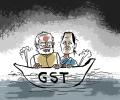
CAG recommended fixing a definite time frame for rolling out simplified GST return forms.

ONGC was the top gainer in the Sensex pack, rallying around 6 per cent, followed by IndusInd Bank, L&T, UltraTech Cement, Titan, SBI and NTPC. NSE Nifty settled 32.10 points up at 14,707.80.
 © 2026 Rediff.com - Investor Information - Advertise with us - Disclaimer - Privacy Policy - Sitemap - Feedback - About us - Terms of use - Grievances