
For fiscal year FY23, the 2022 Union Budget had targeted a capex outlay of Rs 7.5 trillion, which is 35.4 per cent higher than the FY22 Budget Estimate of Rs 5.54 trillion.

Foreign brokerages remain cautious on the road ahead for the Indian equity markets. Though analysts at Nomura have revised their March 2026 Nifty target to 26,140 levels from the earlier 24,970, but the upside from the current levels is a modest 6 per cent. BofA Securities, on the other hand, has not made any change to its year-end Nifty target.

'If private capex has to kick in, there should at least be 2-3 years of visibility.'

India Inc could be embarking upon a new phase of capital expenditure (capex) cycle, observed analysts, and suggest its revival would lead to a rerating of industrial stocks. Assisted by a property upcycle, analysts at Jefferies said several government initiatives were likely to drive capex. Indicators, they said, include a private project announcement at Rs 25 trillion for 2022-23 (up 150 per cent from pre-pandemic levels) and credit growth at about 16 per cent, which is closer to pre-pandemic highs.
The Indian economy continues to sustain the momentum achieved in the first half of 2023-24 and expectations of a fresh round of capex by the corporate sector is likely to fuel the next leg of growth, the Reserve Bank Bulletin said on Tuesday. "The likelihood of the global economy exhibiting stronger than expected growth in 2024 has brightened in recent months, with risks broadly balanced," said an article on 'State of the Economy' published in the bulletin.

The last four years, the best for corporate profits in a long time, have not been as impressive for corporate capital expenditure. The combined net profits of India's top listed companies excluding banks, financial services, and insurance (BFSI) increased at a compound annual growth rate (CAGR) of 32.4 per cent since FY20, a sharp jump from the 7.4 per cent in corporate earnings between FY14 and FY19.

Automobile retail sales in India rose around 5 per cent year-on-year in June with all vehicle segments, including passenger vehicles and two-wheelers, witnessing growth, Federation of Automotive Dealers Associations (FADA) said on Monday.

The weakening of inflation, prospects of economic growth, geopolitical uncertainty and comfortable system liquidity may result in the Reserve Bank of India's (RBI) Monetary Policy Committee (MPC) to cut the repo rate by another 25 basis points, opine top economists. They also said the external economic pressures like trade policies and others would require continued RBI's accommodative stance and policy support for the Indian industry to sustain the growth.
If the fiscal deficit target of 4.9% of GDP has to be met for 2024-2025, which the government must in view of the uncertainties and challenges emerging both domestically and globally, the finance ministry may see in the composition of the current year's capex a sliver of hope, notes A K Bhattacharya.

Telecom operator Bharti Airtel posted about a five-fold jump in consolidated net profit to Rs 11,022 crore in the March 2025 quarter, mainly due to the tariff hike impact and one-time gain on tax benefits. Bharti Airtel had posted net profit (attributable to owners of the parent company) of Rs 2,071.6 crore a year ago.
Investment growth moderated slightly in the economy during the first quarter (Q1) of the current financial year (2023-24, or FY24), notwithstanding the front-loading of capital expenditure (capex) by the Centre. This was also the case despite a pick-up in demand during the period after two dismal consecutive quarters. Although growth in gross fixed capital formation (GFCF), representing investment, fell to a five-quarter low of 7.96 per cent, the comparison with the first two quarters of the previous year is a bit askew due to the low year-on-year (Y-o-Y) base of those periods.

'Each state is unique, but when it comes to finance, the fundamentals cannot be different.'

The news that Amazon India has launched diagnostic services in select metro cities in partnership with the unlisted Orange Health Labs has led to a look at the competitive intensity in healthcare services. Listed companies in the space such as Dr Lal Path Labs, Metropolis Health, Thyrocare, Vijaya, and Krsnaa have all seen double-digit stock price corrections over the last 6-9 months.

In the October-December quarter (Q3) of FY24, Hindalco reported flat consolidated revenue year-on-year (Y-o-Y) at Rs 52,800 crore. Copper revenue rose due to higher shipments and better Average Selling Price (ASP). Revenue from the aluminium vertical and Novelis declined 3 per cent and 6 per cent Y-o-Y, respectively.

Data centres are increasingly becoming a key part of the real estate landscape, as reality firms - with rich expertise in land acquisition, construction and dealing with government approvals - are seeing them as opportunities to build long-term assets with continuous revenue flow.

India's largest cable and wire manufacturer Polycab India ended financial year 2024-25 (FY25) on a high, delivering another strong quarter of double-digit growth and market share gains. This coupled with margin expansion, operating breakeven for its fast-moving electrical goods (FMEG) business, and steady exports outlook for FY26 is expected to support the stock, which is up 18 per cent over the past month. The stock is currently trading at Rs 5,765 a share.

The turnover of FMCG major Nestle India's has grown 2.5 folds to Rs 20,100 crore in last one decade, post the Maggi crisis in 2015, according to the company's latest annual report. At the time of crisis, Nestle India's turnover was at Rs 8,100 crore.

Despite enduring a weak first quarter of the 2023-24 financial year (Q1FY24), Power Grid Corporation (PGCIL) has laid out an ambitious capex plan going forward. It is looking to invest around Rs 1.8 trillion on an existing asset base of Rs 2.7 trillion to aim at keeping over 50 per cent market share in the transmission market. This includes opportunities from the Rs 2.4 trillion green energy corridor.

The recent price correction in broader markets has hit cement companies hard. So far in the current month, smallcap firms like Visaka Industries, Andhra Cements NCL Industries, Sahyadri Industries, and KCP have lost 19.7 per cent, 14.3 per cent, 13.8 per cent, 13.5 per cent, and 11.5 per cent, respectively. On the contrary, largecap companies, while registering losses for the month, have seen a softer blow.

'The government is actively engaging with EU to ensure that concerns of Indian companies and hard-to-abate sectors are adequately addressed under CBAM'

The Adani Group plans to invest a record $15-20 billion across businesses over the next five years to chart out the next phase of growth, chairman Gautam Adani said on Tuesday as he touted the conglomerate's strong balance sheet and robust business to shrug off relentless scrutiny it faces. Record earnings from the businesses ranging from seaports to airports, renewable energy parks to data centres, cement to gas and electricity has built India's largest infrastructure group that not only exists just to serve the markets but to serve the nation's destiny, he said.

Finance Minister (FM) Nirmala Sitharaman has presented a forward-looking Budget, reinforcing the government's commitment to 'Reform, Perform, and Transform'.
The slowdown in corporate revenue growth over the last one year has begun to reflect in India Inc's capital expenditure, or capex. The country's top listed companies are going slow on fresh investment in capacity expansion, in line with a deceleration in their top line growth. The combined fixed assets of the listed companies, excluding banking, finance services and insurance (BFSI) and the government-owned oil & gas firms, were up 10.1 per cent year-on-year (Y-o-Y) during April-September 2023 (H1FY24) - the slowest in 18 months - as against 21.1 per cent Y-o-Y growth in H2FY23 (October 2022-March 2023) and 11.6 per cent growth in the April-September 2022 period (H1FY23).

'The steel industry expects the government to decide on safeguard measures from dumping post-Budget'

Both new and completed project values as of December 2024 remain below pre-pandemic levels seen in 2019.

'If weak indicators persist, there is a risk that India could slip into a prolonged slowdown similar to the one experienced between 2014 and 2019,' warns Debashis Basu.

'2025 is the year to build a portfolio for the future. Focus this year should be on valuations and visible growth.'

'India has the potential to grow at more than 7%, with the monetary policy providing a supportive hand.'

'The shifts in US involvement in global conflicts and geopolitical alliances could introduce uncertainties.'

Power Grid Corporation of India's (PWGR's) Q3FY25 revenue declined 3 per cent year-on-year (Y-o-Y) to Rs 11,200 crore, with operating profit falling 7 per cent Y-o-Y to Rs 9,500 crore and margin contracting to 85 per cent from 91 per cent Y-o-Y. Other income surged 89 per cent Y-o-Y to Rs 500 crore, but regulatory income dropped 62 per cent Y-o-Y to Rs 42.5 crore.
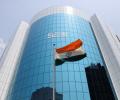
Gensol Engineering, the beleaguered firm that came under market regulator Sebi's lens for fund diversions and governance lapses, said that its independent director Arun Menon has resigned with immediate effect.

'My job is to provide people with a bouquet of options they can choose from.'

The government's indirect tax collection is expected to increase by 8.3 pc in the financial year 2025-26 (FY26), according to a report by ICICI Bank. The report also noted that this growth is higher than the 7.1 per cent increase seen in FY25 and is mainly driven by rise in GST revenue from strong urban consumption. It said "The increase is driven by higher goods and services tax collections which in-turn is explained by boost to urban consumption".

Mukesh Ambani-led Reliance Industries Ltd (RIL) plans to invest Rs 75,000 crore ($9 billion) each into its new energy business and petrochemical expansion, according to a company presentation. In its FY25 result statement, Ambani said the company has laid a strong foundation for its projects in renewable energy and battery operations. "In the coming quarters, we will see the transition of this business from incubation to operationalisation.

'Consider 40% to 50% in equities, 10% in gold as a hedge, and the remaining 30% to 40% split between multi-asset funds and hybrid funds.'

India will be the world's third-largest economy by 2028 as it becomes the world's most sought-after consumer market and gains share in global output, driven by macro stability influenced policy and better infrastructure, Morgan Stanley said. From a $3.5 trillion economy in 2023, the Indian economy is projected to expand to $4.7 trillion in 2026, which will make it the fourth largest in the world behind the US, China and Germany.

'...the auto industry to get back to 7% to 8% annual growth.' 'High growth in the SUV segment alone will not achieve this, as it is a small market.'

The performance of Hindustan Aeronautics Limited (HAL) for 2024-25 (FY25) was driven by improved margins and lower provisions. The order book as of March was of Rs 1.8 trillion, with inflows of Rs 1 trillion during FY25.

'Stay disciplined, and remain invested.' 'Volatile times are the best to invest in structural opportunities at the right price.'
Amid FY23 Union Budget's focus on investments, leading domestic credit rating agency Crisil on Wednesday said that the capital expenditure is "not as high as it sounds". It, however, was quick to add that considering that governments usually tend to cut capex during a crisis, the government has maintained its focus on growth-spurring initiatives amid the pandemic. The research wing of the agency said, if one excludes the Rs 1 lakh crore of loans to states for capex included in the headline figure of Rs 7.50 lakh crore or 2.91 per cent, the actual spend in FY23, will go down to 2.58 per cent of GDP, which is barely at par with the revised estimate of FY22.
 © 2026 Rediff.com - Advertise with us - Disclaimer - Privacy Policy - Sitemap - Feedback - About us - Terms of use - Grievances