
The NEET-UG re-exam was held at centres across the country and overseas on Sunday amid tight security arrangements for the smooth conduct of the examination.
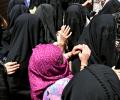
A Gujarat school is under investigation after staging an Independence Day play that depicted burqa-clad girls as terrorists, sparking outrage from the local Muslim community.

Jamiat Ulama-i-Hind, a Muslim body, has raised objections to a recent fashion show held in a local college where participants walked down the ramp wearing burqas.

Some Muslim girls and their relatives held a demonstration at a private college at Chaksu in Jaipur district on Friday when the students were not allowed to attend classes wearing burqas.
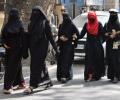
The Muslim girl students said they were ready to remove the burqa inside, but will wear scarves in the classroom, the official said.

Amid tight security with policemen deployed in and around pre-university colleges at many sensitive places, the day saw a section of Muslim students remaining adamant not to remove the burqa, let alone hijab, the Islamic scarves.

Narendra Modi's Jaipur rally on Tuesday courted controversy over a purported direction by the Bharatiya Janata Party -- asking Muslims to come dressed in skull caps and burqas -- as critics questioned the motive behind the "dress code".

the Muslim Rashtriya Manch categorically said that it does not support such 'fanaticism and religious frenzy' and favoured the move to enforce dress code for students in educational institutions in Karnataka.
A bench of Justices Sanjiv Khanna and Sanjay Kumar issued notice to the Chembur Trombay Education Society, which runs the 'N G Acharya and D K Marathe College', and sought its response by November 18.

Amid row over wearing hijab in classrooms in some colleges in Karnataka, the Bharatiya Janata Party state chief Nalin Kumar Kateel said the state government will not allow 'Talibanisation'.

The Supreme Court will hear on Friday a plea challenging a Bombay high court verdict upholding a Mumbai college's decision to ban hijabs, burqas and naqabs inside the campus.
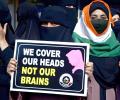
Earlier, it was alleged that a poster of Ganga Jamuna Higher Secondary School in Damoh showed girls, including Hindu students, wearing headscarves that looked like hijab.
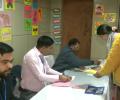
Delhi recorded a voter turnout of over 19 per cent in the first four hours of polling on Wednesday across 70 assembly constituencies, with the highest voter participation witnessed in North East district.

The government has already ordered closure of the degree and diploma colleges till February 16.

Scenes of angry parents of such children arguing with police and school authorities and an instance of a student trying to flaunt a saffron scarf as an apparent retaliation were also reported.

'These are the people who don't want peace in the state, who want to disturb the harmony in the state.'
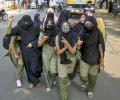
The controversy refuses to die down as some students remained adamant to be allowed to attend classes with 'hijab' and 'burqa' on Thursday as well.

Muthalik said the dress code is introduced so that there is no display of upper and lower caste or religious identities.
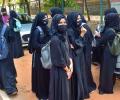
Citing popular protests in Iran, an Islamic country, against the mandatory use of hijabs, he claimed that religion freedom in India cannot mean promotion of "separatist" designs.

'Bommai's predicament is pathetic right now because deep inside he is not like this, but to remain in power he has to talk and speak against his own conscience.'

The Muslim Rashtriya Manch, the Rashtriya Swayamsevak Sangh's Muslim wing, has backed the burqa-clad student who was heckled by youth shouting 'Jai Shri Ram' slogans at a Karnataka college, saying 'purdah' is a part of Indian culture.

"Girls are sitting outside classrooms and demanding their fundamental rights. The hijab is a part of their cultural and religious identity of these girls. It is like the mangalsutra for Hindus, crucifix for the Christians and turbans for the Sikhs," Prathapan said during Zero Hour.
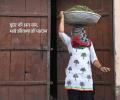
The recent issue of Krishi Samvad, a supplement of the Haryana Samvad magazine, a monthly magazine published by the state government, carries a photograph of a veiled woman.

The six Muslim girl students of the Government Pre University Girls College in the coastal town of Udupi did not turn up for classes on Wednesday, a day after their petition seeking permission to wear hijab inside classrooms was dismissed by the Karnataka high court.
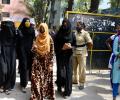
Karnataka has told the high court that its order dated February 5 did not ban the headscarf but only delegated the powers to decide the school uniform to the college development committees.
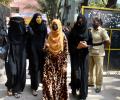
The counsel for the petitioners in the hijab ban row on Monday told the Supreme Court the Karnataka high court did an "objectionable" thing when it tried to "interpret" the Holy Quran and held the headscarf worn by Muslim women was not an essential religious practice.
"This is our stand that hijab is not an essential religious practice. There was a statement by Dr B R Ambedkar in the Constituent Assembly where he said 'let us keep the religious instructions outside educational institutions'," Karnataka Advocate General Prabhuling Navadgi told the full bench of the high court, which is hearing the hijab case.
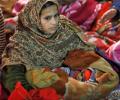
In this winter of discontent, in every procession, in every demonstration, in every protest -- from Jawaharlal Nehru University to Jamia to Shaheen Bagh to the streets of Mumbai -- the front rows have been occupied by women. It's been weeks since women have been sitting in protest across the country against the newly-introduced Citizenship Amendment Act and the proposed National Register of Citizens. The protests are a nerve centre of unwavering voices against what has been perceived as a discriminatory law. The women -- some housewives, some students with hijabs covering their hair, and others in full-length burqa robes -- are rallying against the 'Man' in what could also be perceived as a revolution for the 'weaker sex' in India.

BJP leader Ram Madhav's rant about Vice President Hamid Ansari's absence at the International Yoga Day celebrations goes deeper, says Syed Firdaus Ashraf, deep into their brain.
