
Bharti Airtel Chairman Sunil Mittal has called for proactive regulation of Artificial Intelligence, stating that waiting for an "accident" before implementing safeguards would be "foolish." Speaking at the Bloomberg New Economy Forum 2026, Mittal highlighted the struggle of governments to keep pace with AI's rapid growth and emphasised the need for a global regulatory framework, similar to the aviation sector, to ensure national security and responsible development.

Bharti Airtel's homegrown cloud platform, Airtel Cloud, has acquired approximately 40 customers within a year of its launch, with a significant portion coming from the manufacturing sector. The platform, designed for Indian companies, offers sovereign, telco-grade cloud infrastructure, connectivity, and GenAI-based provisioning, addressing the growing demand for secure, India-hosted data solutions, particularly for sensitive workloads and regulated sectors.

Bharti Airtel, India's second-largest telecom operator, reported a 37.3 per cent rise in consolidated net profit to 8,167 crore for Q1 FY27, driven by the addition of high-paying premium customers, despite missing Bloomberg consensus estimates.

Bharti Airtel's first-quarter (April-June/Q1) performance for 2026-27 (FY27) surpassed estimates across most metrics, fuelled by robust growth in both its India and Africa operations, with significant increases in average revenue per user (Arpu) and subscriber additions.
Bharti Airtel added 7.64 trillion in value over the past five years, making it the biggest wealth creator in India's private sector, while the IT sector, including TCS, Infosys, and Wipro, collectively lost 8.5 trillion in value, according to the latest Burgundy Private Hurun India 500 report.

Indian benchmark stock indices, Sensex and Nifty, rebounded significantly after a four-day losing streak, driven by value buying and strong performance in metal, telecommunication, and healthcare sectors.

African digital financial services platform, Airtel Money, has successfully debuted on the London Stock Exchange, marking the exchange's largest initial public offering (IPO) in several years with an implied market capitalisation of about USD 7 billion.

Despite recent share price dips, Bharti Airtel is strategically positioned for growth, driven by investments in data centres via Nxtra, a potential tariff hike, and strong performance in Africa, alongside efforts to deleverage and expand its subscriber base in underpenetrated rural markets.

Indian equity benchmarks Sensex and Nifty rallied up to 1 per cent in early trade, driven by strong performance in IT stocks, Reliance Industries, and favourable global market sentiment, rebounding from previous losses.
Bharti Airtel reported a 33.5 per cent decline in consolidated net profit to Rs 7,325 crore for the March 2026 quarter, primarily attributed to one-time provisions for statutory and tax liabilities.
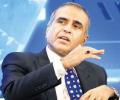
'The Rs 35,000 crore of capex every year, I don't get to sign 35 paise out of this.'
Indian benchmark stock indices, Sensex and Nifty, rallied significantly, with Sensex jumping over 1,500 points and Nifty reaching a nearly three-week high, driven by strong buying in banking, IT, and Reliance Industries stocks, alongside easing crude oil prices.

Bharti Airtel Chairman Sunil Bharti Mittal stated that his satcom venture, Eutelsat OneWeb, is 'significantly ahead' of Elon Musk's Starlink in the Indian satcom queue, having applied for a licence five years ago, and expressed a desire to receive regulatory approval before Starlink.

Indian benchmark indices Sensex and Nifty opened higher, extending their previous session's rally, driven by a decline in global oil prices, despite continued selling by Foreign Institutional Investors.
Indian benchmark equity indices, Sensex and Nifty, closed higher on Monday, driven by softer-than-expected US jobs data which reduced expectations of aggressive monetary tightening by the US Federal Reserve, boosting risk appetite across emerging markets.

The Karnataka Cyber Command Unit has busted an illegal SIM box network operating from two apartments in Bengaluru's Whitefield division, leading to four arrests. The network is suspected of facilitating digital-arrest scams, sextortion, and other financial cyber frauds across India, with potential financial exposure running into hundreds of crores of rupees. Investigations are ongoing to establish the full extent of the network and its links to the e-SIM supply chain.

Indian equity benchmarks Sensex and Nifty extended their losses for a third consecutive session, with the Sensex declining 460.30 points and the Nifty dropping 123.70 points, primarily due to surging crude oil prices driven by escalating tensions in West Asia and weak global cues.

Indian benchmark indices Sensex and Nifty traded lower in early sessions due to profit-taking and significant foreign institutional investor (FII) outflows, despite strong performance from IT stocks like Tech Mahindra. Track Sensex, Nifty on October 16.
Indian equity benchmarks Sensex and Nifty experienced a decline in early trade, primarily due to a sell-off in power and metal stocks, mirroring a broader downturn across Asian markets. Elevated crude oil prices and firm US bond yields further dampened investor sentiment, while an expert warned of an impending correction in overvalued mid and small-cap segments. Track Sensex, Nifty on October 22.

India's venture capital equity funding for startups has remained largely flat over the past three years, with a slight increase in total funding but a sharp decline in the number of rounds, indicating a concentration of capital in fewer, larger deals, particularly in deeptech and AI sectors.

Indian equity benchmark indices extended losses for a second consecutive session, with the Sensex dropping 143 points, driven by a sell-off in power, banking, and financial stocks, coupled with elevated crude oil prices and persistent FII selling.
Indian benchmark indices Sensex and Nifty saw a sharp rebound in early trade, driven primarily by a rally in IT stocks and a decline in crude oil prices, even as global markets faced selling pressure due to US inflation concerns. Track Sensex and Nifty on

The combined market valuation of four of India's top-10 most valued firms eroded by Rs 87,960.29 crore last week, with Bharti Airtel experiencing the largest decline, amidst a bearish trend in the equities market.

Indian benchmark indices Sensex and Nifty experienced declines in early trade, ending a two-day rally, driven by a spike in Brent crude oil prices above USD 101 per barrel and investor caution ahead of the Reserve Bank of India's monetary policy decision. Track Sensex, Nifty on October 7.

Eutelsat OneWeb, a satellite communications company, is awaiting approvals from the Indian central government to launch its services, as confirmed by Sunil Mittal, chairman of Bharti Enterprises, the largest shareholder in the Eutelsat group.
Indian benchmark indices Sensex and Nifty closed higher for the second consecutive day, primarily driven by robust buying in IT stocks following strong quarterly results and positive global trends. Tech Mahindra notably surged over 8% after reporting a significant jump in net profit.

Indian benchmark equity indices, Sensex and Nifty, rallied in early trade, driven by positive global market trends and easing crude oil prices, despite the US Federal Reserve's hawkish stance tempering overall sentiment. Track Sensex, Nifty on September 18.
Indian equity benchmarks, the Sensex and Nifty, opened higher on Friday, driven by a strong rally in IT stocks, despite a significant overnight decline in US technology shares and broader Asian markets. Experts anticipate further market support from falling US bond yields, a strengthening rupee, and a substantial liquidity inflow following the Jio Platforms IPO allotment. Track
Jio Platforms' upcoming initial public offering (IPO) is anticipated to be India's largest to date, potentially listing among the top three stocks with a valuation of around Rs 12 lakh crore, and is expected to proceed without an offer-for-sale as current investors show no interest in diluting their holdings.
Indian stock markets closed lower, with the Sensex falling 429 points, after the Reserve Bank of India raised its benchmark interest rate for the first time in nearly four years, coupled with rising crude oil prices and persistent foreign fund outflows.

Jio Platforms, the digital arm of Reliance Industries Ltd (RIL), is launching its initial public offering (IPO) with a price band of 1,065-1,119 a share, aiming to make RIL a net-debt-free company and create long-term shareholder value.

The combined market valuation of five of India's top-10 most valued firms eroded by Rs 1 lakh crore last week, with IT giant Tata Consultancy Services (TCS) experiencing the largest decline amidst a bearish trend in domestic equities.

Indian benchmark indices, Sensex and Nifty, closed significantly higher, driven by a combination of easing crude oil prices, fresh foreign fund inflows, and a positive trend observed in global equities.

'... but runs with the rigour and discipline of a large enterprise.'
Indian benchmark indices, Sensex and Nifty, saw gains in early trade, driven by a notable drop in crude oil prices and renewed buying interest from Foreign Institutional Investors (FIIs).
Indian benchmark indices, Sensex and Nifty, experienced a sharp decline at the close of trade, with the Sensex dropping 539 points and the Nifty falling below 24,100, primarily due to selling pressure in HDFC Bank and ongoing geopolitical uncertainties.

Airtel Business CEO Sharat Sinha stated that evolving architecture and methodologies for safely deploying Artificial Intelligence, coupled with adequate guardrails, are essential to unlock productivity gains. He welcomed the government's upcoming consultation paper on AI regulation, focusing on safety, deepfakes, and a human-first approach. Sinha also highlighted AI's role in driving demand for digital infrastructure and Airtel's growth in cybersecurity and fraud prevention.

The benchmark BSE Sensex rebounded by 362 points, ending a four-day losing streak, driven by strong buying in metal, private banking, and oil and gas shares, while the broader NSE Nifty saw modest gains despite paring some advances in the closing session.
The Indian stock market experienced a significant downturn, with the Sensex crashing over 1,000 points and the Nifty hitting a fresh 52-week low, driven by sustained selling from foreign institutional investors, the RBI's monetary policy tightening, and elevated Brent crude prices.
Indian benchmark indices, Sensex and Nifty, closed lower on Wednesday, reversing early gains due to profit-taking and weakness in sectors like IT, FMCG, and consumer durables, despite support from lower crude oil prices.
