
India's private-sector banks are likely to lose market share for a second consecutive year in 2025-26, as their loan books continue to expand much slower than overall bank credit.

CPGRAMS -- an online platform available to citizens 24x7 to lodge their grievances to public authorities on service delivery -- has existed for close to two decades. But it has never been this active, points out Tamal Bandyopadhyay.
ICICI Bank has reversed its decision to raise the minimum monthly average balance (MAB) for new savings accounts in metro and urban locations to Rs 50,000, revising it instead to Rs 15,000, effective August 1. The MAB for new savings accounts in semi-urban locations has been revised from Rs 25,000 to Rs 7,500, and for rural locations from Rs 10,000 to Rs 2,500.

Mining conglomerate Vedanta Limited has received approvals from the majority of its creditors for a proposed demerger of businesses, marking an important step in the company's plan to split into six independent listed companies. "I am happy to let all of you know that we have received the 52 per cent plus the additional percentage, which is required for us to reach 75 per cent. "We have crossed that threshold as well. Most of the lenders have approved it," a senior Vedanta executive said in a recent bondholder conference call.

HDFC Bank on Tuesday said RBI has given approval to the group to acquire up to 9.5 per cent stake each in six lenders, including ICICI Bank and Axis Bank.

The Reserve Bank is planning to extend wholesale Central Bank Digital Currency (CBDC) for transactions for interbank borrowing or call money market, sources said on Tuesday. The pilot in the wholesale segment, known as the Digital Rupee -Wholesale (e-W), was launched on November 1, 2022, with the use case being limited to the settlement of secondary market transactions in government securities. "RBI is now planning to go into the interbank borrowing market.

As the fight for deposits intensifies, the cost of money will rise and the margin will be under further pressure, points out Tamal Bandyopadhyay.

The Reserve Bank will launch the first pilot for retail digital rupee in Mumbai, New Delhi, Bengaluru and Bhubaneswar on December 1, and later expand it to nine more cities in the initial phase. This follows a month after the RBI had started a pilot in the digital rupee - wholesale segment on November 1. The Reserve Bank announces the launch of the first pilot for retail digital rupee (e?-R) on December 1, 2022, the central bank said in a statement on Tuesday.
India's first digital rupee pilot project will commence on Tuesday with nine banks, including SBI, HDFC Bank and ICICI Bank, issuing the virtual currency for transactions in government securities. "...the first pilot in the digital rupee - Wholesale segment shall commence on November 1, 2022," the RBI said in a statement on 'Operationalisation of Central Bank Digital Currency-Wholesale (e?-W) Pilot'. It also announced that the first pilot in digital rupee - Retail segment is planned for launch within a month in select locations in closed user groups comprising customers and merchants.

The pilot project for central bank digital currency (CBDC) in the retail segment went live on Thursday with the Reserve Bank of India (RBI) issuing Rs 1.71 crore to four participating banks based on their indents. The central bank has identified four banks for the first phase of the pilot - State Bank of India, ICICI Bank, Yes Bank and IDFC First Bank - in four cities, Mumbai, New Delhi, Bengaluru and Bhubaneswar. The highest indent was received from one private sector bank.

The Union Cabinet on Wednesday approved amendment to the DICGC Act to provide account holders access to up to Rs 5 lakh funds within 90 days of a bank coming under moratorium to ensure timely support to depositors. Last year, the government raised insurance cover on deposit five-folds to Rs 5 lakh to provide support to depositors of ailing lenders like Punjab and Maharashtra Co-operative (PMC) Bank. Following the collapse of PMC Bank, Yes Bank and Lakshmi Vilas Bank too came under stress, leading to restructuring by the regulator and the government.

Top laggards in the Sensex pack were Vedanta, IndusInd Bank, Yes Bank, Tata Steel, ONGC, Tata Motors, Sun Pharma, M&M, TCS and Hero MotoCorp, dropping up to 5.39 per cent.
The drop in net interest margin will separate the men from the boys, explains Tamal Bandyopadhyay.

Top losers in the Sensex pack included IndusInd Bank, Yes Bank, SBI, L&T, Tata Steel, M&M, Bajaj Finance, Vedanta, Tata Motors and RIL, tumbling up to 6.97 per cent.

With the rise in interest rates, bond yields have been on the rise; this will dent banks' treasury profits. Also, many retail borrowers may find it difficult to service their loans when the loan rates rise, points out Tamal Bandyopadhyay.

After Yes Bank was placed under moratorium, digital payments were impacted as PhonePe, which depends on the cash-strapped lender for its transactions, could not operate. Even the bank's own net banking facilities have not been operational since last evening. Other fintech operators who rely on Yes Bank to settle their transactions are also down.

Banking technology start-up Zeta is the latest entrant to the unicorn club after raising $250 million in its Series C round from SoftBank Vision Fund 2. Sodexo participated as an additional minority investor in the round. Founded by serial entrepreneur and billionaire Bhavin Thurakia, the startup is now valued at $1.4 billion. It is the 14th company this year to cross the $1 billion valuation mark after Meesho, Cred, Pharmeasy, ShareChat, Moglix and others.

Finance Minister Nirmala Sitharaman on Friday assured cash-starved Yes Bank depositors that their money is safe and the RBI is working on an early resolution of the issue. "I'm in continuous interaction with the Reserve Bank of India (RBI). The central bank is fully seized of the matter and has assured they will give a quick resolution. I want to assure every depositor that their money shall be safe. Their monies are safe," Sitharaman told reporters in New Delhi.
The Reserve Bank on Monday superseded the boards of Srei Infrastructure Finance as well as Srei Equipment Finance, citing concerns over governance and payment defaults, and decided to refer the two NBFCs for resolution under the insolvency law. This is only the second time in as many years that the Reserve Bank of India (RBI) is referring entities for the resolution process under the Insolvency and Bankruptcy Code (IBC) after taking first ever such step in the case of DHFL back in 2019. Superseding the boards of the crisis-hit Srei Infrastructure Finance Limited (SIFL) and Srei Equipment Finance Limited (SEFL), the RBI has appointed Rajneesh Sharma, former Chief General Manager of Bank of Baroda as the administrator to manage the affairs of the two companies.

Since its launch in April, helpline 155260 has been able to prevent more than Rs 18.5 million of defrauded money from reaching the hands of fraudsters.

It said banks' asset quality will deteriorate across the corporate, small and medium enterprises and retail segments, leading to pressure on profitability and capital.
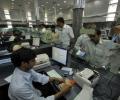
Nearly two million e-mandates for recurring payments have been registered with banks and card networks after the Reserve Bank of India (RBI) made it mandatory from October 1 to take prior consent of a customer before debiting her account, sources in know of the matter said. Industry estimates peg the recurring transactions at approximately 2.5 per cent of the total volume of transactions, and about 1.5 per cent in terms of value. Of these, around 75 per cent of domestic recurring transactions, and about 85 per cent international recurring payments are below Rs 5,000.

The broader NSE Nifty fell 78.75 points, or 0.70 per cent, to close at 11,234.55.

Top gainers in the Sensex pack included Vedanta, ICICI Bank, ONGC, Kotak Bank, Axis Bank, SBI, M&M, Infosys, PowerGrid, HCL Tech, NTPC, Bajaj Finance and Reliance Industries, rising up to 2.72 per cent.

HCL Tech and ONGC were the top gainers in the Sensex, rising up to 3.40 per cent.

NTPC was the top gainer among the Sensex stocks, rising by 3.53 per cent. Coal India, ONGC and Sun Pharma also rose up to 2.41 per cent.

In the Sensex kitty on Wednesday, Tata Motors emerged as the top loser falling 3.01 per cent, followed by Vedanta shedding 2.92 per cent. Other laggards include HUL, Kotak Bank, NTPC, Infosys, HDFC Bank, Bajaj Finance, Hero MotoCorp, ICICI Bank, Yes Bank, HDFC, IndusInd Bank and PowerGrid, falling up to 1.77 per cent.

The other board members will be Sunil Mehta, former non-executive chairman of Punjab National Bank, as the non executive chairman of Yes Bank, Mahesh Krishnamurthy and Atul Bheda as non-executive directors.

Banks say they themselves red-flagged the transactions to RBI. It must be noted that these transactions are not outright evidence of fraud or proof of nefarious activities.

The broader NSE Nifty sank 177.65 points or 1.53 per cent to 11,419.25.

Infosys was the top gainer in the Sensex pack, closing 7.20 per cent higher as investors cheered its financial results. The IT major posted better-than-expected 5.3 per cent rise in its June quarter net profit, and raised revenue growth forecast for the current fiscal.

They are realising unstructured data generated from social media and mobiles is vital for business decisions.

Since the RBI is the 'lender of the last resort', as per terms of arrangement, Yes Bank would have to exhaust immediate liquid assets before accessing this fund.

The Reserve Bank of India's (RBI's) move to ban Mastercard from issuing new cards for not complying with the local data storage guidelines may hit five private banks, a non-bank lender, and a major card-issuing company. The impact is expected to be felt for a few months as these players transition to other card networks. According to Nomura Research, RBL Bank, YES Bank, and Bajaj Finserv are the ones most impacted by the ban as all their credit card schemes are allied to Mastercard. Among others, IndusInd Bank, Axis Bank and ICICI Bank have 35-40 per cent of their credit card schemes tied to Mastercard, the report said.
Axis Bank's loan portfolio quality deteriorated, with gross NPAs rising to 5.22% of gross advances.

Apart from SBI, UPI 2.0 partner banks are HDFC Bank, Axis Bank, ICICI Bank, IDBI Bank, RBL Bank, YES Bank, Kotak Mahindra Bank, IndusInd Bank, Federal Bank and HSBC.

Soon after the lifting of the 13-day moratorium at 6 pm, some customers took to social media complaining that they were not able to access certain services, including internet and mobile banking.

All BSE sectoral indices ended in the red, with oil and gas, bankex, capital goods and finance falling up to 3.04 per cent.

After a positive opening, the 30-share BSE Sensex suddenly faced selling pressure in late-afternoon trade. It finally settled just 5.67 points, or 0.01 per cent, lower at 39,586.41.

Lenders can now initiate recovery proceedings since the SC has lifted the standstill on asset classification, which protected stressed accounts from slipping into NPAs.
 © 2026 Rediff.com - Advertise with us - Disclaimer - Privacy Policy - Sitemap - Feedback - About us - Terms of use - Grievances