
Indian benchmark stock indices, Sensex and Nifty, experienced a significant drop on Monday, with the Sensex falling by nearly 548 points, primarily due to a fresh spike in crude oil prices, persistent foreign fund outflows, and rising bond yields.

Indian benchmark indices Sensex and Nifty experienced declines in early trade, ending a two-day rally, driven by a spike in Brent crude oil prices above USD 101 per barrel and investor caution ahead of the Reserve Bank of India's monetary policy decision. Track Sensex, Nifty on October 7.

The Reserve Bank of India has opened a special dollar window for three public sector oil marketing companies (OMCs) to meet their daily dollar requirements, aiming to curb the rupee's depreciation amidst global economic uncertainty. Additionally, the RBI has introduced new regulatory measures for the foreign exchange market, including reducing the threshold for derivative transactions without underlying exposure and introducing a Foreign Exchange Risk Reserve (FERR).

India's retail inflation surged to 5.54 per cent in September, primarily due to a significant increase in onion and other food prices, remaining just within the Reserve Bank of India's tolerance band. This marks the highest inflation since the new series with base year 2024 took effect in January.

Indian benchmark indices Sensex and Nifty experienced declines in early trade, influenced by the Reserve Bank of India's (RBI) recent repo rate hike and its signal for continued monetary tightening, coupled with rising crude oil prices and foreign fund outflows. Track Sensex, Nifty on October 8.
Indian stock markets closed lower, with the Sensex falling 429 points, after the Reserve Bank of India raised its benchmark interest rate for the first time in nearly four years, coupled with rising crude oil prices and persistent foreign fund outflows.

Reserve Bank of India (RBI) Governor Sanjay Malhotra stated that surplus liquidity in the banking system is expected to drain within the current financial year, utilising tools like currency leakage, sell-buy swaps, open market operations (OMOs), and variable rate operations.

HSBC has emerged as the leading international bank in facilitating fundraising for Indian companies through bonds, syndicated loans, and IPOs during January-September 2026, according to Hitendra Dave, CEO of HSBC India.
The Reserve Bank of India on Wednesday raised its policy repo rate by 25 basis points to 5.50 per cent, beginning a rate-hike cycle as rising inflation risks, elevated global yields and resilient domestic growth strengthened the case for tighter monetary policy. The decision by the Monetary Policy Committee marks a shift from its August policy, when it kept the repo rate unchanged at 5.25 per cent and retained a neutral stance while seeking greater clarity on the inflation outlook and growth-inflation balance.

Reserve Bank of India Governor Sanjay Malhotra has stated that the rupee may be 'undervalued' by many estimates and assured that the RBI will work to ensure its stability and help it find its 'correct value' amidst recent depreciation.

India's leading private-sector banks, including HDFC Bank, Axis Bank, and Kotak Mahindra Bank, reported robust deposit growth in the July-September quarter (Q2FY27), significantly aided by the Reserve Bank of India's concessional FCNR(B) swap window.

Public and private sector banks in India experienced significant deposit growth in the July-September quarter of FY27, largely propelled by foreign currency non-resident (bank), or FCNR(B), deposits mobilised under the Reserve Bank of India's concessional swap window, which closed on August 31.

India's wholesale price-based inflation surged to 11.39 per cent in September, up from 9.92 per cent in August, primarily driven by increasing prices of food, manufactured items, and fuel and power.

The Reserve Bank of India (RBI) has increased its GDP growth forecast for the current fiscal year (FY27) by 40 basis points to 7.1 per cent, acknowledging the resilience of domestic economic activity despite global headwinds and geopolitical tensions.

India's foreign exchange reserves experienced a substantial drop of USD 18.343 billion, settling at USD 747.557 billion for the week ending September 25, according to the Reserve Bank of India.
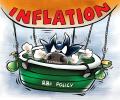
The Reserve Bank of India (RBI) has marginally raised its retail inflation forecast for the current fiscal year (FY27) to 5.2 per cent from 5 per cent, citing increasing price pressures across various commodities. Concurrently, the Monetary Policy Committee (MPC) unanimously decided to hike the key interest rate (repo) by 25 basis points to 5.5 per cent, shifting its stance to 'calibrated tightening'.

HDFC Bank has announced the appointment of Anup Bagchi as its new Managing Director and Chief Executive Officer for a three-year term, effective October 27, 2026. Bagchi, currently leading ICICI Prudential Life Insurance, will succeed Sashidhar Jagdishan, whose term concludes on October 26, 2026. The Reserve Bank of India has approved this significant leadership transition.

The Reserve Bank of India's recent measures, including a dedicated dollar window for state-run oil marketing companies and tightened foreign exchange derivative rules, are expected to provide near-term relief to the rupee's depreciation, but market participants believe global factors and balance of payment dynamics will continue to exert pressure in the medium term.

The Reserve Bank of India's outstanding net short dollar position in the forward book surged to a record $200.06 billion at August-end, up from $136.77 billion at July-end, primarily driven by FCNR(B) flows.

Indian benchmark indices Sensex and Nifty saw a significant rebound in early trade, with the Sensex surging over 700 points, driven by a decline in crude oil prices, easing concerns over Federal Reserve tightening, and the appointment of Anup Bagchi as the new MD and CEO of HDFC Bank.

Analysts predict that the Reserve Bank of India's interest rate decision, crude oil prices, and global bond yields will be the primary factors influencing the Indian stock market this week, alongside macroeconomic data and foreign investor activity.

'We see a lot of cases of bank deposits getting lost, especially when people die, so this will help address that because you have one consolidated view.'

The Reserve Bank of India's 25-basis point increase in the repo rate to 5.5 per cent is expected to exert pressure on housing affordability and buyer sentiment, particularly affecting interest rate-sensitive segments and potentially moderating sales during the crucial festival season.

Finance Minister Nirmala Sitharaman stated that the Reserve Bank of India (RBI) will persist in its efforts to prevent excessive volatility in the rupee, which has significantly depreciated against the US dollar due to global uncertainties, despite India's strong macro-economic fundamentals.

A report by IIT Bombay suggests that the proposed Merchant Discount Rate (MDR) framework for Unified Payments Interface (UPI) transactions needs rationalisation before implementation to safeguard public trust in the digital payments system, highlighting that UPI's long-term economic benefits outweigh potential incremental income from merchant fees.
India's foreign exchange reserves experienced a substantial decline of USD 14.881 billion, reaching USD 765.901 billion for the week ending September 18, primarily due to a fall in foreign currency assets, as per recent RBI data.
Anup Bagchi, the incoming MD & CEO of HDFC Bank, is set to become India's highest-paid bank CEO with a proposed target annual compensation package of approximately 35.9 crore, including a significant variable pay component and a one-time joining bonus.

"Pressure on the current account is a temporary problem. Sooner rather than later, our external sector will improve," said RBI Governor Sanjay Malhotra.

Indian banks are projected to achieve healthy profit growth in the second quarter of financial year 2027 (Q2FY27), driven by lower credit costs, robust advance growth, and fee income. However, net interest margins (NIMs) are expected to face pressure due to significant mobilisation of foreign currency non-resident (bank) FCNR(B) deposits.
The Reserve Bank of India (RBI) net purchased a record $18.65 billion in July, driven by inflows from its concessional swap facility, leading to a significant increase in India's foreign exchange reserves.

Indian equities, particularly the Nifty 50, have significantly underperformed their Asian and global counterparts over the past year, with the index down 10.6 per cent. This lag is attributed to factors like rising global oil prices, rupee depreciation, and a lack of participation in the global chipmaker rally that boosted markets like South Korea and Taiwan.

The Economic Offences Wing (EOW) of the Crime Branch Jammu has filed a chargesheet against two individuals, Manoj Kumar and Vikram Singh, in a financial fraud case involving over Rs 1.22 crore collected from investors in Samba district. The accused allegedly induced residents to invest in schemes from unregistered or de-registered NBFCs, promising high returns but failing to deliver.

'Existing borrowers who have surplus cash should make partial loan prepayments to offset the impact of rising EMIs and reduce the overall interest burden.'

The Reserve Bank of India has raised the repo rate by 0.25%. Three financial planners explain how soon banks will pass the increased loan interest on, what borrowers should check and what they need to avoid.

Indian equity markets, led by the Nifty 50, saw gains following a pullback in Brent crude prices towards $101-102 a barrel and weaker-than-anticipated US jobs data, which eased concerns about a Fed rate hike. However, analysts caution that markets are likely to remain volatile in the near term.
State Bank of India (SBI) anticipates that the newly introduced Merchant Discount Rate (MDR) on person-to-merchant (P2M) UPI transactions above 2,000, effective October 15, will enable it to recover the costs incurred in processing and facilitating these transactions, potentially even generating a small surplus.

RBI Governor Sanjay Malhotra reiterated India's cautious stance on cryptocurrencies due to concerns over monetary sovereignty and capital flows, while actively promoting underlying technologies like distributed ledger technology and tokenisation. He also addressed the global rise in public debt and hardening bond yields, attributing it to increased government and private spending, including that driven by AI, and noted the implications of global interest rates on India's monetary policy.

Fugitive diamond merchant Nirav Modi has been ordered by a UK High Court to pay Bank of India over USD 11.5 million, including accruing interest, for a personal loan guarantee related to his Dubai-incorporated firm, Firestar Diamond FZE.
The Indian stock market experienced a significant downturn, with the Sensex crashing over 1,000 points and the Nifty hitting a fresh 52-week low, driven by sustained selling from foreign institutional investors, the RBI's monetary policy tightening, and elevated Brent crude prices.

After a significant 9.9% depreciation in FY26, the Indian rupee has shown comparative stability in the first half of FY27, depreciating by only 1.1%, attributed to regulatory interventions and measures to attract foreign capital, despite ongoing global pressures from rising crude oil prices and foreign investor outflows.
