
Assistant Secretary of State for South Asian Affairs Robert Blake said Pakistan had frequently raised the controversial and contentious water issue with India during his recent trip to Islamabad, but added that the US had no intention of intervening in the bilateral issue.
Update, tweet and share all you want, but be mindful of how it can affect your life and career.
The United States Administration believes that the involvement of India and neighbouring countries in the security component of the US-led war on terror in Afghanistan will complicate the situation, Assistant Secretary of State for South and Central Asian Affairs, Robert O Blake has said.

An expert on South Asian affairs has said that the US can pursue, support and encourage Pakistan in its transition from tolerating to fighting the various militant groups on its territory, with the help of four policies.
Karl F Inderfurth, former assistant secretary of state for South Asian affairs in former United States President Bill Clinton's administration and a foreign policy adviser in the Barack Obama presidential campaign, says Secretary of State Hillary Clinton's visit to India was 'continuity plus', vis--vis the growing strategic partnership between Washington and New Delhi.Inderfurth said, "This visit was filled with areas to promote even closer cooperation."
India is one of the key countries that will shape the 21st century, believes Robert D Blake, assistant secretary of state for south and central Asian affairs in the Barack Obama administration.Keynoting a conference titled 'Natural allies? US-Indian Relations in the Obama Era', organised by the Washington-based think tank American Enterprise Institute on Monday, Blake stressed that India's importance to the United States has not diminished.
Former Assistant Secretary of State for South Asian Affairs, Karl F Inderfurth, has told the US Congress that Washington should publicly support India's bid for a permanent seat in the UN Security Council, arguing that the India's case has never been stronger.

An acute equipment shortage and an army that has only been trained to fight against India has left the Pakistani army highly ineffectual in its counter-insurgency efforts against the Taliban, said South Asia expert Stephen Cohen.
Inderfurth, currently professor of international relations at George Washington University and, according to insiders, either the Under Secretary of State for Political Affairs in the next administration or the next United States ambassador to India, says too much is being read into Obama's recent remarks on Kashmir.
The Bush administration apparently has no problem with the new Pakistani government's peace deal with militant groups in that country's North West Frontier Province, including Waziristan that have been sympathetic and allied with the Taliban and Al Qaeda. It has even given the tentative agreement its cautious blessings.
"The question of India-Pakistan relations is one that... they have actually made great strides forward in the last couple of years. And obviously, the tensions created by the Mumbai incident made that more difficult right now,"Richard Boucher, the US Assistant Secretary of State for South and Central Asian Affairs, said.
US Assistant Secretary of State for South and Central Asian Affairs, Richard Boucher, has said those involved in the Mumbai terror attacks have links in Pakistan. "I would say it's clear that they had links in Pakistan, that the attackers had links that lead to Pakistani soil" Boucher said in Islamabad on Monday, according to transcripts released by State Department in Washington on Tuesday.
The Indian elections in no way precluded the United States from working jointly with India to try to alleviate the lot of the affected Tamil civilians caught up in the crossfire between the Liberation Tigers of Tamil Eelam and the Sri Lankan troops, the outgoing point man on South Asia for the Obama Administration has said.
Karl 'Rick' Inderfurth, foreign policy advisor on South Asia for United States President-elect Barack Obama's campaign, who is expected to play an influential role in the Obama administration's policy on the subcontinent, says, "It was said immediately after the 9/11 attack that 'we are all Americans'. Now, in the wake of the Mumbai tragedy, it is right for all of us to say 'we are all Indians.'
Congressman Joseph Crowley, a member of the Foreign Affairs Committee of the United States House of Representatives and the former chair of the Caucus on India and Indian Americans, has condemned the terror attack on Mumbai.

Contributing Photographer Jay Mandal was at the Oval Office for a shoot recently when its resident took charge of the proceedings
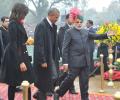
The tactics deployed by Obama to bring India on board, which was the only major power in his way of the climate deal, was described by his former top personal and national security aide Benjamin Rhodes in a podcast interview.
The US has emphasised that Pakistan has still "lot to do" in combating the menace of terrorism and the immediate focus should be on groups responsible for the ghastly Mumbai terror attacks.
"I think the steps that we've seen Pakistan take are good steps. They're promising steps. We hope they get followed up," Assistant secretary of State for South and Central Asian Affairs Richard Boucher said in Beijing last week, according to a transcript released today by the State Department.
'It certainly doesn't have to be accomplished at the end of the year. It will not turn into a pumpkin after some days! The next president and next Congress can take this up,' says expert K Alan Kronstadt.
US Senator John F Kerry, who chairs the Senate Foreign Relations Subcommitttee on Near East and South and Central Asian Affairs -- that has jurisdiction over policy pertaining to India, Pakistan, and Afghanistan -- has called for the resolution of the Kashmir imbroglio, saying that the simmering problem is the rootcause of mistrust between Islamabad and New Delhi, that apparently causes Pakistan's paranoia over even New Delhi's relations with Kabul.

Had India agreed to join the trade pact, Indian markets would have been flooded with cheap Chinese products.
US think tank Lisa Curtis talks about the Pakistan polls and its aftermath.
Thirty-two young leaders from India and Pakistan who have just completed a three-week conflict resolution programme in Maine under the auspices of The Seeds of Peace programme, were felicitated at the State Department by Deputy Secretary of State John Negroponte and Assistant Secretary of State for South and Central Asian Affairs Richard Boucher, who hailed them as the leaders of tomorrow and the catalysts of peace in a region beset by conflict for far too long.
"Some of the fears are exaggerated," and added, "some of the training turns out to be sort of cadet level. Some exchanges don't lead to a lot. I think we just need to have a realistic sense of what this is," Boucher added.
There are a lot of things that go on up there that are difficult to find out. On the other hand, we do have a pretty good idea what's going on up there, whose up there and what they're doing, Boucher said.
"Any renegotiation of the Indo-US nuclear deal will have torpedo the deal and also have a deleterious effect on foreign investment to India," says Prof Sumit Ganguly.
Pakistan says it will go with the Iran-Pakistan-India gas pipeline despite skepticism over the project from the United States.
Applauding India as a "responsible steward" of atomic power, the US has said it looked forward to "trying to complete" the civilian nuclear deal this year so as to bring New Delhi to the "mainstream".
The US on Saturday said it wanted a "smooth and successful transition" to democratic civilian government in Pakistan.
US Assistant Secretary of State for South and Central Asian Affairs Richard Boucher announced the assistance after holding talks with Musharraf.
Boucher, who is the Assistant Secretary of State for South and Central Asian Affairs, was asked by rediff.com not to dodge the question but to clearly articulate which one was binding on Indiathe Hyde Act or the 123 agreement. US Secretary of State Condoleezza Rice had recently assured the Congress that for the nuclear deal to be consummated, it has to be consistent with the Hyde Act.
'Washington knows that it ultimately has to depend on the Pakistani army.'
What seems certain is the growing influence of major Asian countries on the structures and processes of international relations in Asia. At the same time, we cannot overlook the influence of external actors on the continent. Asian security in the 21st century will thus be shaped by the interactions between major Asian powers and influential external actors such as European Union, Russia and the United States.
He cited the US-backed regime changes or "colour revolutions" in former Soviet Republics like Georgia, Ukraine and Kyrgyzstan as events that could have an impact on China's security calculations.
A top US official said Pakistan has to "exercise effective control over all its territory" so that it is not used by terrorists.
'What did the quest for self-sufficiency buy India over a span of forty-odd years?
Khan was first elected to the House of Commons as Liberal MP in 2004 from Mississauga-Streetsville (in Mississauga, ON), and re-elected January 2006 from the same federal riding.
Over 90 Indian-American community leaders and political activists, who were catalytic in pushing through the passage of the legislation, took part in the ceremony in the East Room of the White House.
 © 2026 Rediff.com - Advertise with us - Disclaimer - Privacy Policy - Sitemap - Feedback - About us - Terms of use - Grievances