
India's electric passenger vehicle (ePV) market has expanded sharply over the past five years, with registrations rising from just 3,252 units in 2020 to about 170,000 in 2025. Throughout this scale-up, southern states have remained the bedrock of adoption, consistently contributing around one-third of national electric vehicle (EV) registrations - emphasising the region's role as the structural backbone of India's EV transition.

The fiscal tilt towards capex benefits companies in investment-related sectors like capital goods, defence equipment, engineering & construction and metal & mining. The planned cut in revenue expenditure will weigh on companies in consumption sectors like FMCG, consumer durables and retail.

Tata Motors' commercial vehicle (CV) business debuted on the BSE on Wednesday, completing the automaker's long-planned demerger into separate listed entities for its passenger and CV operations.

'If the targets become unscientific and unjust, Then, just to meet CAFE-III regulation, a small car -- which produces a very low absolute carbon dioxide -- will have to be discontinued.'

Tata Motors, which now houses the company's commercial vehicle business, on Thursday reported a consolidated net loss of Rs 867 crore in the September quarter, impacted by mark-to-market losses of Rs 2,026 crore on account of investment in Tata Capital.

Seven listed Tata companies together own 12.1 per cent in Tata Sons with a combined book value worth around Rs 30,700 crore.

The government is working to make India's automobile industry number one in the world within five years, Union Minister Nitin Gadkari said on Monday. Inaugurating the 'International Value Summit 2025', Gadkari said the automobile sector pays maximum GST revenue to the government and generates employment opportunities.

The Tata Harrier.ev is a car that makes you feel safe and powerful within a luxurious cocoon, raves Rajesh Karkera/Rediff after a gruelling test drive.

'The path beyond diesel is not going to be clear. It is really going to be dependent on applications.'

Tata Indica, the Tata Group's big passenger car bet, was not delivering expected returns a year into its launch. Desperate, the Tata Motors brass, led by Ratan Tata, acceded to a meeting request from Ford Motors for a possible sale of the passenger vehicles division to the American auto major. Some people had advised Tata to sell the business, and the Ford officials came to Bombay House to hold talks.

Stepping up the competition in the electric vehicle (EV) market, JSW MG Motor on Wednesday launched its electric crossover sport utility vehicle (SUV) Windsor with a new and 'aggressive' pricing model, an assured buyback plan, a lifetime battery warranty, and free public charging for one year. Under this new battery-as-a-service (BaaS) pricing model, customers can purchase the Windsor at a starting price of Rs 9.99 lakh (ex-showroom) and then pay a battery usage fee of Rs 3.5 per kilometre (km).

In its first official engagement with the Indian government, Elon Musk-led Tesla and other global automotive (auto) manufacturers sought clarification on the new electric vehicle (EV) policy, specifically regarding investment guidelines and the timeline for the domestic value addition (DVA) requirement. Officials who attended the meeting told Business Standard that the original equipment manufacturers (OEMs) tried to understand whether the complete investment would be made within three or five years and the duration they would have to achieve the 50 per cent DVA. "The consultation meeting was convened to address queries from auto OEMs.

Tata Consultancy Services' (TCS') contribution to the overall market capitalisation (mcap) of listed Tata group companies has slipped below 50 per cent for the first time in over a decade. This has happened amid a rally in other Tata stocks, led by smaller companies, even as TCS, the group's largest company by mcap, has lagged. In recent quarters, Tata's listed firms have emerged as leading performers on the bourses, with the group's combined mcap crossing Rs 30 trillion early last week - a first for a private sector conglomerate.

There is no impediment to normal operations as Tata Motors puts in place the demerger process of its commercial and passenger vehicles businesses. Instead, the demerger would provide greater manoeuvrability for both new entities to operate independently, according to Tata Motors management. While there may not be immediate value unlocking, it will give investors clarity about future growth and the financials across different segments.

If Tesla comes in, India's position as a manufacturing hub will rise many notches, as it will become only the second country, after China, to have both Apple as well as Tesla.

If electric cars with a real range of more than 400 km are launched, the anxiety regarding the charging points will come down, and more people will buy EVs.
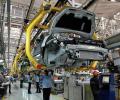
The K-shaped economic recovery in India from the pandemic slowdown shows in corporate results as well. The automobile sector, which represents big-ticket consumption, continues to do well and has increased its share in corporate revenues and profits while fast-moving consumer goods (FMCG) companies that sell low-ticket consumer goods are struggling with poor sales and earnings growth. The share of the automobile sector, including makers of auto ancillaries, in corporate net sales rose to a 10-quarter high of 10.05 per cent during July-September 2023 (Q2FY24) from 8.94 per cent a year earlier and 9.75 per cent in Q1FY24.

India's corporate sector is likely to report a slowdown in revenue growth and earnings for the July-September 2023 period (Q2FY24), according to earnings estimates by brokerages, after the country's top listed companies posted higher than expected profits for the first quarter. The combined net profit of Nifty50 companies, based on brokerage estimates, is expected to have grown by 19.6 per cent year-on-year (Y-o-Y) to Rs 1.75 trillion in Q2FY24 - a sharp deceleration from 37.6 per cent Y-o-Y growth in the combined earnings of index companies in the April-June 2023 period. According to estimates, the combined earnings in the second quarter would be down 8.8 per cent on a quarter-on-quarter (Q-o-Q) basis and the lowest in the past three quarters.

At a time when consumers increasingly embrace green mobility solutions, it is not electric cars but hybrids that are taking the lead, as automotive sales data indicate. Since January, 64,097 electric cars have been sold compared to 266,465 hybrids, according to data from the ministry of road transport and highways' Vahan dashboard. Hybrid car sales have surged from 4.42 per cent of the 4.1 million cars sold in calendar year 2022 to 7.2 per cent this year.
At a time when consumers increasingly embrace green mobility solutions, it is not electric cars but hybrids that are taking the lead, as automotive sales data indicate. Since January, 64,097 electric cars have been sold compared to 266,465 hybrids, according to data from the Ministry of Road Transport and Highways' Vahan dashboard. Hybrid car sales have surged from 4.42 per cent of the 4.1 million cars sold in calendar year 2022 to 7.2 per cent this year.

There has been a sharp recovery in the headline corporate earnings in the April-June 2023 quarter (Q1FY24), after a dismal showing by early bird companies. The combined net profit of the 983 listed companies that have declared their quarterly results, so far, was up 64.7 per cent year-on-year to record a high of Rs 2.68 trillion in the first quarter, but growth in earnings remained lopsided because most of the incremental gains came from a handful of companies. Moreover, the quarterly numbers showed a continued slowdown in revenue growth.

April-June 2023 (Q1FY24) was a mixed quarter for India's top family-owned business groups. Three of the big five in terms of revenue reported a year-on-year (Y-o-Y) decline in combined net sales and two saw a Y-o-Y fall in net profits. Combined net sales of all listed companies in the five groups were up just 2.2 per cent Y-o-Y at Rs 6.6 trillion in the quarter, down sharply from the 10.3 per cent in the March 2023 quarter (Q4FY23) and 42.8 per cent in Q1FY23.
The Q1FY24 earnings season has started on a dismal note for corporate India. The early-bird companies' revenue growth has been at a 10-quarter low, while the combined earnings of non-BFSI (banking, financial services, and insurance) companies seem to have hit the ceiling. The numbers suggest corporate India is entirely dependent on BFSI companies and the IT services sector to drive growth in revenue and profit while other sectors are showing signs of stagnation.

'Instead of ACs, the government should do something to increase our salary.'

Led by Tata Motors and Tata Consultancy Services (TCS), the combined revenue of the Tata group's listed firms crossed the Rs 10-trillion mark for the first time, in 2022-23. The group's 14 key listed companies in which Tata Sons holds a direct equity stake reported a combined revenue of Rs 10.07 trillion in FY23, up 15.3 per cent from Rs 8.73 trillion in FY22. The combined net profit of these companies was, however, down 10.6 per cent year-on-year (YoY) at Rs 66,670 crore in FY23, from a record high of Rs 74,540 crore in the previous financial year, when the profit had jumped 156 per cent YoY, aided by Tata Steel's strong showing.

The third-quarter financials didn't excite market watchers. But equity investors can still make money if they invest in the right stocks.

The Tata group flagship has sold more sport utility vehicles (SUVs) in the domestic PV market in the past four months than any other automotive manufacturer, cementing its no.1 spot. It first grabbed pole position in the SUV segment in October 2021 after the launch of the Punch - a sub-compact SUV offering.

The Tata group companies are now more valuable than all the listed central public sector undertakings (CPSUs) or companies in the country. The key 20 listed Tata companies ended the 2021 calendar year with a combined market capitalisation of Rs 23.36 trillion, ahead of the 70 listed CPSUs, which had a combined m-cap of Rs 23.2 trillion. In comparison, these CPSUs had a combined market capitalisation of Rs 16.7 trillion at the end of December 2020 against the Tata group firms' combined m-cap of Rs 15.7 trillion.

Tata Motors recently announced the launch of 'Dark' edition models of the Harrier, the Nexon, the Nexon EV and its premium hatchback, the Altroz. The 'Dark' editions add a premium touch to its existing models. In 2019, Tata Motors launched the Harrier in its 'Dark' avatar to customers looking for a bold, sophisticated and stylish SUV.

Close to half a dozen more three-row premium mid-size models are expected to hit the road over the next two years.

Sensex ends 133.06 points down at 28,717.91; Nifty falls.

Tata said it was a matter of "great shame" that the company allowed Mahindra & Mahindra to get ahead of it to claim the number three spot in passenger vehicle production.
The markets have opened marginally higher tracking subdued global cues.
Leading automobile company Tata Motors on Friday said it has become the first Indian company producing 1 lakh (100,000) commercial vehicles in a financial year.
In June alone, Rs 13,000 crore (Rs 130 billion) worth shares were released.

I was not expecting to be impressed by the Tata Punch. But my drive proved me wrong, says Rajesh Karkera/Rediff.com.

"The shift is gradually happening more on account of favourable risk-reward for stocks in these sectors and the shift would be more pronounced as investors roll over their targets to 2017," the head of research at a foreign brokerage said.

Leading automakers such as Tata Motors, Skoda, Mahindra & Mahindra, Mahindra Renault, General Motors and Bajaj have production facilities or offices in Pune, the epicentre of H1N1 virus, and other parts of Maharashtra. The swine flu has claimed 10 victims in Pune and scores have tested positive in the region.

The fundamental design characteristics of the Tata brand have been cleverly combined with sporty curvatures to create a coupe-like silhouette.
Just months ahead of the launch of its Rs 1-lakh Nano, the world's cheapest car, automaker Tata Motors has started the process of expanding the dealership network for passenger cars.While the applications have already been invited for dealerships in Delhi and adjoining Ghaziabad, the company officials said that similar exercise is also being carried out in other parts of the country, wherever there is a need for expansion.
 © 2026 Rediff.com - Investor Information - Advertise with us - Disclaimer - Privacy Policy - Sitemap - Feedback - About us - Terms of use - Grievances