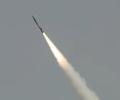
The army said the missile launch was part of "Exercise INDUS" without giving details about the exercise.

'The Indian gung-ho leadership may like to think about it, there should never ever be a doubt in anyone's mind, friend or foe, that Pakistan's operationally ready nuclear capability enables every Pakistani leader the liberty, the dignity and the courage to look straight into the Indian eye and never blink.'
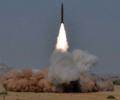
Pakistan on Thursday successfully test-fired a ballistic missile capable of carrying nuclear and conventional warheads to targets as far as 1,500 kilometres, bringing many Indian cities under its range.

Aware of simmering dissensions within the top echelons of the army, Munir has moved slowly in reshuffling senior generals, observes Rana Banerji, who headed the Pakistan desk at RA&W, India's external intelligence agency.
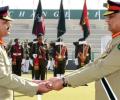
It could be part of a deliberate strategy to heal divisions within and restore the Pakistan army's image, explains Rana Banerji, who headed the Pakistan desk at RA&W.
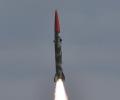
Pakistan on Tuesday successfully test-fired a short-range surface-to-surface ballistic missile Hatf III (Ghaznavi), capable of carrying nuclear and conventional warheads to a range of 290 kilometres, that could cover parts of India.
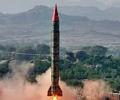
Pakistan on Wednesday tested the Hatf-V nuclear-capable ballistic missile with a range of 1,300 km, with the military saying that the launch was aimed at strengthening the country's deterrence capability.

Pakistan on Saturday test fired two short-range ballistic missiles capable of carrying nuclear and conventional warheads and striking Indian cities, with Premier Yousuf Raza Gilani saying it was time for the world to recognise his country as an atomic power.The armed forces conducted 'training launches' of the Shaheen-I missile with a range of 650 km and the Ghaznavi missile with a range of 290 km at the conclusion of an annual field training exercise.
Pakistan on Friday test-fired a 700-km-range nuclear-capable ballistic missile which could hit targets inside India as its Army Chief dismissed as an "irresponsible alarm" concerns about the country's atomic weapons falling into the hands of terrorists.
This was the third launch of a ballistic missile in as many weeks.
Pakistan on Monday test-fired the Shaheen-II long-range ballistic missile for the second time in three days, which can carry nuclear and conventional warheads and hit targets within India. The Shaheen-II or Hatf-VI surface-to-surface ballistic missile, which has a range of 2,000 km, was launched for the first time during a field training exercise by the army's Strategic Forces Command, the military said in a statement.
This was the second missile test carried out by AFSC this month.
Pakistan on Thursday test-fired its 1,300 km range nuclear-capable ballistic missile Hatf V, a day after it reached an agreement with India on nuclear risk reduction.

Pakistan on Wednesday successfully test-fired a new ballistic missile which is capable of carrying both conventional and nuclear warheads up to a distance of 1,300 kilometres.

Pakistan on Monday successfully test-fired a nuclear capable ballistic missile with a range of 900 kilometers, days after testing a similar missile capable of hitting targets as far as 1,500 kilometers, bringing many Indian cities under its range.

The missile has a strike range of more than 2,000 km.

Keeping trusted men in key positions at Lahore, Rawalpindi and Peshawar has become vital for Bajwa, notes Rana Banerji, who headed the Pakistan desk at the Research and Analysis Wing, India's external intelligence agency.

General Bajwa remains in command as army chief and Prime Minister Imran Khan did not play any role in the reshuffle, says Rana Banerji, who headed the Pakistan Desk at the Research and Analysis Wing, India's external intelligence agency.

'Tehran senses that the Modi government is inexorably gravitating toward the US-Israeli-Saudi axis, jettisoning India's traditional independent Gulf policies,' notes Ambassador M K Bhadrakumar.
 © 2026 Rediff.com - Investor Information - Advertise with us - Disclaimer - Privacy Policy - Sitemap - Feedback - About us - Terms of use - Grievances