
Experts said that earmarking of funds for public health at par with national security indicates a key policy shift.
The government's move to cut GST on medicines and medical devices while exempting lifesaving drugs from the levy is a bold step that will bring direct relief to patients and families while significantly reducing financial strain on them, pharmaceuticals and healthcare industry players said on Thursday.

'We have got enough internal accruals, and we are able to do acquisitions on our own.'
The government should take measures to promote innovation and R&D while simplifying regulations for the sector in the upcoming Union Budget, as per pharmaceutical industry bodies. Outlining the wish list for the sector in the upcoming Union Budget, Indian Pharmaceutical Alliance (IPA) secretary general Sudarshan Jain said the domestic pharma industry is currently around $50 billion in size and aspires to grow to around $130 billion by 2030 and $450 billion by 2047. "To achieve this vision, the Union Budget 2023-2024 should help fuel innovation and R&D, which will set the pace for propelling the pharmaceutical industry forward," he told PTI.

'We urge the government to have discussions with private labs on the actual cost of running a test.'
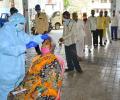
One challenge for many laboratories in ramping up is the shortage of trained manpower for collecting samples, report Sohini Das, Vinay Umarji and Virendra Singh Rawat.

Investment banking star and Moelis India Chief Executive Officer Manisha Girotra remembers a colleague who wanted to resign because she needed to attend to her parents' health issues in a different state. Rather than quit a promising career, she was given the flexibility of working from home on Fridays, which was unusual in the pre-pandemic days. This allowed her to take care of her parents' visits to the doctor and other health-related needs without quitting her job. She would be back in the city office on Mondays.
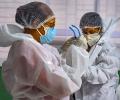
The bouquet of Covid-19 tests that most diagnostic labs are offering include antibody tests (blood tests), rapid antigen tests (point of care tests that detect the presence of an antigen from a nasal or throat swab in case of SARS-CoV-2), and reverse transcription-polymerase chain reaction (RT-PCR) tests.
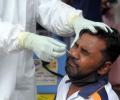
The testing rate is likely to slow down, report Pavan Lall and Sohini Das.
 © 2026 Rediff.com - Advertise with us - Disclaimer - Privacy Policy - Sitemap - Feedback - About us - Terms of use - Grievances