
'The contours of the trade deal need to be reworked now.'
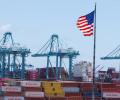
Indian exports to the US will face a 10% tariff, down from 25%, for 150 days following a US Supreme Court ruling. However, uncertainty persists due to potential further tariff hikes and long-term implications.

Textiles, pharmaceuticals, chemicals, engineering goods, gems and jewellery exports will receive a boost from the free trade agreement between India and the 27-nation European Union, according to exporters.

Following a Supreme Court setback, Donald Trump has announced an increase in global tariffs from 10% to 15%, impacting international trade relations and raising concerns about economic repercussions.

The European Union (EU) has suspended export benefits to sectors such as textiles and plastics under a preferential scheme for India and two other countries from January 1, a move that will impact the country's shipment to the 27-nation bloc. The development is important as the two sides are likely to announce the closure of negotiations for a free tarde agreement (FTA) on January 27.
'The immediate impact for India will be very minimal as the share of Venezuela in our total overseas production is very low.'

Mexico on Thursday imposed a tariff of up to 50 per cent on imports from its non-preferential trade partners, including India, a move that might hit New Delhi's annual $5.75 billion shipments to its third-largest car export market.
'There is definitely tepid demand because of the (reciprocal tariff) uncertainty.'

Indian rupee slipping below the record 88 level against the US dollar will enhance price competitiveness of Indian products in global markets and help exporters diversify beyond the US market, say exporters. However, import-dependent sectors such as gems and jewellery, petroleum and electronics may see lower benefits due to a rise in input costs, they stated.
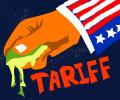
US President Donald Trump on Wednesday slapped an additional 25 per cent tariff on goods coming from India as penalty for New Delhi's continued buying of Russian oil.

The United States announced a 25 per cent tariff on India as the White House released an expansive list of duties that Washington, DC will impose on exports from countries around the world.

American sourcing firms and exporters in China are approaching Indian companies to supply goods to the US as high tariffs imposed by Washington are making it difficult for them to ship directly to America, apex exporters' body FIEO said on Monday. The US has imposed 145 per cent tariffs on Chinese goods entering the American market. For India, the duty is just 10 per cent.

The Iran-Israel conflict has further increased global economic uncertainties, impacting world trade, including India's exports, as it is expected to drive up both air and sea freight rates, exporters say. They said that India's exports to Europe and counters like Russia may get impacted due to this war.

The Indian industry is paranoid about the USA's plan to impose reciprocal tariffs and wants early conclusion of a bilateral trade agreement, sources said on Wednesday. They said that the talks for the proposed bilateral trade agreement are going well.
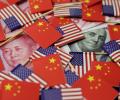
The trade war between the US and China is expected to benefit Indian exporters in increasing their shipments to the American market, sources said. They said the country was the fourth-largest gainer when the US imposed higher duties on Chinese goods during US President Donald Trump's first tenure.

I'...additional concessions, such as opening government procurement, reducing agricultural subsidies, weakening patent protections, and allowing unrestricted data flows -- demands India has resisted for decades.'
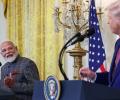
Of Trump's reciprocal tariffs and trade deals

'We have to be prepared for the larger disruption that is likely to take place.'
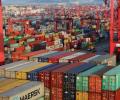
Exporters on Thursday sought a fund of Rs 750 crore for three years to tap USD 25 billion export potential in the US, aiming to seize potential opportunities that may arise as the US President-elect, Donald Trump, has threatened to impose high tariffs on Chinese goods. In its pre-Budget meeting with the finance ministry, Federation of Indian Export Organisations (FIEO) President Ashwani Kumar has also demanded extension of the five per cent Interest Equalisation Scheme (IES).

The escalation of conflict in the West Asian region is expected to push already high logistics costs besides hurting trade in sectors such as oil, electronics and agriculture, according to exporters. They said that insurance costs for exports to the countries directly involved in the war could also go up, which will impact Indian exporters' working capital. Think tank Global Trade Research Initiative (GTRI) stated that the conflict is already hurting India's trade with countries like Israel, Jordan, and Lebanon.

The government on Tuesday announced setting up of hubs to promote exports through e-commerce medium in public-private-partnership (PPP) mode and initially 10-15 hubs will be established. Finance Minister Nirmala Sitharaman said that these hubs, under a seamless regulatory and logistic framework, will facilitate trade and export-related services under one roof. "To enable MSMEs (micro, small and medium enterprises) and traditional artisans to sell their products in international markets, e-commerce export hubs will be set up in PPP mode," she said.

With Donald Trump all set to become US president, Indian exporters may face high customs duties for goods like automobiles, textiles and pharmaceuticals if the new US administration decides to pursue the 'America First' agenda, opined trade experts. Experts also said that Trump could also tighten H-1B visa rules, impacting costs and growth for Indian IT firms. Over 80 per cent of India's IT export earnings come from the US, making it vulnerable to changes in visa policies.

The commerce department has reaffirmed its plans to launch the 'Trade Connect' e-platform to help exporters connect with stakeholders of international trade, as a part of the new government's 100-day action plan, a senior government official said.
Concerned over the fallout of the Red Sea crisis and severe shortage of containers against the backdrop of a steep decline in merchandise exports in August, the Union government is pulling out all the stops to find a solution. To begin with, the government has devised a strategy aimed at boosting container supply and supporting exporters.
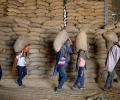
Domestic exporters on Monday expressed concerns over the crisis in Bangladesh and said the developments in the neighbouring country would have implications on bilateral trade. However, exporters expect that the situation may normalise soon. According to exporters, they are already facing disruptions in exports to Bangladesh due to a shortage of foreign exchange in that country.

India's trade deficit with Russia continued to widen for the second consecutive year to $57 billion in the financial year 2023-24 (FY24), with Moscow becoming New Delhi's largest source of crude oil imports. All eyes will now be on Prime Minister Narendra Modi's visit to Russia during July 8-9, where he is set to meet President Vladimir Putin. This will be Modi's first visit to the Kremlin since the Russia-Ukraine conflict began over two years ago.

India's exports to Iran have been falling over the last one year, amid decline in rupee reserves of the West Asian economy. Going ahead, the possibility of augmenting exports to Iran may not be easy for India, considering the geopolitical tensions - Russia-Ukraine and Israel-Hamas conflicts - and the West Asian country's support for Russia and Hamas, people aware of the matter said. Exports to Iran saw a downward spiral since November last year.
India's merchandise exports dipped marginally in March to $41.69 billion, and by 3.11 per cent during the last fiscal year to $437.06 billion mainly due to continued geopolitical turmoil, and depressed global trade. Imports, too, declined in March as well during the entire 2023-24. Trade deficit, or the gap between imports and exports, narrowed 17.74 per cent in March to $15.6 billion and came down 9.33 per cent to $240.17 billion in FY24.

'If attacks escalate, there is a risk the Suez Canal may be closed.'

From toys, footwear and furniture to insulated flasks, smart meters, and air coolers - the Central government over the last decade has mandated higher standards for production and imports of such items. Sample this: Till 2014, there were 14 Quality Control Orders (QCOs) covering 106 products. By the latest count, there are 156 QCOs on 672 products.
After the first quarter was washed out, exporters are now keeping their fingers crossed over a turnaround in outbound shipments to at least North America from September onwards. This comes even as other key destinations such as Europe may take longer to revive in FY24. Slowdown in key economies, as well as geopolitical tensions resulted in sluggish demand for Indian goods.
Indian exporters are keeping their fingers crossed on account of rising Covid infections in China and other countries as it could again disrupt supply chains and affect demand for goods. Federation of Indian Export Organisations (FIEO) director general Ajay Sahai said that if the cases continue to increase in the coming days, it may have implications on imports. "We are keeping our fingers crossed," he said.

As sanctions-hit Russia increasingly relies on consumer products from India, outbound shipments to Russia have started picking up for the second consecutive month in October. This comes after it witnessed contraction for six consecutive months starting March, commerce and industry ministry data showed. During October, India exported goods worth $280 million, up 3.7 per cent as compared to a year ago. It was led by demand for items such as vegetables, tea, coffee, chemicals as well as iron and steel products.

The rising dependence on discounted crude oil has resulted in India's trade deficit with Russia hitting the second-highest place last year, after China, reveals Department of Commerce data. From April through January 2022-23 (FY23), India's maximum trade deficit was with China, at $71.58 billion. This was followed by Russia, where the deficit expanded sevenfold - from $4.86 billion in April-January of 2021-22 (FY22) to $34.79 billion during the same period in FY23.

The government has decided to postpone the release of the new Foreign Trade Policy (FTP) and extend the existing one by six months on account of global uncertainties and currency fluctuations. The government was scheduled to announce the new FTP by the end of September. The current policy was to end on September 30.
India's exports recorded a flat growth of 0.59 per cent to $31.99 billion in November, even as trade deficit widened to $23.89 billion during the month, according to the data released by the government on Thursday. Exports stood at $31.8 billion in November last year. Imports rose by 5.37 per cent to $55.88 billion in November as compared to $53.03 billion in the corresponding month a year ago, the data showed. During April-November 2022, exports rose by 11 per cent to $295.26 billion as against $265.77 billion in the same month last year.

The importance of China as India's top trading partner cannot be understated.

The government on Thursday took a series of measures in view of the rising number of COVID-19 cases in several parts of the world, including China.
Subdued demand from developed countries and blocs like the US and EU is impacting exports of key sectors including engineering, gems and jewellery and may have implications on India's exports in case the global situation does not improve in coming months. Global inflation, Russia-Ukraine war, simmering China-Taiwan crisis and supply disruptions are hurting economic growth worldwide, leading to poor demand, experts say. The world merchandise trade volume is expected to grow 3 per cent in 2022 against the earlier forecast of 4.7 per cent, mainly due to the ongoing war between Russia and Ukraine, according to the World Trade Organization forecast, released in April.

As uncertainty looms large in Afghanistan, Indian pharma exporters are apprehensive to send goods to the war-torn country and the target of exporting $126 million worth of pharmaceutical goods to the Taliban-ruling nation now depends on the future outcome. Udaya Bhaskar, director general of Pharmaceuticals Export Promotion Council of India (Pharmexcil) body under the Department of Commerce on Tuesday said as the situation is grim over there and India pharma exporters have cordial relations with Afghanistan. "The projected target for 2021-22 is $126.22 million.
 © 2026 Rediff.com - Advertise with us - Disclaimer - Privacy Policy - Sitemap - Feedback - About us - Terms of use - Grievances