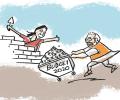
This could impact non-resident Indians staying in countries such as UAE which does not impose income tax on individuals under local tax laws.

At a pre-Budget meeting, the FM was asked to ensure that NBFCs come out of the liquidity crisis they are facing with the help of RBI. They also spoke about the futility of trying to achieve a 3 per cent fiscal deficit target over the medium term.

'It is entering growth territory on a month-on-month basis.'

GST collections in March slipped below the psychological Rs 1 lakh crore-mark for the first time in four months to Rs 97,597 crore as the Covid-19 lockdown that shut most businesses compounded tax collection woes in an already sluggish economy. Goods and Services Tax (GST) mop-up in March recorded a 8.4 per cent decline over March 2019 collection of Rs 1.06 lakh crore. The collections were lower on account of dip in revenues from domestic transactions as well as imports.
.jpg)
The government is likely to file an appeal against the Cairn arbitration award contesting its sovereign rights to tax, sources said.

India's tax pie seems to have undergone a subtle change with a sharp drop in direct tax collections resulting from a disproportionate impact of the COVID-19 carnage on incomes. The share of indirect taxes, which mainly comprise of levy on goods and services as well as import duty, has risen while that of direct taxes - made up of corporate and personal income tax - has gone down in 2020. In an interview with PTI, finance secretary Ajay Bhushan Pandey said in a pandemic like this where the economy has been impacted, any large scale changes impact direct taxes more severely, whereas indirect tax collection is mostly proportional to business turnover and compliance.

The government has set a target of adding 1.3 crore income tax filers in the current financial year against 1.1 crore new filers added last year.

While the surcharge on super-rich would help garner additional income of around Rs 12,000 crore this fiscal on the direct tax side.

While the meetings on Friday were preliminary discussions, it is learnt that sectors like tourism; hospitality; aviation; micro, small and medium enterprises (MSMEs); and livestock have sought deferring loan repayments and temporary tax holidays in specific cases to help them tide over the steep fall in economic activity.

Tax experts are nudging the authorities to figure out why so many assessees are not filing their returns.

The 21st meeting of FSDC comes against the backdrop of the economy hitting a six-year low growth rate of 5 per cent in the first quarter of 2019-20. Even some of the macroeconomic data for the second quarter does not portray an encouraging picture of the economy.

The Centre on Thursday placed before the GST Council two options for borrowing by states to meet the shortfall in GST revenues, pegged at Rs 2.35 lakh crore in the current fiscal.
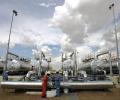
During a series of hectic talks between Cairn Energy and the Indian government over the $1.2-billion arbitration award in favour of the former last week, a slew of options was proposed by the two sides, including computation of capital gains and participation in the Vivad se Vishwas (VsV) dispute resolution scheme. The government is likely to go ahead and appeal against the arbitration award by a Permanent Court of Arbitration at The Hague before March 21, indicated finance ministry officials. Cairn Energy Plc on Sunday said it was hopeful that an acceptable solution to its tax dispute with the Indian government could be found to avoid prolonging and exacerbating the 'negative issue' for all parties.

Concerned by GDP slowdown and unrealistic tax targets, the economists urged Finance Minister Nirmala Sitharaman to implement long-term structural steps like land and labour reforms. Warning against any off-Budget financing the economists said the government should prepare a statement of intent for its social, rural and welfare sector expenditure.
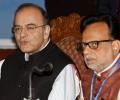
Finance Secretary Hasmukh Adhia vacates his post on November 30 and Expenditure Secretary Ajay Narayan Jha, the second seniormost bureaucrat in the finance ministry, retires on January 31, the day before Jaitley presents the 2019-20 interim budget.

Through this mobile application, the handset will be used for authenticating biometrics of customers making Aadhaar enabled payment.

The tax rate rises to 10 per cent, 15, per cent, 20 per cent and 25 per cent for every Rs 2.5 lakh addition. A 30 per cent tax is charged for income over Rs 15 lakh.

Finance Minister Nirmala Sitharaman will present her second Budget a little more than a month from now. Like any other FM, Sitharaman will depend on her team of bureaucrats and advisors to frame and present the Budget.
The GST rate on mobile phones will be hiked to 18 per cent while that on maintenance repair overhaul (MRO) services for aircraft will be lowered to 5 per cent with effect from April 1, Finance Minister Nirmala Sitharaman said on Saturday. The GST rate on handmade and machine-made matchsticks has been rationalised to 12 per cent from 5 per cent and 18 per cent respectively.

A 15 per cent corporate tax rate for services companies in SEZs, setting up a fund for deep-tech startups and establishing clusters to demonstrate design-to-manufacturing capabilities of tech firms were some of the key demands made by the IT sector at the pre-Budget consultation on Monday. The participants shared their views and suggestions regarding Big Data, incentives for encouraging setting up of data centres, fiscal incentives for data localisation, incentives for pushing digital penetration in rural areas, and corporate guarantee to startups for competing with other nations.

IAMAI in a statement, which represents digital businesses in India, said Trai's recommendation to formulate standards of anonymisation and de-identification was akin to putting the cart before the horse, and till such time the Srikrishna Committee submits the report, making these standards would be like groping in the dark.

His colleague and Law & IT Minister Ravi Shankar Prasad said the court has held that the purpose of issuing Aadhaar to all Indian citizens is legitimate and no surveillance is possible.

Jaitley said the GST Composition Scheme, under which small traders and businesses pay a 1 per cent tax based on turnover, can be availed by businesses with a turnover of Rs 1.5 crore, against the earlier Rs 1 crore, with effect from April 1.

Sitharaman further said that to mitigate genuine difficulties of start-ups and their investors, government has decided to withdraw angel tax provisions for them.

'A bold, progressive step forward,' Kotak Mahindra Bank CEO Uday Kotak said of Nirmala Sitharaman's corporate tax breaks.

The Aadhaar-enabled payment system, or AEPS, allows consumers who don't have smartphones or debit cards to perform basic banking transactions like cash deposit, cash withdrawal, intrabank or interbank fund transfer, balance enquiry and obtaining a mini statement through biometric authentication at micro-ATMs.

The new tax rates will come into effect from January 1, 2019.

The opposition parties vehemently criticised the new 'one nation, one tax' system having four different rates instead of a single rate adopted in some countries including the UK and Singapore.

The Aadhaar issuing authority, Unique Identification Authority Of India, has no data on those who have been denied benefits for want of the 12-digit biometric identification number, the Supreme Court was informed on Thursday.

A K Bhattacharya lists three reasons why Finance Minister Arun Jaitley will most likely present a full Budget on February 1, 2019.

In order for somebody to do Big Brother kind of a job, one has to collect lots of data. Aadhaar collects very minimal data whether at the time of enrollment or at the time of authentication.

Admittedly, EVMs too have a UID number and any convergence of data can make the secret ballot system a party of history, warns Dr Gopal Krishna in the 5th part of his series against Aadhaar.
 © 2026 Rediff.com - Investor Information - Advertise with us - Disclaimer - Privacy Policy - Sitemap - Feedback - About us - Terms of use - Grievances