Air India sale will give a boost to India's privatisation drive, the Economic Survey said on Monday, as it suggested redefining the public sector role in business enterprises to encourage private participation in all sectors. The government earlier this month handed over ownership rights in national carrier Air India to Tata Group for Rs 18,000 crore. The amount includes the takeover of the debt burden of Rs 15,300 crore and another Rs 2,700 crore in cash.

Probable reasons that led to failure of the sale process include 24 per cent government stake and corresponding rights, high debt, volatile crude oil prices, fluctuations in exchange rate, changes in macro environment, profitability track record of bidders and restriction on bidding by individuals.

While Road Transport Minister Nitin Gadkari has been dropped, the panel now has four ministers - Shah, Finance Minister Nirmala Sitharaman, Commerce and Railway Minister Piyush Goyal and Civil Aviation Minister Hardeep Singh Puri.
After its unsuccessful bid to sell Air India in 2018, the government this time has decided to offload its entire stake.
That such a deal can be greeted with celebration in the camps of both buyer and seller speaks volumes about the airline and its recent history, explains T N Ninan.

To attract bidders, the government had decided to hive of around Rs 35,000 crore of the company's debt into a separate subsidiary, leaving around Rs 23,286 crore to be absorbed by the new bidder.
The government has initiated the process for inviting financial bids for the sale of national carrier Air India and the deal is likely to conclude by September, sources said. Salt-to-software conglomerate Tata Group was among the "multiple" entities that had put in preliminary bids for buying loss-making Air India in December last year. The sources said that after analysing the preliminary bids, eligible bidders were given access to the Virtual Data Room (VDR) of Air India, following which investors' queries were answered.

The government on Monday signed the share purchase agreement with Tata Sons for the sale of national carrier Air India for Rs 18,000 crore. Earlier this month, the government had accepted an offer by Talace Pvt Ltd, a unit of the holding company of the salt-to-software conglomerate, to pay Rs 2,700 crore cash and take over Rs 15,300 crore of the airline's debt. Following that, on October 11 a Letter of Intenet (LoI) was issued to the Tata Group confirming the government's willingness to sell its 100 per cent stake in the airline.

'Since the government will not hold any significant stake in the airline this time, such restrictions are not required anymore.'
The airline's 100 per cent shareholding in profit-making budget carrier Air India Express as well as 50 per cent shareholding in equal joint venture Air India SATS Airport Services would also be sold.
'It is very clear that Air India cannot be managed by the government.' 'Air India should be run as a separate profit entity.'

According to the bid document, as part of the strategic disinvestment Air India would also sell 100 per cent stake in low cost airline Air India Express and 50 per cent shareholding in joint venture AISATS. The management control of the airline would also be transferred to the successful bidder.
The EoI and the share purchase agreement would be issued in January itself for the bidders. While Air India's net loss in 2018-19 was around Rs 8,556 crore, its current total debt is around Rs 80,000 crore.

The government proposes to divest 76 per cent of Air India, along with its shareholding in Air India Express and its ground-handling subsidiary, AISATS.
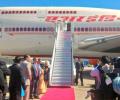
The government is also planning to replace the current ageing Air India One or Boeing 747 with Boeing 777s. Arup Roychoudhury and Archis Mohan report.
The government is planning to liberalise the terms and conditions for the sale of the national carrier. The Centre is still pursuing the option of selling the airline's subsidiaries before the airline itself, in order to deal with an outstanding debt of around Rs 27,000 crore.

It was touted as a game changer but big-ticket privatisation has been a mixed bag as the government faces unanticipated challenges of lukewarm investor response, employee union agitation and legal hurdles. Prime Minister Narendra Modi's often-repeated statement 'the government has no business to be in business' guided the drawing up of an ambitious privatisation pipeline. While Air India sale succeeded, Bharat Petroleum Corporation Ltd (BPCL) divestment failed.
India will miss its revised divestment target for the second time in the past eight years by a wide margin, as the government may not be able to raise an expected over Rs 60,000 crore from the IPO of insurance behemoth LIC in 2021-22. Since the Modi government came to power in 2014, it was only in the financial year 2019-20 that it failed to achieve the revised CPSE divestment target of Rs 65,000 crore. The mop-up during the year was only Rs 50,304 crore. In the ongoing financial year 2021-22, the government was all set to go ahead with the share sale of Life Insurance Corporation (LIC) this month and draft papers for the same were also filed with markets regulator Sebi.

'We expect the bull run to continue until economic growth continues.'
After a hiatus of nearly two decades, the government's programme to privatise state-owned firms restarted with the handing over of debt-laden national carrier Air India to the Tata Group. With the new owner shelling out Rs 18,000 crore for the buyout of the 'Maharaja', this would be the highest-ever amount garnered through privatisation, and is even more than the cumulative sum mopped up through strategic sales from 1999-00 to 2003-04. The government had in October last year inked the share purchase agreement with the Tata Group for sale of national carrier Air India for Rs 18,000 crore. Tatas would pay Rs 2,700 crore cash and take over Rs 15,300 crore of the airline's debt.

Re-rating of Bharat Petroleum Corporation, Container Corporation, Shipping Corporation, SAIL, and Hindustan Copper, for which the government has already shown intent to divest its stake, possible now, say analysts.

The Centre's push to sell Air India on priority has led to delays in other strategic divestment proposals, such as privatising United India Insurance, as well as ongoing transactions, such as Shipping Corporation of India (SCI) and Bharat Petroleum Corporation (BPCL), revealed multiple officials involved in the process. The Department of Investment and Public Asset Management (DIPAM) is yet to take new privatisation recommendations of the NITI Aayog to the core group of secretaries on disinvestment (CGD) headed by the Cabinet secretary, said one of the officials. The priority now is to ensure all approvals for Air India are in place since the government intends to hand over the national carrier as early as this month.
A court in Canada has ordered the seizure of amounts collected by the International Air Transport Association (IATA) on behalf of Air India and the Airports Authority of India (AAI). Separate orders were passed on November 24 and December 21 on pleas by shareholders of Devas Multimedia Private Limited who have filed multiple petitions to enforce arbitration awards against the Indian government. According to a Devas spokesperson, more than $30 million has been seized to date under the IATA action.
The government will transfer about Rs 16,000 crore of unpaid fuel bills and other pending dues that Air India owes to suppliers, to a special purpose vehicle before handing over the loss-making airline to the Tata Group, a senior official said. Air India Assets Holding Ltd (AIAHL), which will hold non-core assets of Air India such as land and building, will also be saddled with 75 per cent of the airline's debt that the Tata Group is not taking over. Besides the debt, the excess liability going to AIAHL comprises unpaid fuel bills to oil companies, airport operators and vendors, said Tuhin Kanta Pandey, Secretary to the Department of Investment and Public Asset Management - the department running the privatisation programme of the government.
The share of public sector undertakings (PSUs) in the total market capitalisation of listed companies--at an all-time low of 10 per cent currently --- may get a leg-up from the government's divestment push. Recently the government announced the successful sale of national carrier Air India to Tata Sons, India's first privatisation of a PSU since 2002-03. The transaction is expected to be completed by December.

After more than two decades and three attempts, the government has finally sold its flagship national carrier Air India, and it is deja vu for Maharaja as it returned home to its founding father the Tata group. Jehangir Ratanji Dadabhoy (JRD) Tata founded the airline in 1932 and named it Tata Airlines. In 1946, the aviation division of Tata Sons was listed as Air India, and in 1948, the Air India International was launched with flights to Europe. The international service was among the first public-private partnerships in India, with the government holding 49 per cent, the Tatas keeping 25 per cent and the public owning the rest. In 1953, Air India was nationalised and for the next over four decades it remained the prized possession for India controlling the majority of the domestic airspace.

There is no reason for keeping an entire ministry with a total staff strength of 2,300, just for the oversight of a few aviation sector laws and regulatory bodies, notes A K Bhattacharya.
The sale is key to meeting the government's disinvestment target of Rs 2.1 trillion in the financial year 2020-21. So far, the disinvestment exercise has fetched the government Rs 34,845 crore during the current financial year.

However, any progress on the deal depends upon Goyal giving up control of the company.

Failure to sell Air India, IDBI may have prompted a change in strategy.
'Industry observers are certain the next attempt will succeed even if they have to browbeat someone into buying as the government has put its might behind it,' predicts Anjuli Bhargava.

'Air India's privatisation is acceptable as long as its control does not pass on to a foreign entity,' says A K Bhattacharya.
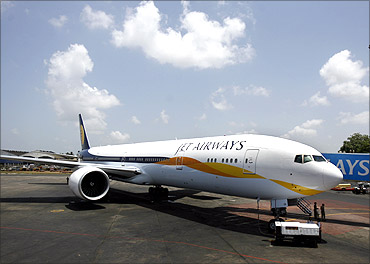
Private airlines Jet Airways and IndiGo joined the race for low-fares, offering their customers hefty discounts, after Air India rolled out a similar offer to challenge Vistara, the latest full-service entrant in the domestic market.

With a debt of several thousand crore rupees, there's no chance the government can attract any buyer unless it cleans up the balance sheet, says Anjuli Bhargava.
 © 2026 Rediff.com - Investor Information - Advertise with us - Disclaimer - Privacy Policy - Sitemap - Feedback - About us - Terms of use - Grievances