
China's troubled moon rover Yutu or Jade Rabbit has come back to life from a troubled dormancy although experts are still trying to figure out the cause of its abnormality, officials said on Thursday.

In a huge setback to China's ambitious space programme, its first lunar rover Yutu or the Jade Rabbit was declared dead after attempts to revive it failed, media reports said on Wednesday.

China's first moon rover is back to work after a "nap" and has succeeded in sending back the first images of the national flags on itself and the lander, space authorities said on Sunday.

The Chang'e-4 spacecraft scripted history on Thursday when it made the first-ever soft landing on the far side of the moon.

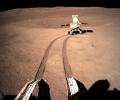
China's first lunar probe on Sunday successfully separated from the lander and left deep traces on its loose soil, hours after the communist giant carried out the world's first soft landing on the lunar surface in nearly 40 years.
China's first moon rover has begun sending back photos, a day after the communist giant carried out the world's first lunar soft landing in nearly 40 years, making a huge advance in its ambitious space programme.

China's first lunar rover on Saturday successfully landed on the moon, making the communist giant one of three world powers to make a "soft landing" as part of an ambitious programme that aims to put a Chinese astronaut on the moon.
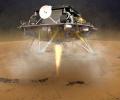
The six-wheeled solar-powered rover named Zhurong, resembling a blue butterfly and with a mass of 240 kg, slowly trundled off a ramp on the lander to hit the red, sandy soil of Mars, starting its journey to explore the fourth planet from the Sun.
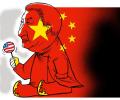
'Seen in the context of world turmoil in face of the pandemic and the Chinese 'miracle' of being the only country in the world to control it, this is not merely a 'Sputnik' moment, but a 'Sputnik Plus' moment,' argues Colonel Anil A Athale (retd).

China's National Space Administration landed the Chang'e 4 lunar probe at 10:26 am Beijing time on Thursday, in the South Pole-Aitken Basin which is an impact crater, China Central Television reported.

China on Sunday successfully placed 20 micro satellites into space using its latest carrier rocket powered by pollution-free fuels, boosting the Communist giant's competitiveness in the global satellite launch sector, state media reported.
'China pumps in a lot more money than what we do. China's space budget is close to $5 billion while it is hardly $1 billion for us.' 'We manage the programmes within the constraints of our budget. The main difference is we prioritise.'
