
Pakistan President Asif Ali Zardari does not believe that India's demand to take action against Jamaat-ud-Dawa chief Hafiz Mohammad Saeed, the mastermind of the terror attacks on Mumbai, is a 'major hurdle' and was hopeful that relations would be normalised soon between the two neighbours."I don't think the issue of Hafiz Saeed is a major hurdle in the normalisation of our relations. I am hopeful that ties between the two countries will be restored very soon," Zardari said.

The Pakistan government today banned Jamaat-ud-Dawa, the front organisation for the outlawed LeT blamed for the Mumbai attacks, after the UN Security Council declared it a terrorist outfit and sealed its nine offices in Sindh apart from rounding up over 20 of its activists.

Mahmood Ali Durrani, who was sacked as the Pakistan's National Security Advisor after he acknowledged Ajmal Kasab's Pakistani nationality, has insisted that Jamaat-ud-Dawa chief Hafiz Saeed had no role in the 26/11 terror strike and has asked New Delhi not to "push" Islamabad.
Even as Pakistan continues to claim that India has not provided enough evidence in the Mumbai terror attack case, Interpol has suggested otherwise by issuing an arrest warrant against Jamaat-ud-Dawa chief Hafiz Saeed.
This residential school boasts of a sprawling campus, dotted with trees, where students go about their regular classes. The school campus includes a farm, a swimming pool and a hospital. It is hard to believe that this is allegedly the breeding ground of Fidayeen terrorists, including those who unleashed terror in Mumbai last week, according to a report in the Gaurdian.
A meeting organised by the Jamaat-ud-Dawah in Lahore on Saturday demanded that the government should either stop India from building dams on rivers flowing into Pakistan or give a 'free hand' to the 'Kashmiri mujahideen' to deal with the issue. A joint declaration issued by the Jamaat-ud-Dawa after the meeting asked the Pakistan government to keep open the option of using force to protect its water resources if India does not stop work on projects.
External affairs Minister SM Krishna has taken on Lashkar-e-Tayiba founder and Jama'at-Ud-Dawa chief Hafiz Saeed saying India believes Saeed is the "brain" behind the Mumbai attacks of November 2008, telling Pakistan's government that if it wants to prove its seriousness on tackling terror, it must tackle Saeed.
On the eve of the Indo-Pak foreign secretary-level talks, Pakistan on Wednesday said that India's demand for handing over of Jamaat-ud-Dawa chief Hafiz Saeed, the mastermind of the 26/11 Mumbai attacks, should not be bracketed with the parleys as it would be 'counter-productive.'
India has said it would talk to Pakistan if it takes "credible steps" to demonstrate its willingness to fight terror both "within and without". External Affairs Minister S M Krishna, however, suggested that Pakistan had not done enough to bring to justice the perpetrators of Mumbai attacks and highlighted the release of Jamaat-ud-Dawa chief Hafiz Saeed as a case in point.
India is expected to convey its unhappiness over Pakistan's equivocation on Jamaat-ud Dawa chief Hafiz Saeed to US Under Secretary of State William Burns, who arrived in New Delhi on a two-day visit.
The government should immediately carry out tailor-made terrorism prevention and incident management drills for each metro city, clearly identifying who will be responsible for leadership and co-ordination. A similar drill should be prepared for the government of India. The drill should cover aspects such as incident management, media management, management of relatives, public management, co-ordination between the state affected and the Centre etc.
The outlawed Jamaat-ud-Dawa said on Wednesday that it would frame an "appropriate response" to the Red Corner Notice issued against its chief Hafiz Mohammad Saeed by Interpol, even as it emerged that the prime accused in 26/11 attacks was not on government's exit control list. "Our legal team is looking into the matter that has come to our notice and we will come out with an appropriate response," JuD spokesman Yahya Mujahid told PTI.
The two boys were brainwashed into believing that there was no need for educational qualification as they were destined to go to paradise.
International pressure made Pakistan act against Saeed and Nazir Ahmed as well as the five involved in the Mumbai attack. Now, Pakistan calculates that international pressure will be less because of its strong action against the Taliban. It hopes to take advantage of this for once again ensuring that the LeT and its capabalities to attack India remain.
Terrorist groups, which were banned during the tenure of former President Pervez Musharraf, have again become active and reopened their offices in the southern Pakistani port city of Karachi.
The UN on Friday, said it is yet to receive any appeal from Jamaat-ud-Dawa or four of its top leaders to review the sanctions imposed on them by the Security Council in the wake of the Mumbai terror attacks. If received, the request would need to be considered by the Security Council, with the letter for review being sent through a member state.
The Lashkar-e-Taiyba and the Jamaat-ud-Dawa might have disowned him, but the father of the lone Pakistani gunman arrested for the Mumbai terror attacks has admitted that the young man whose photograph was beamed by media across the world, is his son.Amir Kasab, the father of Ajmal Amir Iman alias Ajmal Kasab, broke down as he made the admission to the influential Dawn newspaper in the courtyard of his house in Faridkot.
India on Friday asked Pakistan to deport Dawood as well as Hizbul Mujahideen chief Syed Salahuddin.
The govt said the onus is on Pakistan to create such a conducive atmosphere, including by taking "credible, verifiable and irreversible" action to not allow any territory under its control to be used for cross-border terrorism against India.
The US has already banned JuD and sought a ban by the UN Security Council committee on terrorism where China reportedly intervened to ask Washington to substantiate its allegations.
The JUD has been banned by the United States for its role in terrorist activities and India has criticised the Pakistani government for permitting to let it work in PoK in the aftermath of the October 2005 earthquake there.

Punjab government's action comes amidst pressure from the Trump administration to act against terror.
Saeed called Geelani in Jammu and Kashmir and "expressed his concern" over the health of the Hurriyat leader, the Jamaat-ud-Dawa, an organisation founded by Saeed and seen as the parent of the LeT, said in a release from Lahore.
The decision was taken at a high-level law and order meeting attended by President Gen Pervez Musharraf and Prime Minister Mir Zafarullah Khan Jamali.

Activists of radical women's outfit, Dukhtaran-e-Millat on Wednesday hoisted Pakistani flags at several places in Srinagar on the occasion of Pakistan Day.

Pakistan has quietly banned Tehreek-e-Azaadi Jammu and Kashmir, a new front for Hafiz Saeed's Jamaat-ud-Dawa, as international pressure on the country grew, including from a global watchdog, to combat terror and its funding.

Saeed-led JuD is the front organisation for the Lashkar-e-Tayiba which is responsible for carrying out the 2008 Mumbai attack that killed 166 people, including six Americans.
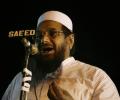
"We are going to wage jihad (war) against India to get our rivers freed," Saeed said while addressing a gathering of JuD workers in Sialokot district of Punjab Province on Friday.

In the audio clip, he is heard directing the attack on Chabad House during Mumbai 26/11 terror attacks.

India was the sole abstention while all other 14 members of the Council voted in favour of the resolution that decided that processing or payment of funds, other financial assets, economic resources, and provision of goods and services necessary to ensure the timely delivery of humanitarian assistance are permitted and are not a violation of the asset freezes imposed by the Council or its Sanctions Committee.
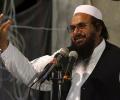
"We will emerge more strongly if you try to suppress us," said Saeed.

Lakhvi, who was on bail since 2015 in the Mumbai attack case, was arrested by the Counter-Terrorism Department.

The Army chief has said that the condition in Kashmir will be normal soon.

Andrabi, the founder of the Dukhtaran-e-Millat, an Islamist separatist organisation is also a member of the All Parties Hurriyat Conference.

Dawood Ibrahim is wanted in India to face the law of the land for carrying out serial blasts in Mumbai in 1993 in which scores of people were killed and injured.
