
The Supreme Court questioned the chief priest of the Sabarimala Ayyappa Temple regarding the constitutionality of preventing believers from touching the deity, during hearings on discrimination against women at religious sites.

The special team would decide on arresting the accused only after completing the questioning.

Division Bench comprising Justice Anil K Narendran and Justice PG Ajithkumar initiated the suo motu.

He, however, made it clear that a sudden change cannot be expected as it was a "sensitive matter" related to an age-old custom and tradition.

'When I applied for the job of santhi, I applied as a person who was eligible.' 'When I joined the temple at the age of 21, it was because I got the 4th rank in the list.' 'Now, everybody is talking only about my caste. I am above all that; it doesn't matter to me and to the people with whom I am associated with.'

'The first time a ban on women aged between 10 and 50 entering Sabarimala came was in 1991 and was by a high court judgment.' 'So, it is only a 27-year-old ban.' 'The high court can fix customs and the Supreme Court can overturn it.' 'I don't see this as an attack on religious freedom or the practice of a religion.'

'The appointment of 60 priests from the Dalit community is a historic moment.' 'Imagine this is happening in Kerala when Dalits are not even allowed to enter temples in some states even today.'
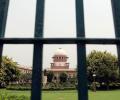
The Supreme Court is scheduled to pronounce on Thursday its verdicts on a batch of petitions seeking re-examination of its decision to allow entry of women of all age group in Kerala's Sabarimala Temple and a review of its judgment giving a clean chit to the Modi government in the Rafale fighter jet deal with French firm Dassault Aviation.

The saffron party will use Lord Ayyappa the same way it made use of Lord Ram in the north to take away the Nair vote and make electoral inroads in the state.
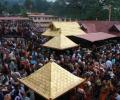
A majority verdict by Chief Justice Ranjan Gogoi and Justices A M Khanwilkar and Indu Malhotra decided to keep pending the pleas seeking a review of its decision regarding the entry of women into the shrine, and said restrictions on women in religious places was not restricted to Sabarimala alone and was prevalent in other religions as well.

The Board, which also comprise the state government nominees, told a five-judge Constitution Bench headed by Chief Justice Ranjan Gogoi that it is high time that a particular class not be discriminated on the ground of 'biological attributes'.

The Sabarimala Karma Samiti, a platform of right-wing outfits, including VHP, appealed to media houses not to depute women journalists in the menstrual age group to cover the developments in Sabarimala.

'It is wrong to assume that it is only after 1991 that we started following this ritual.' 'Ayyappan himself instructed where the temple had to be built, the rituals that had to followed and the route that had to be taken by devotees to the temple.'
