
Indian telecom gear maker Signaltron and semiconductor firm Signalchip have partnered with Indonesia's sovereign research body PRT BRIN to develop and deploy advanced telecom technologies, including 4G, 5G, and future 6G, specifically tailored for Indonesia's unique archipelagic geography to connect underserved regions.

TRAI Chairman Anil Kumar Lahoti has called for robust safeguards, human oversight, and intervention capabilities as Artificial Intelligence becomes increasingly integrated into telecom networks. While acknowledging AI's potential to transform network management and threat detection, Lahoti stressed the need for responsible AI deployment, risk assessments, and clear accountability to ensure consumer trust and prevent misuse, especially in combating online fraud.

Six villagers in Fatehpur district were arrested after allegedly tying a telecom technician to a mobile tower. The incident occurred following prolonged 5G network outages, with residents demanding resolution to connectivity issues. Police rescued the technician and subsequently arrested six individuals who were later released on bail.
Minister of State for Telecom Chandra Sekhar Pemmasani urged BRICS nations to collaborate on building institutional capacity and advocating for fair standards in international telecom and ICT bodies. He highlighted India's willingness to share its modular, open-source digital public infrastructure frameworks like Aadhaar and DigiLocker, emphasising their role in sustainable development and economic growth across the Global South.

India's Department of Telecommunications (DoT) has amended its Unified Licence Agreement, allowing caller identification to include the subscriber's registered name from November 1, 2026, a move aimed at enhancing transparency and potentially curbing spam calls.
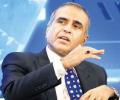
'The Rs 35,000 crore of capex every year, I don't get to sign 35 paise out of this.'

Elon Musk, CEO of SpaceX, stated that Starlink's services in India must be affordable for widespread adoption and that competition would benefit consumers, despite potentially reducing Reliance Jio's profits. He criticised Reliance Jio as a 'de facto monopoly' in India, alleging that certain business conglomerates were blocking Starlink's entry.

The Indian government has strongly refuted Elon Musk's allegations that Starlink's satellite communication services are being blocked in the country, asserting that a fair and non-discriminatory regulatory framework is in place for all telecom providers. The government emphasised that compliance with security norms is mandatory for all licensees, including Starlink, Jio Satcom, and Eutelsat OneWeb, all of whom are currently undergoing security assessments.

Reliance Industries Ltd (RIL) has publicly welcomed competition from Elon Musk's Starlink in the satellite communications sector, asserting that all players, including Jio, must abide by Indian laws and policies.

Jio Platforms Ltd, the digital and telecom arm of Reliance Industries, is poised to launch India's largest-ever initial public offering (IPO) at Rs 30,213 crore, surpassing Hyundai Motor India's Rs 27,870-crore offering.

Bharti Airtel Chairman Sunil Bharti Mittal stated that his satcom venture, Eutelsat OneWeb, is 'significantly ahead' of Elon Musk's Starlink in the Indian satcom queue, having applied for a licence five years ago, and expressed a desire to receive regulatory approval before Starlink.

A Crisil report indicates that India is the world's fastest-growing polymer compound market, contributing 13% to the global industry. Driven by increased manufacturing in automotive, electronics, and infrastructure, the domestic sector is projected to reach USD 16.5 billion by FY2031, with significant demand from various pipeline and cable segments.

Prime Minister Narendra Modi has urged for a global framework to combat cross-border cyber frauds and deepfakes, highlighting the need for governments, tech companies, telecom operators, and financial institutions to collaborate. Speaking at the India Mobile Congress 2026, Modi stressed that technology thrives on trust and that India is ready to share its expertise in tackling cyber threats. He also noted the rapid expansion of 5G and the success of digital governance initiatives like Direct Benefit Transfer.
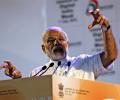
Prime Minister Narendra Modi, at the India Mobile Congress (IMC) 2026, articulated a vision for India's communications sector, emphasizing a global framework to combat cyber frauds and deepfakes. He called for India to become a hub for innovation and product development for the world. Industry leaders lauded his vision, highlighting India's robust digital infrastructure and its journey towards becoming a global technology leader, with a focus on trust, security, and responsible innovation.

Eutelsat OneWeb, a satellite communications company, is awaiting approvals from the Indian central government to launch its services, as confirmed by Sunil Mittal, chairman of Bharti Enterprises, the largest shareholder in the Eutelsat group.

Jio Platforms (JPL) is preparing a capex-light strategy to commercially launch 6G services in the early 2030s through software upgrades, rather than fresh infrastructure investments, according to Akash Ambani, managing director of JPL.

Elon Musk has escalated his criticism of Indian industrialist Mukesh Ambani, sharing media reports that alleged Reliance-funded firms helped boost BJP campaigns on social media and made large political donations. This comes amidst a persistent delay in the launch of Starlink satellite broadband services in India, with Musk accusing Ambani of protecting a monopoly. The Indian government maintains its telecom framework is fair and non-discriminatory, while Reliance has not publicly responded to Musk's allegations.
Elon Musk has renewed his criticism of Mukesh Ambani regarding Starlink's entry into India, accusing Ambani's supporters of hypocrisy for simultaneously claiming Starlink can't compete with low prices and that it poses a strong competitive threat. Musk argues that competition would benefit Indian consumers and that Starlink would adjust pricing if too expensive. He also shared reports alleging Reliance-funded political donations. Communications Minister Jyotiraditya Scindia stated India does not permit monopolies and that multiple players, including Starlink, have received satcom licences.

Airtel Business CEO Sharat Sinha stated that evolving architecture and methodologies for safely deploying Artificial Intelligence, coupled with adequate guardrails, are essential to unlock productivity gains. He welcomed the government's upcoming consultation paper on AI regulation, focusing on safety, deepfakes, and a human-first approach. Sinha also highlighted AI's role in driving demand for digital infrastructure and Airtel's growth in cybersecurity and fraud prevention.
The National Payments Corporation of India (NPCI) has deferred the implementation of a 0.4 per cent Merchant Discount Rate (MDR) on Person-to-Merchant UPI transactions above Rs 2,000. Originally set for October 15, the new date will be announced after Diwali, providing relief to users and merchants, especially during the festive season. The decision came amidst opposition concerns about the levy burdening consumers.

India's government has implemented stringent new regulations under the Telecommunications Act 2023, mandating that all communication infrastructure providers, including those utilising cloud-based networks, must store telecommunication data exclusively within the country, a move expected to significantly impact domestic data centre demand.

Elon Musk questioned if Mukesh Ambani is India's "real boss" amidst Starlink's licensing issues, drawing a cryptic response from Rahul Gandhi. The Indian government clarified that security assessments are pending for all satcom licensees, not just Starlink, and the delay is due to the Ministry of Home Affairs.

Investors are set to monitor quarterly earnings, crude oil prices, the Jio Platforms initial public offering, and foreign investor activity in the upcoming holiday-shortened week, according to market analysts.

The Telecom Regulatory Authority of India (Trai) has mandated that service providers offer voice-and-SMS-only tariff plans, without bundled data, with a minimum validity of 30 days or less, aiming to provide more affordable and shorter-duration options for consumers who do not require data.
Jio Platforms Ltd's initial public offering (IPO), anticipated to be India's largest, is scheduled to open for subscription on October 21 and close on October 23, with reservations for employees and Reliance Industries Ltd shareholders.

HCLTech has announced a global partnership with Anthropic to establish a dedicated business unit focused on developing agentic AI solutions for enterprise clients using Anthropic's Claude. The collaboration aims to help businesses adopt AI systems that operate with minimal human intervention, prioritising safety, cybersecurity, and governance. HCLSoftware will also integrate Claude into its enterprise products.

Indian benchmark stock indices, Sensex and Nifty, rallied significantly, with Sensex jumping over 1,500 points and Nifty reaching a nearly three-week high, driven by strong buying in banking, IT, and Reliance Industries stocks, alongside easing crude oil prices.

The National Payments Corporation of India (NPCI) has deferred the implementation of a 0.4 per cent Merchant Discount Rate (MDR) on Person-to-Merchant (P2M) UPI payments above Rs 2,000, originally set for October 15, until after Diwali.
Digital services major Jio Platforms is anticipated to list on the stock exchange by the end of October, with an estimated enterprise valuation of USD 143-146 billion, making it India's largest public offer at around USD 3.8 billion.
Jio Platforms Limited (JPL) believes satellite broadband services are unlikely to achieve significant scale or compete effectively on price in India's highly connected and affordable market, despite developing its own satellite constellation solutions and flagging it as a potential disruptor.

Punjab & Sind Bank MD and CEO Swarup Kumar Saha clarified that merchants cannot pass on Merchant Discount Rate (MDR) charges to customers for UPI payments, ensuring consumers only pay the displayed price. The new MDR structure, effective October 15, applies a 0.4% charge on P2M transactions above Rs 2,000, with specific flat rates for certain sectors, but small-value transactions remain free.

The Delhi Police's Financial Monitoring Cell prevented potential losses of Rs 1.53 crore in "digital arrest" scams across five states. Their Proactive Victim Identification and Protection Team intervened to save multiple victims, including senior citizens, from transferring additional money to fraudsters who impersonated officials and threatened arrest for fabricated crimes.

Isha Ambani, a director on the board of Jio Platforms, revealed that a failed attempt to upload a college assignment in 2009-10 due to poor internet connectivity in Mumbai sparked the idea and subsequent conversations that led to the creation of Jio.

The Centre has announced a major bureaucratic reshuffle, appointing Prakash Rajpurohit as Deputy Election Commissioner and approving appointments for 27 civil servants at joint secretary and equivalent levels across various ministries and departments.

The Enforcement Directorate (ED) has claimed that Rs 860-Rs 880 crore generated from an alleged liquor scam in Chhattisgarh during the previous Congress regime was delivered to the Pradesh Congress Committee office in Raipur. The agency filed a supplementary chargesheet against former PCC treasurer Ramgopal Agrawal and provisionally attached his properties worth Rs 9.06 crore. The ED alleges a liquor syndicate controlled the state excise department, generating over Rs 2,883 crore in illegal proceeds.

Ericsson CEO Andres Vicente emphasised the critical need for technology alignment and ecosystem collaboration to ensure security in the age of Artificial Intelligence. Speaking on Wednesday, he highlighted that AI's benefits in productivity and innovation cannot be forgone, making shared security concerns across interconnected tech layers paramount. Ericsson is actively working with partners through the Trusted Tech Alliance to establish common AI-era security understandings.

A report by IIT Bombay suggests that the proposed Merchant Discount Rate (MDR) framework for Unified Payments Interface (UPI) transactions needs rationalisation before implementation to safeguard public trust in the digital payments system, highlighting that UPI's long-term economic benefits outweigh potential incremental income from merchant fees.

They had bought Rs 29,631 crore worth of shares in August.

Union Minister Ashwini Vaishnaw warned of increased global turbulence from tech disruptions, AI, and financial risks in the coming years. He stated that India is strengthening its economic and technological resilience to protect its growth from external shocks. India is focusing on domestic manufacturing and design in critical tech areas while maintaining global integration, with trust becoming as crucial as cost in supply chains.
A dozen companies, including major players like Jio Platforms and Zetwerk Manufacturing Business, are poised to launch Initial Public Offerings (IPOs) in October, continuing India's strong fundraising momentum in the primary market. These offerings span diverse sectors, reflecting sustained investor interest in businesses with robust growth prospects.
