
Tata Sons has the balance sheet to support them, for now.

J R D Tata, chairman of the Tata group from 1938 to 1991, said that whenever he had to make a difficult decision, he would ask himself, what will be good for India, and what will be good for the Tatas. If he had a doubt, he would decide in favour of India. In the long run, it would turn out well for the Tatas too, he said, points out Arun Maira.
The Reserve Bank of India (RBI) has rejected Tata Sons' application to surrender its non-banking finance company (NBFC) licence, a decision that mandates a public markets listing for the conglomerate's holding company as it is classified as an upper-layer NBFC.

Chandra's tenure also saw a big jump in Tata Sons' other income, such as brand fee from group companies, treasury gains, and other non-recurring income.

Tata Steel more than doubled its Indian capacity through acquisitions and expansion, strengthening cash generation as it pursued a costly restructuring of its European operations.
'Listing leads to greater transparency and shareholder oversight.'
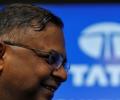
The Tata Sons board has voted to reappoint N Chandrasekaran as chairman for a third five-year term, a decision influenced by the Reserve Bank of India's rejection of the company's application to surrender its NBFC registration, which revives the prospect of a stock market listing.

Natarajan Chandrasekaran, credited with stabilising Tata Sons after a boardroom coup and overseeing significant expansion, has announced his resignation as chairman, capping a nearly decade-long tenure marked by both successes and escalating tensions with the group's controlling charitable trusts.

'It is unfortunate that the Chairman of Tata Sons, a Company renowned for setting high standards of corporate governance, is contending reappointment on such an untenable interpretation of the Articles'.

N Chandrasekaran's letter of not seeking a third term was written to Tata Sons directors (including to Noel Tata as a nominee director) and, therefore, Tata Trusts did not have a locus standi on accepting or rejecting that letter.

The search for N Chandrasekaran's successor as Tata Sons Chairman has reportedly narrowed to Tata Steel CEO T V Narendran, Tata Sons Executive Director Saurabh Agrawal, and NSE MD & CEO Ashish Chauhan, with Chauhan emerging as a potential 'dark horse' candidate.

Tata Consumer Products reported healthy revenue growth in Q1 FY27, driven by its India branded business and accelerating momentum in newer segments, which are now expected to sustain double-digit sales growth and improve profitability.

Tata Motors Passenger Vehicles Ltd (TMPV) has launched its new brand identity, TATA.CARS, aiming to appeal to a younger demographic with a focus on smarter, greener, and more connected mobility experiences.

Tata Motors has launched the Sierra Legend Series, a new line of its iconic Sierra mid-SUV, designed to democratize premium features across all variants. This strategy, dubbed "Luxury, From The Base," aims to challenge traditional industry norms by offering high-end comfort, refinement, and technology even in entry-level models, ensuring the Sierra remains a benchmark in the competitive Indian automotive market.
A crucial annual general meeting (AGM) of Tata Sons, the primary holding company of the Tata conglomerate, was adjourned due to a lack of quorum, specifically the absence of representatives from the Sir Dorabji Tata Trust (SDTT) and Sir Ratan Tata Trust (SRTT). The SRTT is currently under restrictions from the Maharashtra Charities Commissioner, preventing it from making major decisions or holding meetings, which impacted its ability to participate.

The much-awaited board meeting of Tata Sons did not discuss listing of the holding company or a third term for Chairman N Chandrasekaran.

Tata Elxsi has partnered with Sarla Aviation to develop the Shunya air taxi platform. Tata Elxsi will provide engineering support for avionics, software integration, and certification, while Sarla Aviation will lead the design and type certification of the electric vertical take-off and landing (VTOL) aircraft.

Tata Motors' commercial vehicle business is increasingly focusing on parts, services, connected-vehicle platforms, and digital businesses to drive growth and reduce dependence on cyclical vehicle sales, as outlined in its FY26 annual report.

Chandrasekaran's exit is more than a change of chairman. It represents the breakdown of the informal consensus that governed the Tata system under Ratan Tata.

Tata Motors has launched the Curvv Series X, an updated version of its coupe-SUV, focusing on enhancing value-for-money by adding more features to lower and mid-spec variants and streamlining the lineup, with prices ranging from Rs 9.99 lakh to Rs 18.99 lakh (ex-showroom).
N Chandrasekaran not only faces muted financial performance from the group's listed companies, but also mounting losses at Tata Sons' unlisted subsidiaries, many of which have been set up by him in the last decade.

'Chandrasekaran wanted a five-year extension, but the Tata Group has a policy of 65 years as the retirement age for its executive chairman.'

A board meeting of Tata Sons, the holding company of the Tata conglomerate, concluded in Mumbai, with discussions likely revolving around mounting losses in unlisted businesses and the future of Chairman N Chandrasekaran amid rising internal frictions.
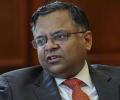
N Chandrasekaran, chairman of Tata Consumer Products (TCPL), stated that India continues to experience credible economic growth, driven by strong demographic fundamentals and accelerating digital public infrastructure, despite a fragmented global landscape.

After weeks of organisational shakeup, Tata Digital's new chief executive Naveen Tahilyani has come up with a revamped executive team for the Neu super app. Tahilyani announced his A-team in an internal mail to employees. The focus of the rejig has been to streamline the structure of the leadership and make the firm nimble and business focused.

N Chandrasekaran's exit marks a major shift for TCS, leaving its leadership to navigate AI disruption without the group chairman's deep expertise.
Tata Sons' unlisted ventures, including Air India, Tata Digital, and Tata Electronics, reported combined net losses of approximately 25,568.8 crore in FY25, a 58.3 per cent increase from the previous year, despite Tata Sons itself remaining profitable for over a decade.

Tata Motors Passenger Vehicles (TMPV) reported Q1FY27 results showing significant margin pressures at both Jaguar Land Rover (JLR) and its domestic operations, despite strong volume growth in the India business. Analysts expect these margin headwinds to persist, potentially offsetting gains from increased sales and new launches.

Tata Group's British luxury carmaker Jaguar Land Rover (JLR) announced plans to reduce its global workforce by approximately 4,000 roles over the next two years, aiming for 1.7 billion in savings to enhance sustainable profitable growth and invest in future technologies.

Tata Consultancy Services (TCS) has inaugurated India's first Industrial Autonomy & Engineering Lab in Pune, a "lights-out factory lab" designed to advance AI-led manufacturing. The facility features a robotic battery pack assembly line, enabling manufacturers to prototype and scale AI-first production systems with minimal human intervention, simulating self-optimising factories.

Tata Motors' commercial vehicle (CV) business is strategically repositioning itself from a traditional truck manufacturer to a comprehensive logistics and mobility platform, aiming to reduce dependence on cyclical vehicle demand by accelerating growth in digital, international, and services segments.

India's Ministry of Electronics and Information Technology (MeitY) has sought an explanation from WhatsApp regarding its username feature, citing concerns over potential cybercrime facilitation. Concurrently, the ministry is investigating reported data leak allegations involving Tata Electronics, a key supplier for Apple's iPhone components in India. MeitY is also exploring techno-legal solutions for VPNs to address challenges posed by unregistered providers operating from outside India.

koda Auto Volkswagen India is actively exploring various approaches to penetrate India's burgeoning electric vehicle (EV) market, including importing global models, local assembly, and developing highly localised products, as EV penetration is expected to reach 17-18% by the end of the decade.

Tata Consultancy Services (TCS) has announced a five-year strategic deal with German automaker Porsche AG worth 1.25 billion (nearly 14,000 crore), which includes the acquisition of Porsche's wholly-owned subsidiary MHP Management- und IT-Beratung GmbH for 320 million (around 3,574 crore). This move is set to significantly expand TCS's consulting footprint in Germany and the broader European market, giving it access to MHP's customer base and specialised talent.

The Indian Premier League (IPL) has seen a significant increase in digital watch-time and strong TV viewership, according to broadcasters. Digital watch-time is up by seven per cent, and TV viewership is on track to reach 500 million.

Indian passenger vehicle manufacturers are significantly increasing production and stocking dealerships in anticipation of strong festival season demand, with new launches planned and supply bottlenecks being addressed. However, the industry faces potential moderation in growth during the second half of FY27 due to a high base from last year's post-GST surge, commodity inflation, and elevated inventory levels.

Tata Motors' 2026 Tiago facelift is a tech-loaded and safety-focused entry-level hatchback, with prices starting at Rs 4.69 lakh.

With features usually seen in more expensive cars and segment-first paddle shifters, the Tiago offers excellent value for money, says Rajesh Alva/Rediff.com.

Tata Steel has expanded its partnership with Google Cloud to deploy a unified, enterprise-wide artificial intelligence (AI) strategy across its global value chain, resulting in significant operational improvements.

Indian listed companies experienced their fastest revenue growth in 15 quarters during Q1FY27, with combined net sales rising 18.4% year-on-year, while net profit grew 16%, primarily driven by mining, metals, and banking sectors, despite a contraction in operating margins due to higher input costs.
