
Talgo's arrival in India marks the beginning faster and efficient train services.

The Spanish train maker has offered to test run its lighter and faster trains free of cost on the existing Indian Railways network.

As of now, the Delhi-Mumbai Rajdhani Express runs at an average speed of 85 km per hour.

A railway official said the Talgo run was only a trial and, in case of launch of commercial services, clearance from CRS would be taken
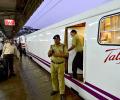
Railways is looking at similar light weight type trains for speedy run on the existing network
On the fifth day of the trial, the train covered 84 km in 38 minutes between Mathura and Palwal.
The semi-high-speed train was expected to complete the journey of 1,384 km in 12 hours and 35 minutes.
Locally manufactured coaches can achieve similar speeds as Talgo trains.

The train with nine lightweight coaches will start its journey at 7.55 PM from New Delhi station and is expected to reach Mumbai at about 8.31 AM in the morning

Next phase of trial will be conducted on Delhi-Mumbai route
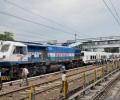
After the trial run on the Bareilly-Moradabad line, it will be tried on Rajdhani route between Mathura and Palwal for 40 days with speed up to 180 km per hour.
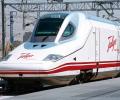
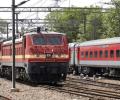
Talgo's Series 9 locomotive to cut Delhi-Mumbai travel time to 12 hours
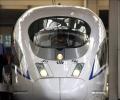
Currently, the travel time between Mumbai and Delhi varies between 16 and 30 hours.

The focus is now on having premium service to give passenger comfort and increasing train speeds.
As the national transporter is planning to come out with semi-high speed routes where trains can clock an average speed of 160-200 kmph, dedicated testing becomes essential.

Under the plan, there will be 151 private trains covering 109 routes which may entail investments worth Rs 30,000 crore.

Here's a recap of events that occurred in India in the past 24 hours.

CRRC Pioneer Electric (India) Private Limited, whose bid for the project is a joint venture of the Chinese firm CRRC Corporation Ltd with a Gurugram-based company according to its website, is one of the six contenders for the tender for procuring propulsion systems or electric traction kits for 44 trains to function as the Vande Bharat Express or Train 18.

Recent derailments had brought the vulnerability of the national carrier into the limelight. For the railways, the fund allotment of Rs 1 lakh crore towards safety, is a welcome move, says Subrat Nath.
Revamping Indian Railways will need bold thinking, and lots of money and time. And all three may be scarce, points out T N Ninan.
