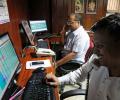
The market capitalisation of BSE-listed firms reached an all-time high of Rs 299.90 lakh crore on Wednesday despite the Sensex falling marginally after a remarkable record-breaking rally in the last few trading sessions. The 30-share BSE Sensex dipped 33.01 points or 0.05 per cent to settle at 65,446.04, after rallying in the past five trading straight sessions. During the day, the benchmark hit a low of 65,256.49 and a high of 65,584.33.

Bajaj Finance led the Sensex gainers' chart, spurting up to 2.38 per cent, followed by Bajaj Finserve rising 2.11 per cent and IndusInd Bank closing 1.66 per cent higher. Bharti Airtel, SBI and L&T increased by 1.60 per cent, 1.28 per cent and 0.92 per cent, respectively.
From the Sensex pack, Larsen & Toubro jumped 4.26 per cent to emerge as the biggest gainer, followed by IndusInd Bank, Tech Mahindra, State Bank of India, HCL Technologies, Power Grid, NTPC, Axis Bank, Kotak Mahindra Bank, HDFC Bank and Wipro. Mahindra & Mahindra, Infosys, UltraTech Cement and Hindustan Unilever were the major laggards.

rediffGURU Dev Ashish answers your personal finance and mutual fund queries.

Among the main gainers were Jio Financial Services which jumped 4.99 per cent, Tata Steel (2.09 per cent), Maruti Suzuki (1.87 per cent), M&M (1.31 per cent) and Infosys (1.19 per cent).

From the Sensex pack, IndusInd Bank, NTPC, Asian Paints, Hindustan Unilever, JSW Steel, Tech Mahindra, Bajaj Finance, Infosys, Wipro, ICICI Bank, Bajaj Finserv, HDFC Bank and Tata Motors were among the major laggards. HCL Technologies, Power Grid, Titan, Reliance Industries, UltraTech Cement, Tata Steel, State Bank of India and Mahindra & Mahindra were the gainers.

Wall Street-correlated stock markets are facing the risk of correction, as Christopher Wood, the global head of equity strategy at Jefferies, conveys to investors in his latest edition of GREED & fear. Rising crude oil prices, which are nearing $100 a barrel (Brent), pose a threat to the global central bank's battle against inflation and have led to a re-evaluation of its exposure to Indian stocks. "The potential for more US Federal Reserve (Fed) rate hikes, combined with the risk that monetary tightening finally bites as regards the economy, remains a risk for Wall Street-correlated world stock markets. "There is also the oil factor. This is why GREED & fear continues to believe the pain trade is down. "Areas in Asia, such as Indian midcaps, which have already done very well, are at obvious risk of some profit-taking," writes Wood.

The slowdown in corporate revenue growth over the last one year has begun to reflect in India Inc's capital expenditure, or capex. The country's top listed companies are going slow on fresh investment in capacity expansion, in line with a deceleration in their top line growth. The combined fixed assets of the listed companies, excluding banking, finance services and insurance (BFSI) and the government-owned oil & gas firms, were up 10.1 per cent year-on-year (Y-o-Y) during April-September 2023 (H1FY24) - the slowest in 18 months - as against 21.1 per cent Y-o-Y growth in H2FY23 (October 2022-March 2023) and 11.6 per cent growth in the April-September 2022 period (H1FY23).
Stock market minnows put up a stellar show in 2021 giving returns of up to 60 per cent amid Dalal Street dream run and are likely to continue sailing northwards in the New Year too. Trumping pandemic-induced uncertainties, the Indian equity market posted stunning gains this year achieving several feats and smaller stocks benefited the most from the strong momentum. From reaching the momentous 50,000-mark in January to scaling 61,000-level in October, the BSE Sensex had an epic journey this year.

'A cutback in hiring and compensation growth by IT companies will have a significant impact on consumer demand, especially in the urban sector of the economy.'

Investors' wealth eroded by Rs 3.46 lakh crore on Wednesday as equity markets took a sharp tumble amid weak global trends and foreign fund outflows. The 30-share BSE Sensex fell by 676.53 points or 1.02 per cent to settle at 65,782.78. During the day, it plunged 1,027.63 points or 1.54 per cent to 65,431.68. In line with the weak trend in equities, the market capitalisation of BSE-listed firms eroded by Rs 3,46,947.54 crore to Rs 3,03,33,258.69 crore.
The rumour verification process would now be triggered by changes in price or 'material price movements', as the paper defines it. What this means is that companies would need to verify rumours only if the share price moves significantly.

'Some risks to this market rally include inflation, erratic weather conditions, rising crude prices, slowing global growth and the resultant impact on domestic exports, escalation in geopolitical tensions.'

The net inflows into active equity mutual fund (MF) schemes registered more than a twofold month-on-month rise in August, crossing Rs 20,000 crore, the highest in five months. This rise in net inflows was boosted by an 18 per cent growth in gross investments, driven by a record Rs 15,800 crore inflow through the systematic investment plan (SIP) route and Rs 5,000 crore collected by seven new fund offers (NFOs) in the active equity space, reveals data released by the Association of Mutual Funds in India (Amfi). Moreover, redemptions moderated in August, declining by 19 per cent to Rs 24,580 crore, after staying elevated in the previous three months owing to profit booking.

The benchmark indices are set to end their five-month gaining streak, but the market breadth continues to hold strong So far this month, stocks gaining have outnumbered those declining, a sign that the bulls still have the upper hand, even as the pullback in the S&P BSE Sensex and the National Stock Exchange Nifty indicates otherwise. On the BSE, 2,126 stocks have advanced and 1,955 have declined in August, translating into an advance/decline ratio (ADR) of 1.1.
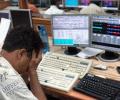
SBI was the biggest loser in the Sensex pack, tumbling 2.83 per cent, followed by Infosys, TCS, Bajaj Finance, Tech Mahindra, Wipro and Axis Bank. In contrast, Titan, L&T, NTPC, Power Grid, Sun Pharma, ITC and HDFC twins were among the prominent winners, rising as much as 1.97 per cent.

From the Sensex pack, Infosys tanked over 8 per cent after the company reported a lower-than-expected 11 per cent rise in net profit for the June quarter and delivered a shocker as it slashed its FY24 growth outlook to 1-3.5 per cent on delayed decision-making by clients amid global macro uncertainties. Hindustan Unilever, HCL Technologies, Wipro, and Tech Mahindra were the other major laggards. On the other hand, Larsen & Toubro rose the most by 3.88 per cent after it bagged an order of worth over Rs 7,000 crore from the bullet train project.

'We suggest an equity strategy of 5% to 10% exposure to cash, 5% to Gold ETF, close to 50% to Sensex/Nifty/large mid-cap stocks.'

Equity benchmark index Sensex buckled under selling pressure for the second straight session to close below the 65k mark on Friday, as investors offloaded IT, teck and metal stocks amid a bearish global trend. Besides, fresh foreign fund outflows also hit investor sentiments, traders said. In a volatile trade, the 30-share BSE Sensex declined 202.36 points or 0.31 per cent to settle at 64,948.66.

Rising for the second straight session, equity benchmark Sensex climbed 142 points on Thursday following buying in IT and finance stocks amid a higher opening in European markets. After a see-saw session, the 30-share BSE Sensex ended 142.43 points or 0.23 per cent higher at 60,806.22. During the day, the index witnessed a high of 60,863.63 and a low of 60,472.81.

Public-sector enterprise stocks have seen a good run thus far in 2023-24 (FY24), with the S&P BSE PSU Index surging by over 26 per cent during the period, compared to an 11 per cent increase in the benchmark S&P BSE Sensex.

Mutual funds focused on small-caps have emerged as the winner with a net inflow of close to Rs 11,000 crore in April-June quarter, as fund managers struggle to create alpha in the large-cap space, and the trend is expected to continue for some time. On the other hand, large-cap space, which is yet to pick up momentum, witnessed an outflow of Rs 3,360 crore during the quarter under review, data from the Association of Mutual Funds in India (Amfi) showed. Apart from the June quarter, small-cap funds logged an inflow of Rs 6,932 crore in three months that ended in March.

HCL Tech was the biggest loser on the Sensex chart, shedding 2.79 per cent, followed by Tata Steel, ICICI Bank, Reliance Industries, ITC, Wipro, Infosys and M&M. In contrast, Tata Motors, L&T, Bharti Airtel, HDFC Bank and SBI were among the winners, climbing up to 2.05 per cent.

The move to demerge the hotel business into a separate entity by ITC has brought back focus on hotel stocks, which have already seen a good run thus far in fiscal 2023-24 (FY24). Analysts believe there could be more gains in store over the next one year for the stocks in this sector, but suggest investors put in money on a correction only from a long-term perspective. Hotel stocks, according to A K Prabhakar, head of research at IDBI Capital, have seen a good run as travel picked up post Covid in India. Not only have the room rents increased, the occupancy, too, has surged.

IndusInd Bank was the biggest gainer on the Sensex chart, rising 4.75 per cent, followed by M&M, L&T, NTPC, ITC, Ultra Cement, Tata Steel, Maruti and SBI. In contrast, Bajaj Finance, Tech Mahindra, Infosys and Sun Pharma were among the losers, shedding up to 2.30 per cent.

The 55 basis point (bps) spike in the US 10-year bond yield, triggered by a combination of FOMC's hawkish commentary and BOJ's relaxation of the yield control curve (YCC) has made analysts cautious on Asian equities and expect them to trade sideways in the short-to-medium term.
HCL Tech led the Sensex gainers' chart, spurting 3.58 per cent, followed by UltraCement, Nestle India, Tata Steel, Kotak Bank, ICICI Bank, Bharti Airtel and HDFC twins. In contrast, ITC, Maruti, NTPC, Asian Paints and Sun Pharma were among the main laggards, shedding up to 1.51 per cent.
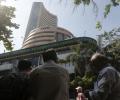
From the Sensex pack, Infosys, HCL Technologies, Infosys, NTPC, Mahindra & Mahindra, Tata Consultancy Services, Nestle, Tech Mahindra and Bajaj Finance were the major gainers. Power Grid, Larsen & Toubro, Maruti, Titan, HDFC Bank, Wipro, HDFC and ITC were among the laggards.
IndusInd Bank was the biggest loser in the Sensex pack, shedding 7.46 per cent, followed by SBI, Tata Motors, M&M, Bajaj Finserv, Axis Bank and Infosys. In contrast, Tech Mahindra was the only winner.

Investors became richer by over Rs 2.27 lakh crore on Monday as equities rebounded, with the BSE Sensex rallying over 1 per cent amid continuous foreign fund inflows and upbeat global markets. The 30-share BSE Sensex jumped 709.96 points or 1.16 per cent to settle at 61,764.25. During the day, it zoomed 799.9 points or 1.31 per cent to 61,854.19. Following the rally, the market capitalisation of BSE-listed firms jumped by Rs 2,27,794.46 crore to Rs 2,76,06,443.06 crore.

Investors became poorer by Rs 1.36 lakh crore on Friday as the markets witnessed a sell-off amid weak global trends. Benchmark stock indices Sensex tanked 671.15 points or 1.12 per cent to close at 59,135.13, as 21 of its scrips declined. The sharp decline in equities eroded Rs 1,36,037.96 crore from the market capitalisation of BSE-listed firms and that now stands at Rs 2,62,94,723.65 crore.

Kotak Mahindra Bank was the biggest loser from the Sensex pack, skidding 1.83 per cent, followed by Axis Bank, NTPC, Hindustan Unilever, ICICI Bank, Bharti Airtel, Reliance Industries, HCL Technologies, IndusInd Bank and Nestle. In contrast, Bajaj Finance, Bajaj Finserv, Tech Mahindra, Tata Consultancy Services, Titan, Infosys, HDFC Bank, HDFC and ITC were the gainers.

Benchmark Sensex dropped 334 points on Monday due to intense selling pressure in metal and power stocks as FII outflows dampened investor sentiment. Besides, a sharp decline in the rupee against the US dollar also put pressure on domestic equities, traders said. After losing nearly 500 points, the 30-share BSE index recovered some lost ground to settle at 334.98 points or 0.55 per cent lower at 60,506.90. During the session, the index touched its intra-day low of 60,345.61.

Stock market investors became poorer by Rs 8.30 lakh crore as equities continued their slide for the sixth consecutive day on Friday. The BSE Sensex has tumbled 1,855.58 points or 3 per cent since February 16. During this period, the combined market capitalisation of BSE-listed firms has tanked Rs 8,30,322.61 crore to reach Rs 2,60,00,662.99 crore. "The domestic market is broadly demonstrating a lack of confidence, registering its sixth consecutive day of losses despite global markets turning green.

Among the Sensex firms, Bajaj Finserv, Tata Motors, Asian Paints, ITC, IndusInd Bank, State Bank of India, Tata Steel, Wipro, Infosys and Maruti were the major gainers. Tech Mahindra, HCL Technologies, Kotak Mahindra Bank, Titan and Larsen & Toubro were the major laggards.

Smaller stocks have continued to give higher returns to equity investors so far this fiscal, significantly outperforming bigger peers on indices. The BSE smallcap index has zoomed 7,333.47 points or 35.51 per cent, while midcap index has jumped 5,096.41 points or 25.25 per cent so far this fiscal. In comparison, the 30-share BSE benchmark Sensex has gained 9,797.78 points or 19.78 per cent.

The sharp rally in the broader markets has propelled India's market capitalisation (m-cap) to a new high. The combined m-cap of all BSE-listed firms rose to Rs 291.9 trillion in intraday trade on Thursday before settling lower at Rs 290.9 trillion. The previous record was on December 14, 2022, at Rs 291.3 trillion.

Investors' wealth climbed Rs 3.20 lakh crore as markets staged a smart comeback on Wednesday after falling in the last eight trading sessions. The BSE Sensex rallied 448.96 points or 0.76 per cent to settle at 59,411.08. During the day, it jumped 513.33 points or 0.87 per cent to 59,475.45.

With the markets scaling new highs, as many as 43 stocks from the Nifty50 index and 27 of the 30 scrips that are part of the S&P BSE Sensex are trading above their respective 200-day moving average (DMA). The 200-DMA is seen as one of the most relevant trend indicators by investors and traders, who believe that stocks and indices trading above this level possess strength and are likely to rally in the short to medium term, while the ones trading below this level are viewed as bearish and expected to see a sell-off. Wipro, UPL, Kotak Mahindra Bank, Hindalco, Infosys, Cipla, and Adani Enterprises are the only stocks from the Nifty50 pack that are still below their respective 200-DMA, the exchange data suggests.

The sharp rally in the markets thus far in fiscal 2023-24 (FY24) has left analysts struggling to find investment-worthy themes. The S&P BSE Sensex has surged nearly 7 per cent thus far in FY24 and hit a fresh 52-week high of 63,601.71 levels on June 22, mostly led by foreign institutional (FII) flows. "The Indian market has seen a broad rally in the past few months but headline indices have seen more modest performance. "We are not very clear about the reasons for the rally and the divergent performance and struggle to find ideas in the consumption, investment and outsourcing sectors after the sharp run-up in several of our favored sectors and stocks in the past two months," wrote Sanjeev Prasad, co-head, Kotak Institutional Equities, in a recent co-authored note with Anindya Bhowmik and Sunita Baldawa.
