
Active largecap funds, which have the toughest job in terms of outperforming the benchmark, did better in 2023 as their bets in the mid and smallcap stocks paid off.

10 largecaps stocks which stand to gain from the Budget.

The IPO filing-to-approval lapsing ratio this year is the best in three years, underscoring the improvement in the IPO market's buoyancy.

All sectoral indices ended lower. BSE Telecommunication tanked 2.18 per cent, metal (1.77 per cent), auto (1.70 per cent), energy (1.64 per cent), oil & gas (1.59 per cent), commodities (1.39 per cent) and financial services (1.37 per cent) were the major laggards.

'Ideally, one should not time SIPs.' 'If people churn their SIP portfolios, then they are equating the concept of SIPs to lump sums.'

The market breadth was negative. 1153 stocks had declied while 804 had advanced.
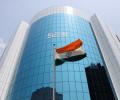
The market regulator's newly proposed selection criteria for the over Rs 400-trillion-a-day futures and options (F&O) market could pave the way for the entry of popular stocks such as Life Insurance Corporation (LIC) of India, Jio Financial Services, Zomato, Paytm, DMart, and Adani Energy into the derivatives segment. The Indian derivatives market, which accounts for most of the trading volumes, could see big churn with over two dozen exits from the current list of 182 stocks due to an upward revision in the eligibility thresholds.

Smaller stocks have emerged as Dalal Street's favourites in 2023 that has turned out to be a "great year" for equities, rewarding investors with big gains, driven by optimism over the country's macroeconomic fundamentals and heavy retail investors participation. Experts said equity markets are experiencing a prolonged bull run and it is during this time that the midcap and smallcap segments tend to outshine their larger counterparts. Till December 22 this year, the BSE smallcap gauge has jumped 13,074.96 points or 45.20 per cent while the midcap index has surged 10,568.18 points or 41.74 per cent.

A little over 2,400 BSE-listed stocks ended with gains in April amid a sharp rebound in the broader markets from the March lows. This was the highest number of stocks that rose during a calendar month, as per data provided on BSE's website. The previous high was 2,322 gainers recorded in January.

Passive funds tracking the National Stock Exchange Nifty Next 50 Index have seen their assets under management (AUM) more than double in the past year. The index's growing popularity can be attributed to its robust 50 per cent return over the same period. Currently, the AUM of funds tracking the Nifty Next 50 index stands at nearly Rs 30,000 crore.

Dalal Street had a roller coaster ride in 2024 from shattering record after record to facing heavy correction off-late but equity markets still rewarded investors with positive returns, driven by a surge in domestic fund flows and a resilient macro landscape. The first half of the year saw robust corporate earnings, a surge in domestic flows, and a resilient macro landscape, driving the Nifty to an all-time high of 26,277.35 in September 2024, according to Motilal Oswal Wealth Management.

Ask rediffGURU and PF and MF expert Janak Patel your mutual fund and personal finance-related questions.

Equity benchmark index Sensex on Wednesday crashed over 900 points to sink below the 73,000 level due to widespread selling pressure amid a sharp fall in smallcap and midcap indices. Besides, deep losses in utility, energy and metal stocks and recent selling by foreign investors added to the gloom, analysts said. Benchmark indices started the session on a positive note, but the selling intensified during afternoon trade, with all sectoral indices ending in the red.

The rally in the equity markets in the second half of 2023 has led to a sharp surge in the cutoff for stocks to qualify as largecaps and midcaps. On the latest list put out by the Association of Mutual Funds in India (Amfi), the smallest largecap stock now has a market capitalisation (m-cap) of Rs 67,000 crore, 35 per cent higher than in July 2023. In the case of midcaps, the cutoff has surged 26 per cent to Rs 22,000 crore.

Among major Sensex gainers, Mahindra & Mahindra rose the most by 3.29 per cent. Adani Ports gained 1.26 per cent, Tata Motors by 1.14 per cent, and Axis Bank by 0.92 per cent. Nestle, NTPC, Reliance, ITC Titan, Kotak Bank, Infosys and TCS also gained. HCL Tech, Tech Mahindra, and ICICI Bank were the losers.

As regards mid-caps and small-caps, analysts suggest investors buy only those stocks of those companies where there is earnings visibility for at least a few quarters and where the valuations have become reasonable.

'As the markets are expected to remain jittery in the near term, we advise investors to use this opportunity to enter quality largecaps from a long-term perspective.'

Business cycle funds aim to optimise returns by aligning their portfolios with different phases of the economic cycle. First-time investors, those who prefer stable sector allocations, and those averse to volatility should steer clear of them.

'...you evaluate three key factors before committing your money.'

With a deployment of Rs 2,720 crore in July, MFs' total investment in HDFC Bank in calendar year 2024 (till now) surged to Rs 48,820 crore.
Small and midcap schemes may impose restrictions on redemptions, cap employee withdrawals, and increase the exit load, while ensuring a proportionate liquidation of the portfolio during market crises to safeguard the interests of all investors. These measures have been outlined in the investor protection policies recently put out by mutual fund (MF) trustees. The policies for small and midcap schemes were prepared by MF trustees following directives from the Securities and Exchange Board of India (Sebi) earlier this month.

'On the weekly chart, the Nifty 50 index has formed a bearish candle and remains below all short-term moving averages.'

'While investors need to be prepared for making some losses, they should not lose big money chasing euphoria amid fear of missing out.'

'We expect the bull-market phase to still persist, but now led by large-caps which offer better valuation and benefit from FII inflows.'
'We expect continued pressure on midcaps, but any sharp correction looks unlikely from here on.'

'The economy is clearly at a very soft spot, and earnings growth is disappointing every day.' 'After three great years, the Indian economy has hit a rough patch.'

Build a portfolio diversified across market caps, investment styles, and geographies.

Riding the wave of the equity market, the mutual fund (MF) industry experienced double-digit growth in Samvat 2079, concluding the Hindu calendar year close to the Rs 50 trillion assets under management milestone. After a subdued 6 per cent growth in Samvat 2078, the industry's assets surged over 18 per cent last year to Rs 46.7 trillion. Industry players anticipate that Samvat 2080 will also be a fruitful year for the asset management industry, given the strong inflows from retail investors, particularly through the systematic investment plan route.

'...which is possible through flexicap and multicap funds.' 'The latter has a better balance between large, mid and smallcap stocks.'

From the Sensex basket, Mahindra & Mahindra, Tata Motors, NTPC, HCL Technologies, Larsen & Toubro, Infosys, Tech Mahindra and State Bank of India were the major laggards. Bharti Airtel, Bajaj Finance, Bajaj Finserv, Tata Consultancy Services and IndusInd Bank were among the gainers.

Mutual funds (MFs) added systematic investment plan (SIP) accounts at a record pace in 2023 with the net additions in the calendar year surpassing 15 million - 24 per cent higher than the 2022 tally of 12.2 million, according to data from the Association of Mutual Funds in India (Amfi).

From Sensex firms, Tech Mahindra, Mahindra & Mahindra, Tata Motors, UltraTech Cement, Tata Consultancy Services, HCL Technologies, ICICI Bank and Tata Steel were the biggest gainers. Sun Pharma emerged as the only laggard.
From the 30 Sensex firms, Larsen & Toubro, Reliance Industries, Axis Bank, Asian Paints, Tata Motors, Bajaj Finance, Maruti, Bajaj Finserv, Kotak Mahindra Bank, Titan, Adani Ports and HDFC Bank were the major laggards. JSW Steel emerged as the only gainer.

Benchmark Sensex closed above the 85,000 level for the first time while Nifty scaled the 26,000 peak at close on Wednesday as fag-end buying in banking and power shares helped stock markets recoup early losses. After a see-saw trade during the day, the 30-share BSE Sensex rose by 255.83 points or 0.30 per cent to settle at an all-time high of 85,169.87. During the day, it surged 333.38 points or 0.39 per cent to hit a record intra-day peak of 85,247.42.

'Asset allocation should change only if your goals, life situation, or risk profile have changed.'

India's stock markets are experiencing a shift in investor sentiment, with a 30 per cent surge in Chinese stocks, prompting investors to move money from domestic markets to China. This reversal of fortunes is a notable change from the past three years, where China's losses benefited India.

'Those satisfied with returns and not expecting further rally could be booking profits and also stopping SIPs.'

A portfolio can be rebalanced by either selling a portion of the outperforming asset class or by buying more of the underperforming asset class.

China has stayed on top for two consecutive months in the MSCI Emerging Markets Investable Market Index (EM IMI), after ceding the position to India in August. At the end of October, China's weight in the key EM gauge stood at 24.72 per cent, up from 21.58 per cent at the end of August. India's weight during this period has slipped to 20.42 per cent from 22.27 per cent.

If you already hold significant amounts of equity in your portfolio, avoid MAAFs with over 60 per cent equity. But if you lack equity exposure, an aggressive MAAF may be appropriate.

Hong Kong has regained its spot as the world's fourth-largest market following a broad market rout in Indian equities. Currently, the Chinese territory's market capitalisation stands at $4.9 trillion versus India's $4.75 trillion, according to data compiled by Bloomberg. In January, the domestic equity markets' market capitalisation had surpassed that of Hong Kong following a spectacular rally in the small- and midcap stocks.
