
As per SIAM data, vehicle sales across categories, including passenger vehicles and two-wheelers and commercial vehicles stood at 18,21,490 units last month as against 23,82,436 units in August 2018, a fall of 23.55 per cent.

Passenger vehicle sales in India could hit a record of over 38 lakh units in FY23 but the strong growth momentum is not expected to carry over to 2023-24 with pent-up demand already been released, according to Tata Motors Passenger Vehicles managing director Shailesh Chandra.

New participants included Chinese players such as Great Wall Motors and Haima Automobile along with Olectra.
The optimism stems from benign fuel prices, adequate and well distributed rainfall and the recent measures announced by the government to boost liquidity at banks and NBFCs.

With much sadness, so many of us woke up to the news that Vikram Kirloskar, vice-chairperson of Toyota Kirloskar Motor, had passed away late Tuesday. As I reminisce on the nearly 40 years I have known him, I can unequivocally say that he had such a rare and deep understanding and passion for automotive manufacturing that it would make Toyota, which pioneered the Toyota Way, proud. Many of us know Vikram as the man who brought the iconic Japanese carmaker Toyota to India. But few know the back story and hard work that went into creating a system of manufacturing that was everything Toyota could have hoped for and then some more because it was perfectly calibrated for manufacturing in India.

Reliance Industries Ltd will acquire German firm Metro AG's wholesale operations in India for Rs 2,850 crore as the conglomerate run by billionaire Mukesh Ambani seeks to strengthen its dominant position in India's mammoth retail sector. "Reliance Retail Ventures Limited (RRVL), a subsidiary of Reliance Industries Ltd, signed definitive agreements to acquire a 100 per cent equity stake in Metro Cash & Carry India for a total cash consideration of Rs 2,850 crore, subject to closing adjustments," said a joint statement. Through this acquisition, Reliance Retail will get access to a network of Metro India stores located in prime locations across key cities, along with a large base of registered kiranas and other institutional customers, and a strong supplier network.

It came on the back of tepid dispatches in the March quarter as consumer sentiment took a knocking, owing to uncertainty ahead of the general election.

The growth in the PV segment was primarily led by car market leader, Maruti Suzuki India, which saw its dispatches to dealers grow 4.4 per cent YoY to 144,277 units after 10 months of drop. It was driven by new launches, such as the S-Presso, a mini sport UV.

Domestic passenger vehicle sales dropped by 17.54 per cent to 2.25 lakh units in June from 2.73 lakh units in the same month of previous year, data released on Wednesday by an apex industry body showed.

Auto Expo's Twitter handle (@AEMotorShow), with a follower base of 16,000, is abuzz with activity. The Facebook page of Auto Expo has about 158,000 followers.

The increase in PV sales in September was driven by festive season purchases, with SUV models like Maruti Suzuki's Brezza, Hyundai Creta, Mahindra Scorpio, Ford Ecosport and Honda W-RV witnessing good traction

Domestic passenger vehicle sales declined 0.84 per cent to 2,63,773 units in November from 2,66,000 units in the year-ago period. Motorcycle sales, too, declined 14.87 per cent to 8,93,538 units. Vehicle sales across categories registered a decline of 12.05 per cent to 17,92,415 units from 20,38,007 units in November 2018.
Data issued by Siam shows sale of PVs (cars, vans and utility vehicles) grew 14.3 per cent to 275,417 vehicles.

In a rare face off, captains of the auto industry have hit out at the government for not walking the talk. At an industry event in the capital on Wednesday, R C Bhargava, chairman of India's largest carmaker Maruti Suzuki, and Venu Srinivasan, chairman of TVS Motor, questioned the government's intent to support the auto sector. Revenue secretary Tarun Bajaj sat in the audience listening, before his turn came to counter them.

"There were discussions and the ministry had received suggestions that petrol-diesel vehicles should be banned. I would like to clarify that the government does not intend to ban petrol and diesel vehicles. We are not going to do anything like that," Gadkari said, addressing a gathering at the Society of Indian Automobile Manufacturers (SIAM) annual convention, 2019.

Durable, automobile and real estate players have been lobbying hard for a tax cut, saying it will boost demand.

The list clearly shows the dominance of Maruti and Hyundai in the Indian passenger vehicle market.
Vehicle sales across categories registered a decline of 8.62 per cent to 20,86,358 units from 22,83,262 units in May 2018.
The final Budget for the fiscal is likely to be tabled in July after formation of the new government.

Sales of commercial vehicles rose 5.30 per cent to 52,481 units in January this year, SIAM said.
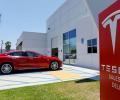
Making it clear that relaxations will not be provided to US-based electric vehicles major Tesla unless it participates in manufacturing activities in India, Union Minister Krishan Pal Gurjar on Tuesday said there cannot be a situation where the market is India but jobs are created in China. The minister of state for heavy industries also told the Lok Sabha during Question Hour that the company is yet to apply for schemes as per the government's policy. Last year, the Elon Musk-led company sought a reduction in import duties on electric vehicles (EVs) in India but the Ministry of Heavy Industries asked the firm to start manufacturing its iconic EVs in the country before any tax concessions can be considered.

During the meeting with Finance Minister Nirmala Sitharaman, the auto industry broadly presented factors such as issues regarding availability and affordability of financing, increasing cost of acquisition of vehicles and change in axle load capacity for commercial vehicles that have hurt demand.
Scooters, once the fastest growing sub-segment, also declined for the second consecutive month in September.

First off the block will be a new multi-purpose vehicle which is being co-developed with Toyota - Suzuki's alliance partner. The model will also wear a Toyota badge.

Total two-wheeler sales in June rose 3.55 per cent to 13,07,710 units.

In the 2012-13, car sales in India fell 6.69 per cent, which was the first decline in a decade.

While commercial vehicles are expected to benefit from strong replacement demand, the two-wheeler and tractor segments are expected to gain from a recovery in the rural economy.

Sales of commercial vehicles were up 7.58 per cent to 52,198 units in August, SIAM said.
The economy segment of India's car market is unlikely to revive soon term as inflation and prices prompt buyers to defer purchases. The share of entry-level cars in the passenger vehicle market dropped to the lowest in seven years at the end of the Financial Year 2021-22 (FY22). A recovery in the segment will be largely driven by the overall economic growth, improvement in income levels, and easing of semiconductor shortage, say carmakers and analysts.

The inspection and subsequent rectification will be carried out free of cost for all Rexton customers

According to the data released by Society of Indian Automobile Manufacturers (SIAM), domestic car sales in October this year stood at 1,59,036 units as compared to 1,63,199 units in the same month of 2013.

Hero MotoCorp, Honda Motorcycles, Scooters India, TVS, Honda India, Toyota Kirloskar Motor, Ford, Nissan, Ashok Leyland are all giving the Auto Expo a miss this time.

Demand for passenger vehicles has been driven by new models, especially in the SUV category with the likes of Maruti Vitara Brezza and Hyundai Creta clocking good numbers
Large number of buyers has put purchases on hold because of a combination of factors, including high fuel prices, higher insurance cost, and firm interest rates.

Car sales in India fell for a record seventh consecutive month in May with a decline of 12.26 per cent, prompting industry body SIAM to caution that the prolonged slump in the market could result in job losses in the automobile sector.

Commercial vehicles however declined by 2.83%

India's biggest car maker Maruti Suzuki said on Tuesday that its vehicle production in September will tumble by 60 per cent due to chip shortage. The company, which had earlier cut down production at its Gujarat plant, said the chip shortage will hit production in Gurugram and Manesar plants, effectively forcing the automaker to cut production by 60 per cent. Owing to a supply constraint of electronic components due to semiconductor shortage, the company is expecting an adverse impact on vehicle production in September in both Haryana and its contract manufacturing company, Suzuki Motor Gujarat Pvt Ltd. (SMG) in Gujarat.
Declining motorcycle sales remained a cause of worry.
Gloomy macro-economic factors and negative sentiments continue to hit demand.
Under the policy, which is applicable for all manufacturers, from two-wheelers to commercial vehicles, if a company is of the opinion that there is a manufacturing defect that compromises safety of vehicles, it will voluntarily rectify the problem free of cost to the customer.
