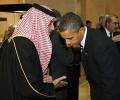
Further deterioration of the US-Saudi relationship will have geo-economic and geopolitical effects, says Nitin Pai.

It's a packed 5-nation, 9-day, visit for Prime Minister Modi as he heads to Uzbekistan, Kazakhstan, Kyrgyzstan, Turkmenistan and Tajikistan, apart from Ufa in Russia.

'Living in Brazil, I had internalised the football mythology of that country, the way I had learnt Mahabharata stories in my childhood. The tragedy at the Maracana stadium in 1950, when a confident Brazil had lost to Uruguay in the finals. They tell the story of this debacle, this 'Hiroshima' that hit them, like the Shias lament the death of Ali. It led to the Brazilian team burning their white uniforms and switching later to Yellow and blue symbolising their national colours,' says Ambassador B S Prakash, India's former envoy to Brazil.
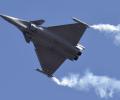
Every demand of the armed forces remains essentially anchored to 1964 and its fulfilment or otherwise largely a function of money availability

Will Citibank gain from India's position among emerging markets?

Narendra Modi's engagement at the upcoming BRICS Summit in Brazil will be keenly watched as the prime minister will interact with some of the world's most powerful leaders. The summit to be held in Fortaleza will also see the launch of the significant BRICS bank whose idea was mooted by India. Rediff.com's Sheela Bhatt gives a lowdown on Modi's first major international rendezvous.

Higher growth, reform bets have boosted returns but leave limited room for error.

If the chemistry between Modi and Xi Jinping goes well, it will herald a new future not just for the region but for the world, says Tarun Vijay.

Has New Delhi internalised the truth that it does not matter, asks Saeed Naqvi. Such deafening silence from the government, principal opposition, even the pundits!
The second and final part of former cabinet secretary Naresh Chandra's interview to Sheela Bhatt.

PM Modi seems to be gradually ending India's strategic ambiguity

What is so honourable in defending or dis-honourable in not defending the 'Johnson line' in Aksai Chin? That is a question that needs to be asked to the Indian shouting brigade. The Chinese also need to be asked as to why they wish to implement the 'MacDonald McCartney' line drawn by British Imperialists? asks Col (retd) Anil Athale.

On Thursday, November 6, the Washington Post newspaper reported that controversial American diplomat, Ambassador Robin Raphel, had her office and home searched by the FBI. This most unusual development likely raised much cheer at India's ministry of external affairs, in whose flesh Raphel had been a thorn through much of her tenure in the first Bill Clinton administration in the early and mid-1990s by her anti-India and pro-Pakistan stand. Seventeen years ago, as she was about to step down as Assistant Secretary of State for South Asian Affairs, Raphel granted an exclusive interview to Aziz Haniffa and India Abroad, the leading Indian-American weekly newspaper, which is now owned by Rediff.com The July 1997 interview, which provoked a raging controversy in both capitals, Washington, DC and New Delhi, is reproduced here...

'My wife was asked to get out of an autorickshaw because she was married to me. My children were targeted and branded a traitor's children. In spite of the Supreme Court and the NHRC having cleared my case, the state government is yet to close it. Local politicians are behind this. Why can't they close the case, give me compensation, accepting gracefully that they have wronged me?' Dr S Nambi Narayanan, the scientist who was accused and then exonerated in the 1994 ISRO spying case, speaks to Rediff.com's Shobha Warrier about his continuing travails and his recent meeting with Narendra Modi.

With Beijing having had a profound rethink on India's admission as a full member of the Shanghai Cooperation Organisation, the tectonic plates of the geopolitics of a massive swathe of the planet stretching from the Asia-Pacific to West Asia are dramatically shifting. That grating noise in the Central Asian steppes will be heard far and wide -- as far as North America, says Ambassador M K Bhadrakumar.

'It is only because we were facing US threats that we were able to successfully develop a nuclear programme of our own.'
