
Real estate, or property, is one of the one of the major asset classes people the world over invest in. Such real estate could be residential house property, whether self-occupied or let out, commercial property, whether used for one's own business or profession or meant for letting out, farm house, agricultural, urban and rural lands, and so on. Through proper planning it is possible to save a great deal of tax on real estate investments -- on income and on capital gains.

CBI officials, however, said no such evidence had so far been found. CBI, on receiving a tipoff from its sources, found that a private financial services company, its chairman and managing director, and other associates were allegedly bribing senior officials of public sector banks and financial institutions for facilitating largescale corporate loans.

The mega real estate loan scam could delay the initial public offers of over half a dozen real estate developers because of poor investor sentiment, said bankers and analysts tracking the sector.

Real estate players say they are in talks with companies to build their customised stores in India.

Despite headwinds, it remains "structurally bullish" on India and expects the Sensex to scale up to the 70,000-mark by December 2022; 80,000 level in a bull-case scenario and hover around the 50,000-mark as a bear-case, the brokerage house said in a report.
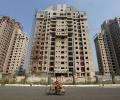
Property sales have been sluggish and the sector has been facing headwinds. So, firms are in wait-and-watch mode.
The sources said the company had provisioned to open one or two new stores every month during this financial year. The hypermarkets will offer a range of digital, food and lifestyle products.

According to the report released by brokerage firm Religare Securities, the festive discounts and promotional offers by the builders will boost the volumes, which may also result in an upside of about 10 per cent in the property prices.

Ajit Mishra, vice president, Research, Religare Broking, answers your queries.

the 2015 figure also showed how developers had absorbed some of the increased holding costs.

The Supreme Court on Wednesday directed a full-fledged probe into the collusion of Tihar jail officials with Unitech's imprisoned ex-promoters Sanjay and Ajay Chandra, based on Delhi police commissioner Rakesh Asthana's report filed in a sealed cover.
Ascendas, which manages property trusts in Asia, said it will set up the $324 million Ascendas India Development Trust to invest in Indian real estate projects.
Consultants expect the sector to grow 20-25% next calendar year.

The Indian stock market is in the midst of a great bull run. Indiabulls, a prominent name in the financial services arena, applies for a licence for mutual fund operations.
The farmers' agitation, spread over months, had halted construction and delayed supply of thousands of residential units.

Loans for Indian airlines have dried up as banks have become cautious to lend to the sector.

Axis Bank was the top gainer in the Sensex pack, surging around 4 per cent, followed by M&M, HDFC Bank, ITC, SBI, ICICI Bank, Maruti, Kotak Bank and Sun Pharma. On the other hand, HDFC, Titan, Nestle India, Bharti Airtel, ONGC and Infosys were among the laggards.

Home sales slow after price spurt, but office market picks up as economy does.
Asset sale plans lag target in both current and next financial years; the airline had a three-year plan to monetise assets worth Rs 5,000 crore (Rs 50 billion) by March 2016.

Bangladesh has proclaimed an order to redesign the capital city, requiring reclamation of 3,000 acres of land occupied by influential real estate companies, earlier dubbed as "land pirates" by senior government leaders.

In an hour-long chat on rediff.com on Thursday, financial planning expert Sailesh Multani offered some valuable investment tips.

For instance, Rajiv Swagruha Corporation Limited, the affordable-housing wing of the state government, has an exclusive project for senior citizens at Bandlaguda on the city outskirts.

In the quarter ended September 30, the Pirojsha Godrej-led firm recorded Rs 492 crore net sales, up 49% year-on-year

Mumbai, India's financial capital, is set for a mega transformation with a massive patch of land opening up for redevelopment; a new metro railway ready to start services by the year-end; and the country's oldest railway station, the Chhatrapati Shivaji Terminus, going for modernisation with private sector participation. Work on Mumbai's second airport will start from next month, while construction of the sea link connecting central Mumbai to Navi Mumbai has already moved into a fast lane despite Covid-induced lockdowns. Also, a coastal road project, connecting Nariman Point to Worli, is under way and will help decongest the city to quite an extent. Of all these mega infrastructure projects, the one that has a huge potential to change the city's skyline is the Eastern Waterfront project - to be built on the Mumbai Port Trust (MbPT) land.
Do the lower prices of pre-launch offers look attractive to you? Be careful, for you could fall easy prey for dubious developers of the so-called 'future projects.'
Riding high on the recent success of pure-play real estate biggies in the Indian capital market, another realty firm is taking one step further by aiming to list on London Stock Exchange to raise about Rs 1,520 crore
Indians are among the top property investors among non-Arabs in Dubai following British nationals who top the list

The central bank may increase both repo and reverse repo rates by another 25 basis points each in the next policy meeting.
An early stage venture capital fund recently raised a Rs 100 crore (Rs 1 billion) Mauritius-based fund to invest in Indian real estate and plans to raise a similar fund later this year.

The Budget has proposed a Benami Transactions (Prohibition) Bill.

The party's CM choice came as a surprise for many as the low-profile, first-time legislator was not seen to be among the top contenders for the post.

The model offers homes with sports facilities like race tracks.

Sun Pharma was the top gainer in the Sensex pack, rising over 5 per cent, followed by IndusInd Bank, Tech Mahindra, ONGC, Bharti Airtel, Infosys, ICICI Bank and Bajaj Auto. On the other hand, Kotak Bank, Nestle India, Titan, Bajaj Finance, HDFC Bank and NTPC were among the laggards.

Real estate players also report an increase in demand from the IT sector.

The Maharashtra government has decided to increase floor space index (FSI) to 3 from the current 2.5 for buildings which have come up between 1940 and 1960. The decision opens up the possibility for redeveloping 16,461 old buildings.
HDFC chairman Deepak Parekh on Monday said that he expected property prices to come down by 20 per cent in the next six months even as there is an upward pressure on interest rates.
 © 2026 Rediff.com - Advertise with us - Disclaimer - Privacy Policy - Sitemap - Feedback - About us - Terms of use - Grievances