
Experts believe that states will be in a predicament because of their tight fiscal position and reluctance to replace their own health schemes with this newly announced National Health Protection Scheme.
Net direct tax collection in the April-June quarter of the current fiscal rose by 41 per cent to Rs 3,54,569.74 crore, Minister of State for Finance Pankaj Chaudhary informed the Lok Sabha. During the April-June period of 2021-22, the government had collected a net direct tax of Rs 2,50,881.08 crore. At the same time, net indirect tax collection including Goods and Services Tax (GST) and custom duty increased by 9.4 per cent to Rs 3,44,056 crore as against Rs 3,14,476 crore in the first quarter of the previous fiscal, he said in a written reply.

Chaudhary also said that 66 per cent of government-sponsored health insurance schemes in the country are being run by the central government. "When the COVID-19 pandemic started, a decision was made for sale of all medicines at the GST rate between 5 and 12 per cent and the GST rate for COVID-19 related medicines and instruments has been reduced to five per cent," he said during the Question Hour.

Announcing this while presenting the Budget in Parliament on Monday, the Finance Minister Pranab Mukherjee said that Rs 350 crore, marking a 40 per cent increase over the previous allocation is being provided in the 2009-10 BE for this.
The government has decided to extend health insurance cover to sections such as rickshaw pullers, rag pickers, mine workers, sanitation workers, and auto rickshaw and taxi drivers.
The Brookings Institution, a think tank associated closely with the US administration, recently expressed keen interest in it.

The government on Friday said it intended extending coverage of its flagship health insurance scheme for poor families to auto-rickshaw drivers, cycle rickshaw pullers, street vendors and rag-pickers.
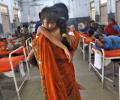
'If you look at household hospitalisation compensation, then you will find only one-third is hospitalisation. Two-thirds is outpatient.' 'Even if you provide Rs 5 lakh coverage, people will still have a tough time.'

All the poor people identified by the Socio Economic and Caste Census 2011 will be eligible for the scheme, officials said, adding that it will be linked to Aadhar but will not be a mandatory condition for availing the benefit.
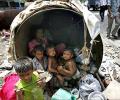
Beneficiaries to get hospitalisation cover up to Rs 30,000.
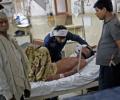
States are now gearing up to implement the scheme, integrating it with their own public health insurance plans and tying up the loose ends.
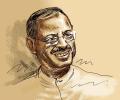
Anil Swarup, who conceived the Rashtriya Swasthya Bima Yojana -- a scheme the United Nations Development Programme and the International Labour Organisation recognised as among the finest -- speaks to Anjuli Bhargava.

The model is now being worked out between NITI Aayog and health ministry, he said, adding the date of implementation would be next financial year and some time in the course of the year it will be worked out.

Ayushman Bharat aims at providing a cover of Rs 5 lakh per family annually and is aimed at benefitting more than 10 crore poor families across the country.

By April, operational guidelines for the scheme will be finalised and shared with states
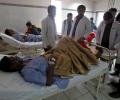
The budgetary allocation for the sector is Rs 60,908.22 crore, with Rs 6,400 crore earmarked for the centre's flagship health insurance scheme Ayushman Bharat- Pradhan Mantri Jan Arogya Yojna (AB-PMJAY).
Kunnal Prem, chief executive officer of the Insurance Information Bureau of India, tells Mayank Jain on what they're doing.

'The government is abdicating its responsibility on healthcare.' 'Just to start this scheme, it will take a minimum till October 2018 and elections are coming in 2019, so before that this can go into the dustbin.'
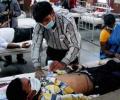
As a result of the mass state-led scheme, the processes in the health insurance market could get simplified over time and become uniform
 © 2026 Rediff.com - Advertise with us - Disclaimer - Privacy Policy - Sitemap - Feedback - About us - Terms of use - Grievances