
'If the war continue for a longer period of time, it is just a matter of time before the government will pass on some of the price increases.'

Financial Services Secretary M Nagaraju has urged banks to adopt the MuleHunter AI tool developed by RBI to identify and prevent mule accounts used in cyber financial frauds. The meeting also discussed 'Operation Octopus' by Hyderabad Police and emphasised coordinated efforts and intelligence sharing.

The Reserve Bank of India (RBI) is set to revise its directives for bank boards, aiming to alleviate operational burdens and enable them to concentrate on crucial policy and strategic decision-making, thereby enhancing corporate governance in the Indian banking sector.
Uncertainties stemming from the West Asia crisis and its potential impact on inflation and economic growth were key factors in the Reserve Bank of India's Monetary Policy Committee (MPC) decision to maintain the status quo on interest rates, according to the recently released MPC meeting minutes.

Reserve Bank of India (RBI) Governor Sanjay Malhotra stated that preventing second-round effects of supply shocks, where inflation expectations rise due to prolonged disruptions, is the primary role of monetary policy. He also defended the RBI's foreign exchange market interventions, asserting it did not commit to an 'indefensible peg'.

The Reserve Bank of India (RBI) has opted to keep its key interest rates unchanged at 5.25%, anticipating a global economic recovery following a ceasefire in the US/Israel-Iran conflict, despite ongoing inflationary pressures and currency fluctuations.

The Reserve Bank of India (RBI) Governor Sanjay Malhotra is now confronting the classic growth-inflation tradeoff, a situation exacerbated by the West Asia war, which threatens to end the 'goldilocks period' of low inflation and robust growth.

In the draft norms issued last month, the RBI said that the ultimate responsibility for the bank's performance, conduct and control rests with the Board

The Indian rupee weakened against the US dollar due to geopolitical tensions surrounding the Strait of Hormuz and ahead of the Reserve Bank of India's monetary policy review.

The Indian stock market is poised for a volatile week, influenced by the Reserve Bank of India's monetary policy decision, crucial global macroeconomic data, and the escalating geopolitical tensions in West Asia, according to market analysts.

Markets will look for clear guidance on how the MPC interprets the uncertainty and what it implies for the future course of monetary policy, points out Rajeswari Sengupta.

The Reserve Bank of India (RBI) has issued a statement assuring the public of HDFC Bank's stability and sound financial position following the resignation of its chairman, Atanu Chakraborty, citing ethical concerns.
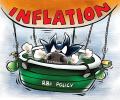
The Indian government has extended the Reserve Bank of India's (RBI) mandate to maintain retail inflation at 4 per cent, with a tolerance band of 2 per cent on either side, for another five years until March 2031.
"It is quite possible that the rates will remain low in the near to medium term, but that will depend on how conditions evolve," said RBI Governor Sanjay Malhotra.

The Indian government has issued an updated Standard Operating Procedure (SOP) for processing Foreign Direct Investment (FDI) applications, aiming to clear all proposals within 12 weeks, a two-week extension from the previous 10-week target, to ensure a fully paperless and transparent process.

The Enforcement Directorate has reported a staggering 170 per cent surge in asset attachments, reaching 81,422 crore in the last financial year (FY26), underscoring its intensified efforts against financial crimes and its significant role in restituting funds to victims.

Reserve Bank Governor Sanjay Malhotra on Friday said the key policy rates will remain at low levels for a long period and may go down even further.
After a 25 basis point rate cut in December, the RBI on Friday decided to pause on the policy rate front amid geopolitical uncertainties.

The Indian rupee saw a significant appreciation against the US dollar following President Trump's suspension of military strikes against Iran and the Reserve Bank of India's decision to maintain its key interest rate. Market sentiment was further buoyed by positive comments from the RBI regarding the health of the banking sector.
HDFC Bank reported an 8.04 per cent increase in its March quarter consolidated net profit to Rs 20,350.76 crore, but highlighted potential near-term risks for small-business borrowers due to the West Asia conflict. The bank's CEO also addressed the recent resignation of its non-executive chairman and hinted at a potential top-level reorganisation.

S Mahendra Dev, chairman of the Economic Advisory Council to the Prime Minister, expressed confidence that the rupee would stabilise around the 92-93 level against the US dollar, despite geopolitical tensions, and that foreign investment flows would return.

Indian stock markets experienced a significant rally following the announcement of a US-Iran ceasefire, coupled with a drop in crude oil prices. The Sensex and Nifty both closed nearly 4 per cent higher, mirroring gains in global markets.

'Being an important institution in the banking system, we are subject to regulatory supervision, both offsite and onsite.' 'When you look at the intensity at which these levels of supervision come, we, on the board and in management, believe there should not be any surprises.'

The Election Commission has warned against any lapses in maintaining law and order ahead of the West Bengal Assembly elections, questioning the absence of a Narcotics Advisory Committee in the state and directing strict monitoring of financial transactions.

HDFC Bank's leadership addresses the sudden resignation of its chairman, citing ethical concerns, and attempts to reassure stakeholders about the bank's governance and future stability.

Only bona fide victims would be compensated by banks within five days of receiving the complaint.
Strong domestic growth will continue to draw foreign investment into the Indian economy, Reserve Bank of India (RBI) Governor Sanjay Malhotra said on Tuesday. He said this was reflected in recent free trade agreements and investment commitments by large technology companies.

Sanjay Malhotra has made structural changes to banking regulation to bring down costs and increase efficiency. Plus, he kicked off a benign interest regime. But there are challenges ahead.

Even if the Reserve Bank of India's Monetary Policy Committee decided to hold interest rates in the October meeting, it acknowledged the scope for further rate cuts while waiting for the impact of the past steps to play out.

Atanu Chakraborty has resigned as chairman of HDFC Bank, citing ethical concerns, marking an unusual departure and prompting the appointment of an interim chairman.

'Rate cut looks unlikely and there is reason to believe that the cycle is over.'

Shrugging off concerns over the depreciation of rupee, the RBI has cut interest rate by 25 basis points to 5.25 per cent in a bid to further bolster economic growth, which rose to a six-quarter high of 8.2 per cent in the second quarter of the current financial year.

As the rupee remains under pressure due to several headwinds and the uncertainty around the India-US trade deal, the Reserve Bank of India (RBI) has been stepping in only to calm volatility, not to stop the fall.
From the Sensex firms, State Bank of India, Bajaj Finserv, Bajaj Finance, Maruti, HCL Tech, Larsen & Toubro, Mahindra & Mahindra and Infosys were among the major winners. However, Hindustan Unilever, Eternal, Tata Motors Passenger Vehicles, and Sun Pharma were among the laggards.

Fitch Ratings on Friday said persistently higher oil prices could cause India's retail inflation to rise faster than the expected gradual pace, and lead to a slowdown in economic growth in the first half of financial year 2026-27 (FY27).
Shrugging off concerns over the depreciation of rupee, the RBI has cut interest rate by 25 basis points to 5.25 per cent in a bid to further bolster economic growth, which rose to a six-quarter high of 8.2 per cent in the second quarter of the current financial year.

The consumer price index (CPI)-based inflation hitting an all-time low in October would encourage the six-member monetary policy committee (MPC) of the Reserve Bank of India (RBI) to cut the policy repo rate in its upcoming December 3-5 meeting. However, the July-September GDP growth, expected to be above 7 per cent, may act as a deterrent.

The Indian economy is growing at a robust pace, driven by strong domestic demand, low inflation, and the healthy balance sheets of banks, said a Reserve Bank report released on Wednesday.

Stock markets closed higher on Friday after the Reserve Bank of India kept its benchmark interest rate unchanged as expected and proposed allowing banks to lend to Real Estate Investment Trusts (REITs) with certain prudential safeguards to deepen the financing pool for the real estate sector.

The rupee appreciated 13 paise to close at 90.34 against the US dollar on Thursday, on trade deal optimism and overnight decline in commodity prices, even as the upside remained capped as investors look for more clarity on the India-US trade deal.
 © 2026 Rediff.com - Advertise with us - Disclaimer - Privacy Policy - Sitemap - Feedback - About us - Terms of use - Grievances