
Banks are also weighing the option of hiring experts for help in specialised areas.

The NITI Aayog has recommended privatisation of state-owned insurer United India Insurance Company as the government aims to move ahead with its new public sector enterprise (PSE) policy for Atmanirbhar Bharat. The policy think tank has suggested that the public sector insurer be considered for privatisation in the banking, insurance and financial services sector, which has been classified as 'strategic' in the PSE policy, said an official. The policy proposes the "bare minimum" presence of government-owned companies in strategic sectors, and privatisation, merger or closure of remaining public sector undertakings (PSUs).

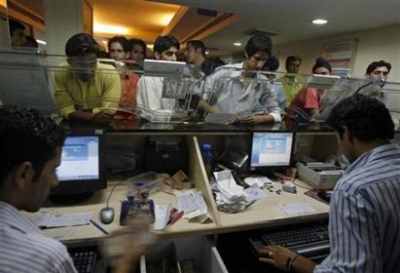
Lakhs of employees of public sector banks continued their strike on the second day on Friday as well to protest against proposed privatisation of banks by the government impacting normal operation across the country. Shutters of branches across many parts of the country on Friday were down following the strike call given by the United Forum of Bank Union (UFBU), an umbrella body of nine bank unions including All India Bank Officers' Confederation (AIBOC), All India Bank Employees Association (AIBEA) and National Organisation of Bank Workers (NOBW). As a result, services such as deposits and withdrawal at branches, cheque clearance and loan approvals remains paralaysed due to the two-day strike ending later in the day.

Finance Minister Nirmala Sitharaman on Tuesday held a review meeting on credit guarantee scheme with heads of public sector banks, and asked them to expedite loan disbursement under the Rs 3-lakh crore ECLGS for MSME sector, hit hard by coronavirus-induced lockdown. The meeting on Emergency Credit Line Guarantee Scheme (ECLGS) was held through video conference, and the minister appreciated the efforts of banks in execution of the scheme.

Sidbi acquires Ahmedabad-based start-up at hefty premium; founders deny link to govt.

The United Forum of Bank Unions (UFBU), an umbrella body of nine unions, has given a call for a two-day strike from December 16 to protest against the proposed privatisation of two state-owned lenders. In the Union Budget presented in February, Finance Minister Nirmala Sitharaman had announced the privatisation of two public sector banks (PSBs) as part of its disinvestment plan. The government has already privatised IDBI Bank by selling its majority stake in the lender to LIC in 2019 and merged 14 public sector banks in the past four years.

Non-Performing Assets are a wake-up call for public sector banks.

The sector seems set for a rally that may be somewhat temporary.

Move aimed at speeding up process, checking corruption in funds' transfer.

Bankers said the mammoth task of cleaning up the PSBs and improving their health will be a mammoth task for any chief executive.

A section of analysts feel now may not be a bad time to buy select PSBs.

The biggest challenge with public sector banks is the processing time, which is why starting early helps.

Finance Minister Nirmala Sitharaman on Tuesday said the interest of all employees of state-owned banks which are likely to be privatised will be protected, even as bank unions observed a two-day strike against the government's privatisation decision. Replying to a query during a press conference, she clarified that public sector presence will continue in the banking space. "...we have announced public enterprise policy based on which we have identified those four areas in which we said government presence, public sector presence will be there, and bare minimum presence is what we have said, in that financial institutions are also there. "Meaning, even in financial sector we will still have the presence of public sector enterprise...not all of them are going to be privatised," she said.

Among PSBs, the top gainers have been Union Bank of India and Corporation Bank, whose shares have rallied more than 15% each. Indian Bank and Bank of Baroda, too, registered double-digit rise

Anup Roy and Krishna Kant on the challenges the public sector banks face in revitalising themselves

In the atmosphere created by the reaction to the PNB fraud and RBI's resolution framework, "don't lend, don't resolve" is bound to become the bankers' new mantra, says T T Ram Mohan.

While the CEO of a public sector bank earns an average of Rs 18 lakh per annum, his counterpart in the private sector earns an average of Rs 3.5 crore.

This is a key reason for the finance ministry's objection to fixing the tenure at 100 years, as it is pushing PSBs to be self-dependent and raise funds from the market, reports Hamsini Karthik.

The meeting is expected to chart a road map for cleaning up their balance sheets and boost credit flows, reports Somesh Jha.

Bad loans, however, continued to rise in the micro, small and medium enterprises category

12 out of 21 public sector banks reported declines in their loan books in the last financial year against seven such banks in 2015-16 and none in 2013-14.

Bringing down government stakes would augment their capital.
It said banks' asset quality will deteriorate across the corporate, small and medium enterprises and retail segments, leading to pressure on profitability and capital.
Private banks are assumed to be more efficient at intermediating between depositors and investors.

India has a unique window of opportunity to effectuate long-lasting structural change in its banking sector, says Riju Agrawal.

What was the RBI doing, what was the PNB top management doing, what were the auditors doing, asks Debashis Basu.
Banks looking to raise capital via bond sales to fund decade-high credit growth were compelled to put some of these debt issuances on hold amid a sharp rise in yields since late September, sources told Business Standard. A major private lender, Axis Bank, has not yet followed through with a planned issuance of infrastructure bonds worth around Rs 3,000 crore. This is because volatility in the bond market in late September led to investors seeking higher yields, sources said.
Corruption cases in public sector banks have reduced by half in the past one year, chairman of the Parliamentary Standing Committee on Personnel, Public Grievances, Law and Justice, E M Sudarsana Natchiappan, said on Wednesday.

This is being done for two reasons: to avoid conflict of interest and bring in transparency in the functioning of the banking regulator.

Corporation Bank is the biggest beneficiary of this round of capital infusion with Rs 9,086 crore of funding, followed by Allahabad Bank with Rs 6,896 crore.
For banks, the package will limit the burden of provisioning for stressed loans. Besides, the proposed restructuring package for MSMEs with a credit of up to Rs 25 crore is expected to provide a breather to units from this sector.
The choice clearly is between prompt corrective action and slow but sure destruction, says Tamal Bandyopadhyay.
Asset Reconstruction Company has acquired bad debts totalling Rs 805 crore (Rs 8.05 billion) from ICICI Bank and National Housing Bank (NHB) and is close to finalising 2-3 more deals including public sector lenders, a top ARCIL official said.

Public sector banks accounted for a bulk of frauds reported in 2018-19 -- 55.4 per cent of the number of cases reported and 90.2 per cent of the amount involved -- mainly reflecting the lack of adequate internal processes, people and systems to tackle operational risks, the RBI report said.

Lack of decisiveness and courage to deal with PSBs may turn out be the biggest impediment to the Modi government's economic initiatives, says Debashis Basu.
Representations have been received from public sector banks to increase foreign investment limit. However, there is no proposal under consideration to amend the limit, Minister of State for Finance P K Bansal told Lok Sabha in a written reply.

Experts attribute the lower target to increased allocation under the credit guarantee scheme for small businesses. Out of the Rs 3.21 trillion worth loans sanctioned under the Pradhan Mantri Mudra Yojana (PMMY) in the last financial year, Rs 3.12 trillion were disbursed to entrepreneurs, according to official data.
