
Profits of India's top listed companies have been growing at a faster pace than those of their American peers, but when it comes to revenue growth, the order has reversed recently. The combined net profit of the S&P 500 companies was up 14.1 per cent year-on-year (Y-o-Y) during the trailing 12 months (TTM) ended December 2023, as against 17.4 per cent profit growth logged by the BSE 500 companies in the same period. This is the second consecutive year of faster profit growth for the BSE 500 companies.

From the 30 Sensex firms, Mahindra & Mahindra, JSW Steel, Maruti, Tata Steel, Larsen & Toubro, ICICI Bank, Power Grid, Nestle, Bharti Airtel and Adani Ports were the biggest gainers. Tata Consultancy Services emerged as the only laggard.

'Investors looking at the next 6-12 months can be certain that the Fed will maintain its easing cycle, and we expect the overall environment to be conducive for fixed income investments for portfolio diversification.'

'Invest only in stocks of those companies that deliver on earnings and there is earnings visibility too for the next few quarters.'

'India represents one of the top opportunities with robust growth, solid fundamentals, and openness to foreign investment.'

On April 10, the Nifty could have begun a new super cycle which could run to 2025, says Sonali Ranade

The Securities and Exchange Board of India (Sebi) has proposed stricter eligibility criteria for adding and retaining stocks in the futures and options (F&O) segment, which accounts for the bulk of the trading volumes. The proposal-which comes six years after the securities regulator last revised the stock selection framework---is much awaited by the market players as the derivatives stock list has largely remained stagnant for the last two years.

Nestle, State Bank of India, Power Grid, Tata Steel, Larsen & Toubro and Mahindra & Mahindra were the other major gainers. In contrast, Tech Mahindra, Axis Bank and Reliance Industries were the laggards.

Even as net flows into smallcap funds in March turned negative, for the first time in 30 months, they remained a big draw for new investors. The smallcap fund category saw a net of 360,000 investment accounts, or folios, getting added last month, the second-most among all active equity categories. Smallcap funds' continued traction could be driven by their strong performance across timeframes, say experts.

Among the Sensex firms, major winners included Tata Steel, rising 3.77 per cent, followed by HCL Tech, which gained 3.62 per cent. IndusInd Bank and PowerGrid closed with a gain of 3,60 and 3.34 per cent, respectively. Other gainers were Tech Mahindra, Hindustan Unilever, Bajaj Finserve and Bharti Airtel, among others. On the other hand, ICICI Bank, Axis Bank, Asian Paints, Bajaj Finance and TCS were the only laggards, sliding up to 2.94 per cent.

Global financial markets are wrong in hoping that the worst is over in geopolitical crises such as the Iran-Israel conflict and the Russia-Ukraine war, wrote Christopher Wood, global head of equity strategy at Jefferies, in a recent note to investors called 'GREED & fear'. While most investors and the media are focused on United States (US) Federal Reserve policy and the "endless chatter" of Fed governors, Wood believes the news flow in the financial sphere "pales into complete insignificance" compared with the "tectonic shifts" going on in geopolitics.

'India's fundamentals are a lot better (than those of other emerging market economies).' 'India will suffer (witness a fall in its stock market) what I call the second order effect.' 'And the second order will happen when these funds (belonging to macro and hedge fund investors and which have leveraged Japanese yen-carry trades), because they lose money elsewhere as lot of their positions were financed by borrowing Japanese yen, will have to book profits in investment destinations where they are making money, including in markets like India.' 'They (these investors) will have to effectively sell in countries like India and which is the consequence (the crash in equity markets) that Indian markets might see.'

Major laggards among Sensex constituents included Bharti Airtel, Hindustan Unilever, Tata Steel and ITC. Power Grid, UltraTech Cement, NTPC and Titan emerged as winners.

JSW Steel (3.37 per cent), Tata Steel (3.33 per cent), Maruti (3.24 per cent), Power Grid (3.07 per cent), IndusInd Bank (2.95 per cent), Bajaj Finance (2.12 per cent) and Tech Mahindra (2.22 per cent) were among major gainers. On the other hand, Ultratech Cement, Sun Pharma, Nestle and L&T were the losers.

A piece of slightly negative news can cause a serious setback, warns Debashis Basu.

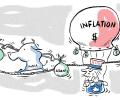
Boom, bust or a bit of both: as the jury bides time before ruling on the US 'recession', the economy's vital signs at a perplexing time of high-interest rates, still-punishing inflation, and surprisingly strong economic gains are a study of a growing debate over whether the world's largest economy is barrelling into a new downturn. With the US Federal Reserve's (Fed's) inflation fighters attempting the risky pursuit of 'pillow-soft landings' and its economy sending out mixed signals, if there is indeed a recession, it could spell trouble for domestic equities and corporate earnings growth.

From the Sensex pack, IndusInd Bank, Mahindra & Mahindra, PowerGrid and Bajaj Finserve gained up to 2.01 per cent. On the other hand, bellwether stocks such as ITC, Kotak Mahindra, Tech Mahindra and Reliance were the laggards. ITC shares closed the session with a loss of 3.87 per cent lower and Reliance ended 1.92 per cent lower.

Dwaipayan Bose on how index funds play a key role in the diversification of portfolios and help manage risks

From the Sensex pack, JSW Steel, Tata Steel, NTPC and UltraTech Cement emerged as major winners, closing the day with a gain of up to 3.33 per cent. On the other hand, Asian Paints, ITC, L&T and SBI were the laggards, ending the session up to 3.95 per cent lower. Of the 30 Sensex stocks, 14 closed the day in green, while on the 50-stock index Nifty 25 scrips ended with gains.
M&M was the biggest loser in the Sensex chart, falling 6.39 per cent, followed by Tech Mahindra, Nestle India, Bajaj Finance, Axis Bank, ITC, JSW Steel, HDFC Bank and RIL. On the other hand, Sun Pharma, Tata Motors, Bharti Airtel, L&T and Infosys were among the winners, rising up to 2.10 per cent.

Omkeshwar Singh, head, Rank MF, a mutual fund investment platform, answers your queries:

Nifty50's earnings growth, estimated at 20 per cent by global research and brokerage firm Jefferies for financial year 2023-24 (FY24), will be amongst the top three in the Asian region, and is likely to outperform peers. Asean 40 index with 29.1 per cent estimated earnings growth and Straits Times Index (STI) with 29.1 per cent estimated earnings growth are the only two other indices in the Asian region that are likely to outperform India, suggests the recent Jefferies report, coauthored by Mahesh Nandurkar, their managing director along with Abhinav Sinha and Nishant Poddar.

Expect heightened volatility and stress to hit the markets. Caution may be the need of the hour, alerts Akash Prakash.
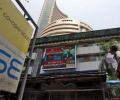
Benchmark indices Sensex and Nifty declined in early trade on Wednesday due to selling in financials, oil and IT stocks amid weak global trends.

Among Sensex shares, HDFC Bank fell the most by 2.58 per cent, followed by SBI (2.12 per cent), HDFC (2.09 per cent), and IndusInd Bank (2.02 per cent). Axis Bank, Bajaj Finserv, M&M, L&T, Reliance, Infosys and TCS were among the major losers. In contrast, Tata Motors, Maruti, NTPC, Sun Pharma, Power Grid and Titan were among the gainers.

Just because India has outperformed the US markets in a short recent period, it does not mean that this is based on fundamental reasons that are here to stay, points out Debashis Basu.

Benchmark BSE Sensex rose by 319 points on Monday on gains in IT and financial stocks after positive quarterly results amid supportive global cues. The 30-share BSE barometer rose by 319.90 or 0.53 per cent to close at 60,941.67. The index opened higher and gained more than 400 points to scale the 61,000 level. It touched a high of 61,113.27 and a low of 60,761.88 in the day.

Back home, the Nifty IT index - a gauge of the performance of the IT stocks on the National Stock Exchange (NSE) that has closely mirrored the performance of NASDAQ over the past few years - has lost nearly 2 per cent in CY23.

Dwaipayan Bose examines the seven important factors that investors about exchange traded funds must know before they start investing/trading in them.

Five Indian-origin women executives have made it to Barron's prestigious annual '100 Most Influential Women in US Finance' list for achieving positions of prominence in the financial services industry and helping shape its future. Barron's is a sister publication of the Wall Street Journal, published by Dow Jones and Company. "The list honours established and emerging leaders in financial services, the corporate world, nonprofit organisations, and government," the magazine said in a press release.

Benchmark Sensex trimmed early gains to close marginally higher while Nifty settled flat in choppy trade on Tuesday as gains in auto shares were offset by selling pressure in banking and energy shares. The 30-share BSE barometer closed marginally up by 37.08 points or 0.06 per cent to 60,978.75 with 15 of its stocks ending in green and the rest in red. The index opened higher and gained over 300 points to a high of 61,266.06 in early trade.

Investors' wealth eroded by more than Rs 2.21 lakh crore in early trade on Wednesday, with the market witnessing a selling-off amid prospects of aggressive rate hikes by the US Federal Reserve to tackle high inflation, and sluggish global trends. In less than an hour of the start of trading on Wednesday, the key indices -- Sensex and Nifty -- were deep in the red and witnessed significant volatility, reflecting jittery investor sentiments. The market capitalisation of BSE-listed companies, which is also an indicator of wealth of investors, tumbled more than Rs 2.21 lakh crore to Rs 2,84,49,727.56 crore amid the 30-share Sensex falling 564.76 points to 60,006.32 points.

'India seems to be on a relatively better wicket compared to other emerging markets.'

'Investors don't have to worry about underperformance in passive funds, which earn market-equivalent returns.'
'The biggest risk to the Indian markets from a 12-18-month view is that the current government does not get re-elected, or loses in a way that is not represented at all in the next central government.'

'The market will focus on the fact that India does have strong earnings growth this year.'

An escalation in the already simmering tensions between North and South Korea, China and Taiwan, and Russia and Ukraine could prove to be a bigger worry for the markets over the next few months rather than central bank policy action, said analysts. The markets, they said, are still not fully factoring in this possibility. "The conflict between Iran and Saudi Arabia is another geopolitical worry.

Conventional wisdom is that when the US sneezes, emerging markets like India catch a cold. And yet the Indian stock market went up last year, points out Debashish Basu.

Foreign portfolio investors (FPIs) turned net buyers in October after being net sellers in the previous month. In October, FPIs bought shares worth nearly Rs 8,430 crore ($1 billion) against net selling of Rs 13,405 crore ($1.6 billion) in September. Positive flows during three of the previous four months have pushed the domestic markets towards fresh all-time highs. At present, the Sensex and Nifty are less than 2 per cent shy of breaching record highs logged in October 2021. A rally in equity markets in the US and Europe is in hopes that the Federal Reserve may go soft on rate hikes after its November meeting.

Investors became poorer by over Rs 4.47 lakh crore on Friday as markets faced severe drubbing, mirroring weak trends in global equities. The 30-share BSE benchmark dived 866.65 points or 1.56 per cent to settle at 54,835.58. During the day, it tumbled 1,115.48 points or 2 per cent to 54,586.75.
 © 2026 Rediff.com - Advertise with us - Disclaimer - Privacy Policy - Sitemap - Feedback - About us - Terms of use - Grievances