
Indian benchmark indices, Sensex and Nifty, opened lower on Tuesday, driven by a surge in global crude oil prices and continued outflows by Foreign Institutional Investors (FIIs), reflecting fragile market sentiment influenced by external factors.

Indian markets on Dalal Street rallied sharply as easing tensions in the US-Iran conflict and stable oil prices boosted sentiment. Track Nifty 50 and BSE Sensex performance and key global triggers.

Indian equity benchmark indices Sensex and Nifty surged significantly in early trade, mirroring a global market rally and a drop in crude oil prices below USD 100 per barrel, driven by renewed hopes of diplomatic engagement between the US and Iran.

Indian equities on Dalal Street saw volatility as global market trends and fresh tariff concerns linked to Donald Trump impacted investor sentiment. Track Sensex, Nifty50 movement and key market drivers for April 9, 2026.
Indian equity benchmarks, Sensex and Nifty, ended lower after a spectacular rally, with the Sensex tumbling 931 points, as renewed tensions in West Asia, particularly the risk to the ceasefire deal after Iran closed the Strait of Hormuz, dampened investor optimism.

Indian equities on Dalal Street saw volatility as global market trends and fresh tariff concerns linked to Donald Trump impacted investor sentiment. Track Sensex, Nifty50 movement and key market drivers for March 30, 2026.

Indian stock markets tumbled sharply with the Sensex falling 800 points and nearly 4 lakh crore wiped out in a single session. Here are the 6 key factors, including rupee weakness and global cues, behind the crash.
Benchmark indices Sensex and Nifty tumbled in early trade on Friday after a two-day rally, tracking a weak trend in global peers, as the US-Iran conflict continues to be a key overhang for the markets. Track Sensex, Nifty50 movement and key market drivers for March 27, 2026.

Donald Trump defends the recent surge in global oil prices, arguing it's a necessary short-term cost to eliminate Iran's nuclear threat and ensure global security.

'...a mix of asset classes.' 'Include equities for growth (across market caps), debt for stability and liquidity, gold as a hedge against macro and currency risk, and global assets for geographical and economic diversification.'

This is the second-worst performance by the pack during this period over the last five years since CY20.

Investing in gold trumped most other asset classes in terms of compounded annualised returns over the long term, suggests a report by FundsIndia.

New investors or those with lower-than-planned exposure should add US-oriented funds through SIPs.

'India may never fully participate in the AI hype cycle, but we can position ourselves to benefit from its inevitable disenchantment and the cycle of disillusionment,' alerts Akash Prakash.

Among Sensex firms, Tata Motors, Infosys, Hindustan Unilever, Power Grid, Bharat Electronics, ITC, UltraTech Cement and Tata Consultancy Services were the major laggards. However, Adani Ports, Bajaj Finance, Bajaj Finserv and Axis Bank were among the gainers.

Stock market investors this week would track the renewed tariff tensions between the US and China, domestic inflation data, besides, quarterly earnings from blue-chips HCL Tech, Infosys and Reliance Industries would also drive the momentum in equities, analysts said.

'The danger is that when the music stops, the fall will be sudden, faster, and deeper than anyone expects,' warns Debashis Basu.

Here's what Indian investors diversifying into equities, ETFs, and real estate abroad to manage risk, returns, and currency exposure must watch out for.

Indication of a potential US Federal Reserve rate cut may trigger optimism in the domestic equity market, with investors' attention shifting to the looming deadline for additional US tariffs on Indian goods in a holiday-shortened week ahead, analysts said.
'If nominal growth improves and earnings pick up, Indian stock markets could see a rally next year.'

The US market has been a standout performer this year, with the benchmark Standard and Poor's 500 (or simply the S&P 500) gaining over 16 per cent during the first half of calendar year 2023 (CY23) in what was its best first-half show since 2019. By comparison, India's National Stock Exchange Nifty 500 has gained 6.4 per cent. On the surface, it appears that the US markets have done exceedingly well. However, a deeper analysis reveals the gains in the domestic market to be more well-spread.

You can't be the second-most expensive market in the world and deliver just 10 per cent EPS growth, points out Akash Prakash.
IndusInd Bank, Nestle, UltraTech Cement, Mahindra & Mahindra, Power Grid, Asian Paints, Sun Pharma and Tech Mahindra were also among the laggards. Bajaj Finance, Bharti Airtel, ICICI Bank, Adani Ports and HCL Tech were among the gainers.

From the Sensex firms, Infosys declined by 3.54 per cent. Power Grid, Eternal, HCL Tech, Tata Consultancy Services, Bharti Airtel, IndusInd Bank, NTPC and HDFC Bank were the major laggards. Sun Pharma, Adani Ports, Bajaj Finance, State Bank of India and Tech Mahindra were the gainers.

They don't just want better returns -- they're looking for global opportunities, more variety and smarter ways to grow their money, says Soubho Moulik, CEO, Appreciate.

Nestle surged 4.25 per cent after the FMCG major reported 4.94 per cent increase in net profit at Rs 688.01 crore for the quarter ended December 31, 2024. IndusInd Bank, Titan, Tata Motors, Tata Steel, ITC and Maruti were the other major gainers. ITC Hotels, Bharti Airtel, Bajaj Finserv, Bajaj Finance and ICICI Bank were among the laggards.

Tata Steel and Tata Motors dropped over 10 per cent each. Larsen & Toubro, HCL Technologies, Adani Ports, Tech Mahindra, Infosys, Tata Consultancy Services, Reliance Industries and Mahindra & Mahindra were the other big laggards.

Foreign investors withdrew Rs 10,355 crore from the country's equity markets in the last four trading sessions this month due to sweeping tariffs imposed by the US on most nations, including India. The outflow occurred after a net investment of Rs 30,927 crore in the six trading sessions from March 21 to March 28. This infusion helped reduce the overall outflow for March to Rs 3,973 crore, according to data from the depositories.

In an eventful week ahead, stock markets may face volatile trends before the RBI's interest rate decision and the US inflation data announcements, as investors continue to assess the broader implications of US tariffs on global economy and inflation, analysts said. Investors fear that a full-blown trade war will impact global trade and economic growth, according to market experts.

From the Sensex pack, Zomato, IndusInd Bank, NTPC, Infosys, HCL Technologies, Titan, Power Grid, Hindustan Unilever, Tech Mahindra and ITC were among the gainers. On the other hand, Reliance Industries, Nestle India, Tata Motors, Adani Ports, Tata Steel, UltraTech Cement and Kotak Mahindra Bank were the laggards.
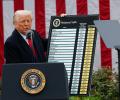
Amid the tumbling stock market in the United States, following the White House clarification of tariffs on China to be at least 145 per cent and an earlier announcement of a 90-day pause on tariffs for over 75 countries, President Donald Trump addressed the challenges associated with his tariff policy, stating that there would be 'transition problems'.

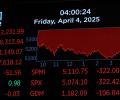
Dalal Street investors were a poorer lot on Monday as their wealth eroded sharply by Rs 14 lakh crore following a sharp decline in benchmark indices amid a global market meltdown due to recession fears. The 30-share BSE Sensex tumbled 2,226.79 points or 2.95 per cent to settle at 73,137.90. Intra-day, the benchmark slumped 3,939.68 points or 5.22 per cent to 71,425.01.

All Sensex shares, except for Hindustan Unilever, ended with losses. Tata Steel fell the most by 7.33 per cent followed by Larsen & Toubro which cracked 5.78 per cent. Tata Motors, Kotak Mahindra Bank, Mahindra & Mahindra, Infosys, Axis Bank, ICICI Bank, HCL Technologies and HDFC Bank were the other big laggards. Hindustan Unilever ended marginally higher.
'If the US stagnates and falls into a recession, the dollar will weaken, oil prices will also dip. This augurs well for India.'
Domestic benchmark equity indices may see a positive trading sentiment on Friday thanks to a spectacular rally in world markets after the US President Donald Trump announced to put tariff hikes on hold for 90 days, excluding China from the reprieve. Indian stock markets were closed on Thursday for Shri Mahavir Jayanti. Trump has declared a three-month pause on reciprocal tariffs on non-retaliating countries marking a rather unexpected U-turn after record high levies he imposed led to global stock market meltdown.

United States President Donald Trump on Sunday warned of new and significantly higher tariffs on Chinese goods if Beijing does not withdraw a recent 34 per cent retaliatory tariff hike, threatening to end all ongoing talks with China.

In a major development that will allow Indian investors access to the American market, the National Stock Exchange (NSE) has decided to begin trading in futures contracts of S&P 500 and Dow Jones Industrial Average (DJIA), two of the world's most influential market indices.

'Investors with foreign currency-denominated goals, such as foreign education or foreign travel, should go for US equity funds.'

'Market corrections are a natural part of investing, so it's essential to remain focused on long-term financial goals.'
'Of the 20 trading days of January till January 28, FIIs have been selling for 19 trading days'. 'When did FIIs withdraw money with this kind of intensity?' 'It never happened. It's the first. It did not happen even during the 2008-2009 financial crisis when Lehman went under.' 'Even then you did not have like a 19-day selling spree from the FIIs.'
 © 2026 Rediff.com - Advertise with us - Disclaimer - Privacy Policy - Sitemap - Feedback - About us - Terms of use - Grievances