
The Delhi high court asked the AAP government to explain whether it is not enough to continue their odd-even vehicles scheme for one week instead of running it till January 15.

While the AAP asked the Congress president's son-in-law to help in the success of the initiative aimed at bringing pollution under check, BJP said it was ironic and raised more questions.

Kejriwal on Saturday struck a conciliatory note and said it will be tried out for limited period of time and it will be stopped if there are problems galore.
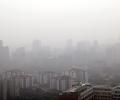
Air quality in Delhi and its suburbs dropped to the severe category again on Wednesday morning, with smoke from post-harvest paddy straw burning in neighbouring states accounting for one-third of the air pollution in the national capital.

This time, Delhi saw a sharp improvement in air quality just ahead of Diwali which can be attributed to intermittent rainfall on Friday and wind speed favourable for the dispersion of pollutants.

In cricket, we have something that we can share with our families, neighbours and indeed, the whole country. It is colour-blind, language-neutral, truly secular and transcends all regions, from Kashmir to Kerala and Mizoram to Maharashtra, explains Shreekant Sambrani.

Lt Governor Anil Baijal on Friday approved the Delhi government's proposal to allow private offices to function with 50 per cent staff but suggested maintaining the status quo on lifting weekend curfew and removing the odd-even rule for the opening of shops in the markets, sources said.

Squandering the relief due to rain, Delhi recorded a jump in pollution levels and a smoky haze returned on Monday morning after residents flouted the ban on firecrackers on Diwali night.

The city's Air Quality Index (AQI) stood at 420 at 8 am on Thursday, compared to 426 at 4 pm on Wednesday. The AQI map prepared by the Central Pollution Control Board showed clusters of red dots (indicating hazardous air quality) spread across the Indo-Gangetic plains.

The air quality is expected to improve further due to wind speed favourable for the dispersion of pollutants.

Amid a spike in pollution levels in Delhi-NCR, the Supreme Court on Tuesday directed Punjab, Haryana, Uttar Pradesh and Rajasthan to ensure crop residue burning was stopped "forthwith", saying it cannot let "people die" due to pollution.
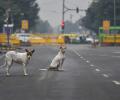
The government offices have also been allowed to reopen with 50 per cent staff.

The 'unlocking' comes as COVID-19 cases have seen a steady fall in recent weeks.

However, metro services, schools, colleges, cinema halls and salons will remain closed, the chief minister said. Wearing masks and following social distancing norms are mandatory in the city, Kejriwal said, adding that no activity will be permitted in containment zones, except for essential services.
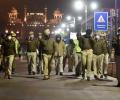
Delhi CM Arvind Kejriwal said Covid cases are mild and there is no increase in the consumption of oxygen or the use of ventilators despite the rise in numbers.
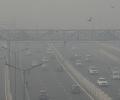
Acentral panel directed authorities to ban the plying of 4-wheeled diesel LMVs in Delhi and adjoining NCR districts and the entry of trucks into the capital.
In accordance with ''Level-1'' alert under the graded response action plan (GRAP), private offices will function with physical attendance of 50 per cent of the staff, barring essential categories.

Last year, the teenager was ranked 338 in the world when she received a wildcard and she reached the last-16 against all odds

Deputy Chief Minister Manish Sisodia also announced that during weekdays, government employees, barring those engaged in essential services, will be asked to work from home, while private offices will remain open with 50 percent capacity.
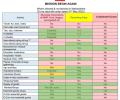
Will you be allowed to step out? Will you be able to go to work? Can you go out for a job? These questions will be answered by this simple table below.

Delhi Chief Minister Arvind Kejriwal announced that primary schools will be closed from Saturday in view of spike in pollution levels in the national capital.

Delhi Chief Minister Arvind Kejriwal hopes pollution will not affect the India-Bangladesh T20 International in the city on November 3, emphasising that his government has been taking steps such as the odd-even scheme to improve the air quality.
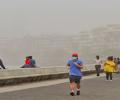
'Till such time climatic activities resume up north in the plains and the hills, Mumbai's air quality may not improve.'

The overall Air Quality Index (AQI) of Delhi stood at 398 at 11 am, worsening from 357 at 4 pm on Friday. It was 354 on Thursday, 271 on Wednesday, 302 on Tuesday and 312 on Monday (Diwali).

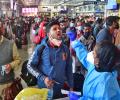
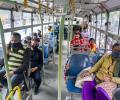
Long queues of passengers were seen outside various Delhi Metro stations on Wednesday morning, a day after new restrictions were put in place by authorities, including running of its trains with only 50 per cent seating capacity and no provision for standing for commuters, in view of rising cases of COVID-19 in Delhi.
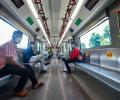
The Delhi Metro will operate at 50 per cent capacity and markets and malls in the national capital will open on an odd-even basis from June 7, Chief Minister Arvind Kejriwal said on Saturday as he announced further relaxations in lockdown.
He said stringent curbs have been put in place as part of the Graded Response Action Plan for COVID-19 to check the spread of the infection and the Delhi Disaster Management Authority (DDMA) will decide on implementing more restrictions.

Police used mild force to disperse the crowd and five people have been detained, officials said.

The Home Ministry, which is often seen in conflict with the Aam Aadmi Party government on administrative issues, has asked all its officials to adopt car pooling to make the odd-even formula proposed by the city government successful.

The 'yellow' alert restrictions stipulate that shops and establishments of non-essential goods and services and malls will open based on odd-even formula from 10 am to 8 pm.

With the COVID-19 positivity rate touching 0.55 percent, the Delhi government has decided to re-impose night curfew from Monday, according to sources.
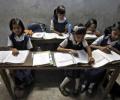
He said that children are most affected due to rising pollution and government will make a policy of odd-even formula with their involvement.

'When Covid first struck, the lockdown resulted in clean air in major Indian cities.' 'You were able to see the Himalayan range from Ludhiana.' 'In Delhi, you were seeing deer and stags all over the city because there was no traffic.' 'It was incredible. Nature was waiting to come back.'

The move follows after a warning by Chief Minister Arvind Kejriwal, who on Monday assured strict action, including impounding of cabs, if the app-based taxis were found charging more than the prescribed rates.

Bhavna Arora, who was arrested but released late Sunday night on a personal bail bond for throwing ink on Delhi Chief Minister Arvind Kejriwal while he was expressing his gratitude to the people of Delhi for making the odd-even formula successful, will appear before court on Monday.

With COVID cases declining, Delhi will see further relaxation in lockdown, including reopening of markets and malls and resumption of metro services, from June 7 while Maharashtra will implement a five-level plan to ease curbs based on weekly positivity rate and occupancy of oxygen beds in districts.
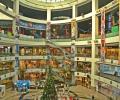
The suggestions submitted to the Centre on Thursday evening also recommended restarting construction activities and allowing movement of labourers within the city, sources said.

New Delhi's overall air quality index read 456 at 4 pm, up from 425 at 4 pm on Tuesday.

Most key rabi-producing states of north India, such as Madhya Pradesh and Rajasthan, have staggered their procurement to enable farmers to come in batches, so that there is no overcrowding. The Centre has also set up a call centre to coordinate the inter-state movement of farm commodities.

Centre for Science and Environment said that Delhi has lost the air quality gains of odd and even scheme.
